


Airline passengers flying from Pakistan to the UAE may need to show an attested vaccination certificate to enter the Emirates.
A letter issued by the UAE Embassy in Islamabad said it would be mandatory to carry a UAE embassy-attested vaccination certificate for passengers entering the UAE from August 1.
The General Consulate of Pakistan in Dubai confirmed its government had received the letter, which was first shared on social media.
Emirati officials later clarified that no plan was in place yet. Passengers from Pakistan are currently restricted from travel to the Emirates, other than a handful of exemptions, including diplomats.
Flights from Pakistan have been halted by the UAE since May 12 and no official confirmation has been given yet if inbound flights are resuming from August 1.
Nearly 50 per cent of cases in Pakistan have been caused by the highly infectious Delta variant, as the nation of 216.6 million people fights against is fourth Covid-19 wave.
A total of 2,545 new cases and 47 deaths were reported by Pakistan on Thursday.
There have been 981,392 recorded cases and 22,689 deaths in the country since the pandemic started, and Pakistan has administered nearly 20 million doses of the vaccine so far.
The UAE has the second highest Pakistani expat population, with more than a million who call the Emirates their home.
Flights from India, Sri Lanka, Bangladesh, Nigeria, South Africa, Afghanistan and Indonesia also remain banned by the UAE, as of now.
The Covid-19 pandemic in Pakistan - in pictures
-

Aziz Ullah, 60, and 21-year-old Muhammad Usman, two aid workers of Alamgir Welfare Trust, loading oxygen cylinders into a vehicle for delivery to Covid-19 patients in Islamabad, Pakistan. Imran Mukhtar/ The National -
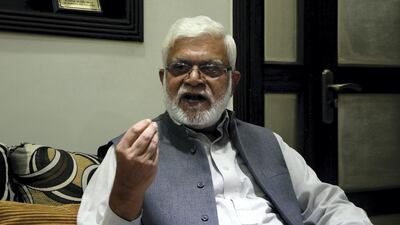
Hamid Ather, president of the Alkhidmat Foundation's Islamabad chapter, talks about its oxygen delivery programme for needy patients. Imran Mukhtar/ The National -
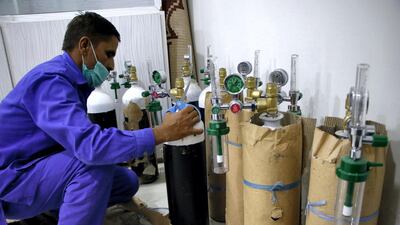
Khalid Hussain, 45 and an aid worker of Alkhidmat Foundation, checks oxygen cylinders before they are delivered to Covid-19 patients. Imran Mukhtar/ The National -
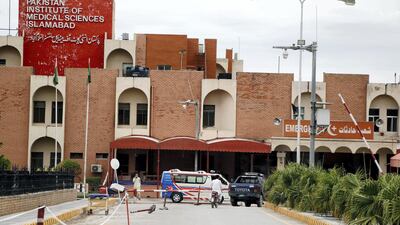
The main building of Pakistan Institute of Medical Sciences (PIMS) in Islamabad, where a specialised isolation ward has been set up to treat Covid-19 patients. Imran Mukhtar/ The National -

A paramedic leaves the emergency ward at the Alkhidmat Raazi Hospital in Islamabad that is run by Alkhidmat Foundation. Imran Mukhtar/ The National -
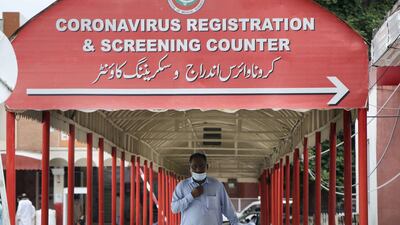
A sign directs visitors to the coronavirus screening counter at the Pakistan Institute of Medical Sciences, the largest public sector health facility in Islamabad. Imran Mukhtar/ The National -
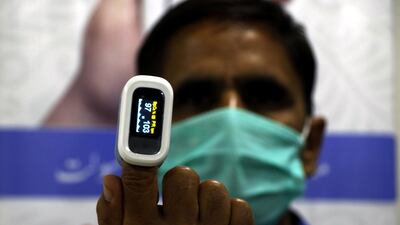
An Alkhidmat Foundation aid worker displays a pulse oximeter that the organisation gives out with oxygen cylinders. Imran Mukhtar/ The National -
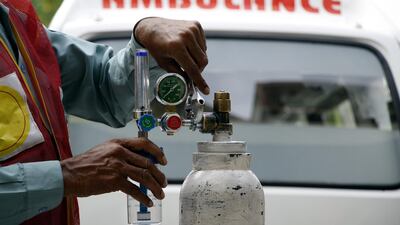
An aid worker of the Alamgir Welfare Trust in Islamabad fixes a regulator on an oxygen cylinder before it is delivered to a Covid-19 patient. Imran Mukhtar/ The National -
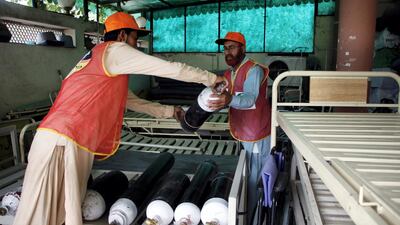
Aziz Ullah, 60, and 21-year-old Muhammad Usman, both aid workers of Alamgir Welfare Trust, arrange oxygen cylinders at the warehouse of the non-profit organisation in Islamabad. Imran Mukhtar/ The National



