

The global energy industry’s methane emissions surged to 135 million tonnes last year, slightly below 2019’s record highs, the International Energy Agency has said.
Despite high energy prices, worries about security of supply and economic uncertainty, there was no reduction in methane emissions observed in 2022, the agency said in a report on Tuesday.
“Some progress is being made but emissions are still far too high and not falling fast enough — especially as methane cuts are among the cheapest options to limit near-term global warming. There is just no excuse,” said IEA executive director Fatih Birol.
Methane is responsible for about a third of global temperature increases since the Industrial Revolution. It dissipates faster than carbon dioxide but is a much more powerful greenhouse gas during its short lifespan.
The energy sector accounts for about 40 per cent of total methane emissions attributable to human activity, second only to agriculture.
-

Coal power plants are a major source of methane emissions. AP -

Livestock accounts for about one third of methane emissions, the International Methane Emissions Observatory reported. AFP -
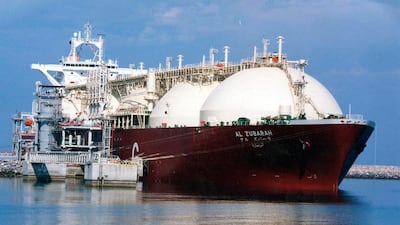
A Qatari tanker ship is being loaded up with LNG, made up mainly of methane. The state-owned oil and gas company Qatar Energy said it is joining a new industry-led initiative to reduce nearly all methane emissions from operations by 2030. AP -
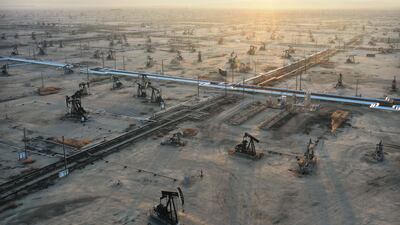
An oilfield near McKittrick, California. The state has 35,000 oil and gas wells sitting idle, many of which are unplugged and could leak methane gas. AFP -

Wind turbines turn on top of a dump next to the BP Refinery Scholven in Gelsenkirchen, Germany. Spiralling energy costs caused by various economic factors and the Ukraine war could be a turning point towards cleaner energy, the International Energy Agency says. AP -

Waste and landfill sites account for more than 20 per cent of methane emissions. AFP -

Globally, agriculture is the largest source of human-caused methane emissions. Bloomberg


Methane emissions from oil and gas alone could be reduced by 75 per cent with existing technology, highlighting a “lack of industry action on an issue that is often very cheap to address”, the agency said.
Less than 3 per cent of the income made by oil and gas companies globally last year would be required to make the $100 billion investment in technology needed to achieve this reduction, it added.
Last year, the largest recorded emission of methane occurred due to leaks in the Nord Stream pipelines, which transported natural gas from Russia to Europe.
“The Nord Stream pipeline explosion last year released a huge amount of methane into the atmosphere,” said Dr Birol.
“But normal oil and gas operations around the world release the same amount of methane as the Nord Stream explosion every single day.”
Ceasing all non-emergency flaring and venting of methane is the most effective measure to rein in emissions, the agency said.
Out of the 260 billion cubic metres of methane lost to the atmosphere each year, three quarters could be retained and brought to market using “tried and tested” policies and technology, it said.
“The captured methane would amount to more than the European Union’s total annual gas imports from Russia prior to the invasion of Ukraine.”
The agency said that satellites detected more than 500 “super-emitting” events from oil and gas operations last year.
Entities such as fossil fuel plants, waste or agriculture-related equipment and other infrastructure that discharge methane at exceptionally high rates are known as super-emitters.
“The untamed release of methane in fossil fuel production is a problem that sometimes goes under the radar in public debate,” said Mr Birol.
“Unfortunately, it is not a new issue and emissions remain stubbornly high. Many companies saw hefty profits last year following a turbulent period for international oil and gas markets amid the global energy crisis.
“Fossil fuel producers need to step up and policymakers need to step in — and both must do so quickly.”
In November, the UN Environment Programme (UNEP) said methane concentrations in the atmosphere were continuing to rise.
Efforts by the fossil fuel sector offer, “by far, the greatest potential to achieve rapid methane emissions reductions”, said the report, which was released by UNEP’s International Methane Emissions Observatory said.
Currently, only a fraction of companies is providing methane emissions estimates that are based on actual measurements, it said.
-
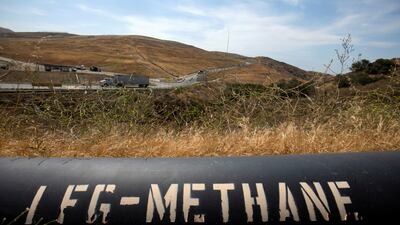
A pipeline that takes methane gas from the Frank R. Bowerman landfill to an onsite power plant in Irvine, California. Reuters -

A satellite image shows a methane plume three kilometres long detected south-east of Carlsbad, New Mexico. Nasa scientists, using a tool designed to study how dust affects climate, have identified more than 50 sites around the world emitting high levels of methane, a potent greenhouse gas, the US space agency said. AFP -
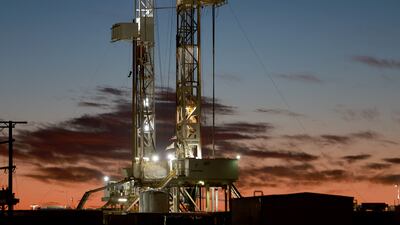
An oil drilling rig in the Permian Basin oilfield in Midland, Texas. US President Joe Biden imposed a ban on Russian oil, which may mean that oil producers in the Permian Basin will need to pump more oil to meet demand. The Permian Basin is the largest petroleum-producing basin in the United States. AFP -
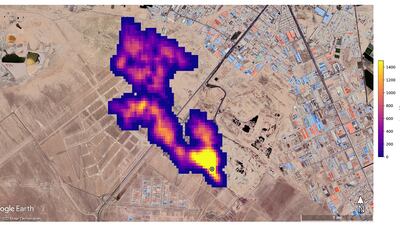
This satellite image from Nasa shows a 4.8km methane plume coming from a major landfill, where methane is a byproduct of decomposition, south of Tehran, Iran. AFP -

Workers on an oil rig in the Permian Basin oilfield in Stanton, Texas. AFP -
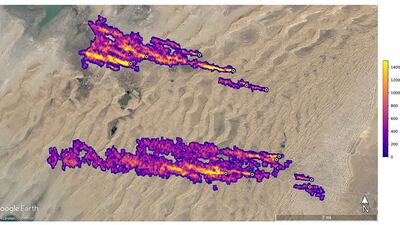
This satellite image shows 12 methane plumes streaming westward for more than 32 kilometres east of Hazar, Turkmenistan. Nasa -

Turkmenistan's President Gurbanguly Berdymukhamedov at the opening of the East-West pipeline at the Belek compressor station, about 500 kilometres from Ashgabat. On December 23 Turkmenistan completed a $2.5 billion gas pipeline connecting its eastern gas fields to the Caspian Sea, potentially expanding Europe's energy security options. AFP -
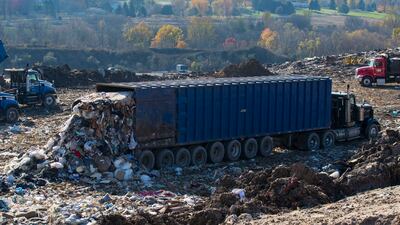
A lorry unloads rubbish at the South Kent landfill in Byron Township, Michigan. The National Oceanic and Atmospheric Administration released a study calculating that levels of the heat-trapping gas methane rose at a record pace in 2021. AP Photo -

Delhi fire officials take a break while fighting a fire at the Bhalswa landfill in New Delhi. Every day more than 2,300 tonnes of waste are dumped at the landfill without being segregated, resulting in the build-up of combustible methane gas. AP Photo -
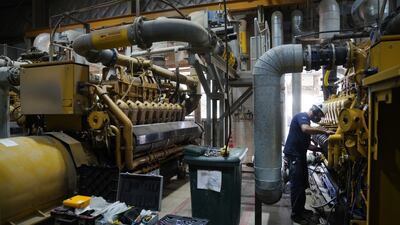
The Norte III biogas plant, which removes methane from waste at the landfill, outside Buenos Aires, Argentina. Norte III recently activated a new power station that runs on methane gas piped from under the landfill to generate electricity. Bloomberg



