


Mangroves in the Arabian Gulf and surrounding regions could shrink by 45 per cent over the next half century if current trends continue, scientists have warned in a study.
The assessment, by the International Union for Conservation of Nature (IUCN), found that the area in the Gulf covered by mangroves has declined by about 14 per cent since 1996.
Mangroves in the UAE have, however, fared better than those in other parts of the Gulf, with much smaller declines, the researchers said, indicating that efforts to protect the habitats can prove effective.
"The mangrove net area change has been minus 14.3 per cent since 1996," the IUCN report states, referring to the Arabian Gulf.
“However, there have been increases in patches largely due to plantation efforts. If this decline trend continues, an overall change of minus 45 per cent is projected over the next 50 years.”
The most pressing threats to mangroves in the region include dredging and sediment removal for coastal infrastructure and human-made islands.
Disruptions of tidal flows – due to, for example, dredging or the filling in of wetlands – may also harm mangroves by causing salt levels to rise and oxygen levels to fall.
“Under a high sea-level rise scenario, [about] 16.1 per cent of the Arabian Gulf mangroves would be submerged by 2060,” the assessment stated.
About 47 per cent of mangroves in the Arabian Gulf area are found in the southern UAE coastline, the assessment noted, with a further 39 per cent by the northern coast of Iran.
UAE bucks trend to offer hope
-
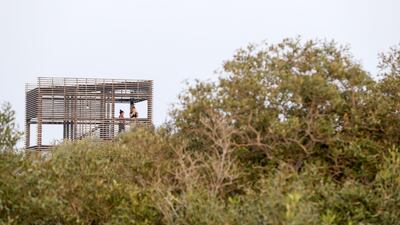
Visitors look out over the mangroves at Jubail Island, Abu Dhabi. All photos: Khushnum Bhandari/ The National -
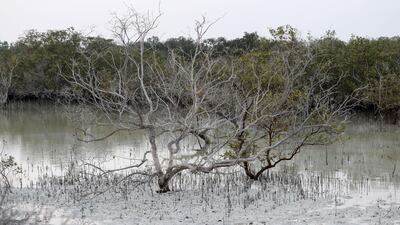
Mangroves play an important environmental role in the the UAE. -
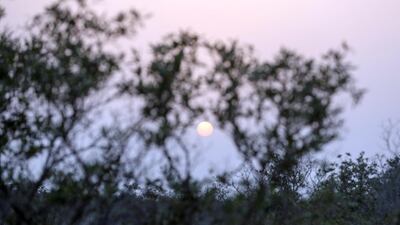
The sun sets over Jubail Mangrove Park. -
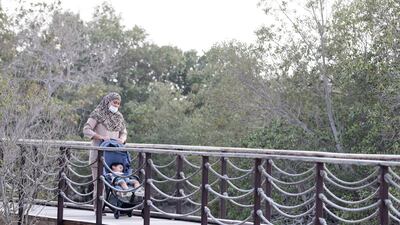
Jubail Mangrove Park reopened to visitors in October 2020, after it was closed to curb the spread of Covid-19. -
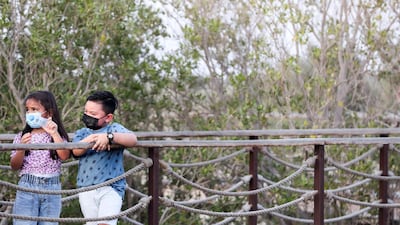
The park first opened in January 2020 with the aim of raising awareness of the importance of mangroves in the UAE. -
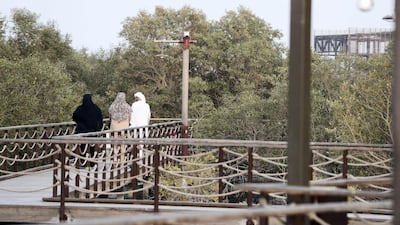
Residents take an evening stroll through the mangrove park at Jubail Island. -
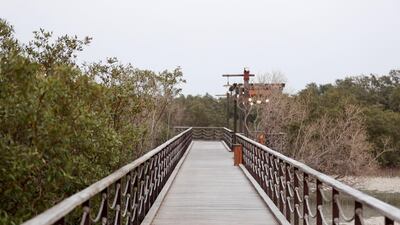
The one million-square-metre site features a winding boardwalk.


Regionally, there have been significant reductions in mangrove areas in Bahrain, Qatar and parts of Iran.
However, UAE mangroves have experienced just a 2 per cent decline since 1996, according to Global Mangrove Watch, an online platform. Some other assessments have even indicated that mangroves in the Emirates have increased in area.
At the Cop26 climate change conference in Glasgow, Scotland, in late 2021, a plan to plant 100 million mangroves in the UAE was announced by the Ministry of Climate Change and the Environment.
The Environment Agency Abu Dhabi is enforcing the Abu Dhabi Mangrove Initiative, unveiled in early 2021, and has already carried out large-scale mangrove planting.
The agency said in December that 44 million mangrove trees had been planted since 2020 under the ambitious plan, enough to cover 9,200 hectares.
Meanwhile, plans for what would be the world’s largest coastal regeneration project were revealed in Dubai last month.
Dubai Mangroves – if given the go-ahead – would become a 72km stretch of regenerated coastline and home to 100 million planted mangrove trees, developer URB announced.
The EAD was involved in the new IUCN assessment of mangroves in the Arabian Gulf, which overall classified the ecosystems in the region as “vulnerable”.
The Gulf-wide research is part of the IUCN’s newly announced Red List of Ecosystem Assessments, which indicates that more than half the world’s mangroves are threatened, many because of sea-level rises brought about by climate change.
About 50 per cent of mangrove areas globally are classed as vulnerable, endangered or critically endangered – meaning that they are at risk of collapse.
Marcos Valderrabano, a programme manager for the Red List of Ecosystems, said that it was a surprise that such a large proportion of mangroves were threatened, as large-scale losses in the 1970s and 1980s, often as a result of dam construction and other developments, had slowed.
Also, there have been significant efforts made to restore mangroves in recent decades and improved policies to protect the habitats.
Climate change concerns

However, climate change has become a greater concern in recent years and is now seen as a threat to about one third of mangroves globally, while development, pollution, dam construction and deforestation are other hazards.
“Probably the factor that we underestimated the most was sea-level rise under the current climate projections,” Mr Valderrabano told The National.
A key cause of decline of mangroves in some hotter and drier parts of the world is a reduction in freshwater river flows into coastal areas where there are mangroves. This is happening because water is taken for agriculture or for domestic water supplies in cities.
In areas where sea-level rises are the main threat, Mr Valderrabano said that efforts can be made to help mangroves adapt.
These include helping mangroves to grow vertically, such as by capturing sediments, or by providing a buffer zone behind the mangroves so that they can retreat in the face of rising sea levels.
“The natural process of adaptation for mangroves' ecosystems is slower than the projected speed of sea-level rise, so managers will have to help mangroves adapt in the near future,” he added.
Mr Valderrabano said that restoration and conservation efforts with mangroves worldwide were having “a significant impact”, especially if initiatives extended beyond planting seedlings to also consider sediment flow and whether rivers are bringing enough water.
Mangroves can offer many benefits to people, including protecting coastal communities from tsunamis and acting as nurseries for fish. They are also vital stores of carbon, so they can reduce the extent of climate change.
As a result of these varied benefits, the loss of mangroves would be “disastrous for nature and people across the globe”, Angela Andrade, chairwoman of the IUCN Commission on Ecosystem Management, said in a statement.
“That is why this assessment is so important,” she added. “The Red List of Ecosystems provides clear pathways on how we can reverse mangrove loss and protect these delicate ecosystems for the future, helping in turn to safeguard biodiversity, tackle the effects of climate change and support the realisation of the Global Biodiversity Framework.”
The Kunming-Montreal Global Biodiversity Framework was adopted at a United Nations-organised conference in Montreal in late 2022 and includes key targets related to biodiversity conservation to be achieved by 2030 and 2050.

