
The UAE will impose a nationwide ban on single-use plastic from next year, the government has said.
From January 1, 2024, plastic bags of any material or composition will be prohibited.
From January 1, 2026, it will be prohibited to import plastic cutlery, drinks cups, styrofoam and boxes.
The ban will include everything from “food packaging, plastic bottles, cotton sticks, crackers bags and cigarette butts … wet wipes, balloons and balloon sticks” that contain plastic.
The move will protect the environment and be of benefit to consumers, state news agency Wam said.
The government said authorities, retailers, suppliers and consumers should prepare with “suitable, sustainable and multi-use alternatives in all shopping stores, retail stores and sales outlets on a permanent basis”, the agency reported.
The federal ruling goes further than new rules last summer in Dubai, which imposed a nominal 25 fils charge on plastic bags, and in Abu Dhabi, which banned most plastic bags.
In Abu Dhabi, the June 1 ban has already led to 87 million fewer single-use plastic bags being used, a cut of about 90 per cent. Sharjah had already planned a ban on bags from January 1, 2024.
The ruling contains exceptions that include plastic bags made from recycled materials. It also includes plastics required in goods that are exported abroad.
Plastic bags are one of the most problematic kinds of waste, polluting streets and waterways and harming birds and marine life. It takes decades to degrade and microscopic particles have been found inside the bodies of fish, birds and other animals.
Last year, as the plastic charge was rolled out, Dubai officals said nine in 10 turtles and five in ten camels found dead had plastic in their stomachs.
The UAE, which will host the United Nations climate summit Cop28 in November, aims to achieve carbon neutrality by 2050.
Best long-life alternatives: in pictures
-

Cotton reusable mesh bags can be used for fruit and vegetables. Getty Images -

Reuseable plastic bags on sale at Lulu Hypermarket are thicker and more durable than single-use ones. Victor Besa / The National -
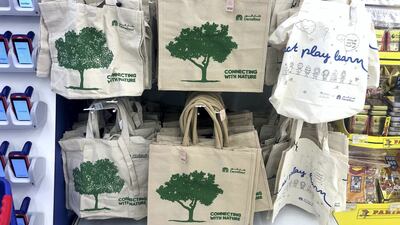
Reusable canvas and jute bags on display at Carrefour in Mall of the Emirates. Jute bags are one of the most durable options and are also naturally biodegradable. Canvas tote bags may not be as environmentally friendly because they require more resources to produce and distribute but can be used many times. Chris Whiteoak / The National -
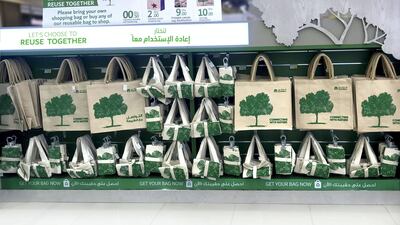
Carrefour is encouraging customers to bring their own recyclable bags by providing dedicated checkout counters and bonus Share points as incentives. Photo: Majid Al Futtaim -

Jute bags are both durable and biodegradable. Pawan Singh / The National -

A customer using a trolley bag at Spinneys supermarket in Dubai Marina. Trolley bags are perfect for those walking home from the supermarket. Pawan Singh / The National
World%20Cup%202023%20ticket%20sales
Cinco in numbers
Dh3.7 million
The estimated cost of Victoria Swarovski’s gem-encrusted Michael Cinco wedding gown
46
The number, in kilograms, that Swarovski’s wedding gown weighed.
1,000
The hours it took to create Cinco’s vermillion petal gown, as seen in his atelier [note, is the one he’s playing with in the corner of a room]
50
How many looks Cinco has created in a new collection to celebrate Ballet Philippines’ 50th birthday
3,000
The hours needed to create the butterfly gown worn by Aishwarya Rai to the 2018 Cannes Film Festival.
1.1 million
The number of followers that Michael Cinco’s Instagram account has garnered.
The%C2%A0specs%20
Zodi%20%26%20Tehu%3A%20Princes%20Of%20The%20Desert
Joker: Folie a Deux
Starring: Joaquin Phoenix, Lady Gaga, Brendan Gleeson
Director: Todd Phillips
Rating: 2/5
Vidaamuyarchi
Director: Magizh Thirumeni
Stars: Ajith Kumar, Arjun Sarja, Trisha Krishnan, Regina Cassandra
Rating: 4/5
The smuggler
Eldarir had arrived at JFK in January 2020 with three suitcases, containing goods he valued at $300, when he was directed to a search area.
Officers found 41 gold artefacts among the bags, including amulets from a funerary set which prepared the deceased for the afterlife.
Also found was a cartouche of a Ptolemaic king on a relief that was originally part of a royal building or temple.
The largest single group of items found in Eldarir’s cases were 400 shabtis, or figurines.
Khouli conviction
Khouli smuggled items into the US by making false declarations to customs about the country of origin and value of the items.
According to Immigration and Customs Enforcement, he provided “false provenances which stated that [two] Egyptian antiquities were part of a collection assembled by Khouli's father in Israel in the 1960s” when in fact “Khouli acquired the Egyptian antiquities from other dealers”.
He was sentenced to one year of probation, six months of home confinement and 200 hours of community service in 2012 after admitting buying and smuggling Egyptian antiquities, including coffins, funerary boats and limestone figures.
For sale
A number of other items said to come from the collection of Ezeldeen Taha Eldarir are currently or recently for sale.
Their provenance is described in near identical terms as the British Museum shabti: bought from Salahaddin Sirmali, "authenticated and appraised" by Hossen Rashed, then imported to the US in 1948.
- An Egyptian Mummy mask dating from 700BC-30BC, is on offer for £11,807 ($15,275) online by a seller in Mexico
- A coffin lid dating back to 664BC-332BC was offered for sale by a Colorado-based art dealer, with a starting price of $65,000
- A shabti that was on sale through a Chicago-based coin dealer, dating from 1567BC-1085BC, is up for $1,950
Mercer, the investment consulting arm of US services company Marsh & McLennan, expects its wealth division to at least double its assets under management (AUM) in the Middle East as wealth in the region continues to grow despite economic headwinds, a company official said.
Mercer Wealth, which globally has $160 billion in AUM, plans to boost its AUM in the region to $2-$3bn in the next 2-3 years from the present $1bn, said Yasir AbuShaban, a Dubai-based principal with Mercer Wealth.
“Within the next two to three years, we are looking at reaching $2 to $3 billion as a conservative estimate and we do see an opportunity to do so,” said Mr AbuShaban.
Mercer does not directly make investments, but allocates clients’ money they have discretion to, to professional asset managers. They also provide advice to clients.
“We have buying power. We can negotiate on their (client’s) behalf with asset managers to provide them lower fees than they otherwise would have to get on their own,” he added.
Mercer Wealth’s clients include sovereign wealth funds, family offices, and insurance companies among others.
From its office in Dubai, Mercer also looks after Africa, India and Turkey, where they also see opportunity for growth.
Wealth creation in Middle East and Africa (MEA) grew 8.5 per cent to $8.1 trillion last year from $7.5tn in 2015, higher than last year’s global average of 6 per cent and the second-highest growth in a region after Asia-Pacific which grew 9.9 per cent, according to consultancy Boston Consulting Group (BCG). In the region, where wealth grew just 1.9 per cent in 2015 compared with 2014, a pickup in oil prices has helped in wealth generation.
BCG is forecasting MEA wealth will rise to $12tn by 2021, growing at an annual average of 8 per cent.
Drivers of wealth generation in the region will be split evenly between new wealth creation and growth of performance of existing assets, according to BCG.
Another general trend in the region is clients’ looking for a comprehensive approach to investing, according to Mr AbuShaban.
“Institutional investors or some of the families are seeing a slowdown in the available capital they have to invest and in that sense they are looking at optimizing the way they manage their portfolios and making sure they are not investing haphazardly and different parts of their investment are working together,” said Mr AbuShaban.
Some clients also have a higher appetite for risk, given the low interest-rate environment that does not provide enough yield for some institutional investors. These clients are keen to invest in illiquid assets, such as private equity and infrastructure.
“What we have seen is a desire for higher returns in what has been a low-return environment specifically in various fixed income or bonds,” he said.
“In this environment, we have seen a de facto increase in the risk that clients are taking in things like illiquid investments, private equity investments, infrastructure and private debt, those kind of investments were higher illiquidity results in incrementally higher returns.”
The Abu Dhabi Investment Authority, one of the largest sovereign wealth funds, said in its 2016 report that has gradually increased its exposure in direct private equity and private credit transactions, mainly in Asian markets and especially in China and India. The authority’s private equity department focused on structured equities owing to “their defensive characteristics.”
WIDE%20VIEW
How to apply for a drone permit
- Individuals must register on UAE Drone app or website using their UAE Pass
- Add all their personal details, including name, nationality, passport number, Emiratis ID, email and phone number
- Upload the training certificate from a centre accredited by the GCAA
- Submit their request
What are the regulations?
- Fly it within visual line of sight
- Never over populated areas
- Ensure maximum flying height of 400 feet (122 metres) above ground level is not crossed
- Users must avoid flying over restricted areas listed on the UAE Drone app
- Only fly the drone during the day, and never at night
- Should have a live feed of the drone flight
- Drones must weigh 5 kg or less
While you're here
Kareem Shaheen: Even a pandemic could not unite today's America
Michele Wucker: The difference between a black swan and a grey rhino
Robert Matthews: Has flawed science and rushed research failed us?
Killing of Qassem Suleimani
National Editorial: Suleimani has been killed, now we must de-escalate
Mina Al Oraibi: Air strike casts a long shadow over the decade ahead
Jack Moore: Why the assassination is such a monumental gamble
Damien McElroy: A CEO tasked with spreading Iran's influence
Hussein Ibish: Trump's order on solid constitutional ground
Simon Waldman: Cautious Israel keeping a low profile
How Filipinos in the UAE invest
A recent survey of 10,000 Filipino expatriates in the UAE found that 82 per cent have plans to invest, primarily in property. This is significantly higher than the 2014 poll showing only two out of 10 Filipinos planned to invest.
Fifty-five percent said they plan to invest in property, according to the poll conducted by the New Perspective Media Group, organiser of the Philippine Property and Investment Exhibition. Acquiring a franchised business or starting up a small business was preferred by 25 per cent and 15 per cent said they will invest in mutual funds. The rest said they are keen to invest in insurance (3 per cent) and gold (2 per cent).
Of the 5,500 respondents who preferred property as their primary investment, 54 per cent said they plan to make the purchase within the next year. Manila was the top location, preferred by 53 per cent.


