

Live updates: Follow the latest news on Cop28
At the Cop28 climate conference in Dubai, schisms have developed between those advocating the continuing use of some form of fossil fuels and others calling for their elimination.
More than 100 countries committed to a global pledge aiming to triple renewable energy capacity by the decade's end. Yet the abstention of China and India, two of the world’s largest economies, further underscores the contrasting priorities among countries and regions.
However, most participants at the UN climate summit agree that any solution aimed at hastening the transition to cleaner energy is incomplete without private capital.
Climate finance has in fact taken the centre stage, with governments, businesses and development banks announcing plans to mobilise billions of dollars.
“There isn't a meeting I have with a CEO or chairman of a business where this isn’t a topic,” Noel Quinn, group chief executive HSBC, said during a panel session on Monday.
“I'm optimistic … on the basis of the conversations I have with my clients. They're talking about the need to invest in sustainable infrastructure [and] the need to invest in new technology to make their business models have a lower carbon footprint."
By 2030, emerging markets and developing economies will require $2.4 trillion every year to address climate change, according to the Climate Policy Initiative.
Meanwhile, Deloitte has said investment of $5 trillion to $7 trillion a year is needed until 2050 in the energy sector to drive the transition but less than $2 trillion is currently spent each year.
Institutional investors control assets worth more than $200 trillion, only 0.3 per cent of which is going towards climate financing.
“That is because they have a responsibility to take care of their populations,” said Ray Dalio, founder of Bridgewater Associates, a hedge fund with about $125 billion in assets.
“I think the important thing is when you look at who's got the money, you just can't go get the money, you have to convert that into productivity,” he told a Cop28 panel session.
-

Activists stage a peaceful demonstration in the Blue Zone at Cop28, calling for a ceasefire in Gaza. All photos: Pawan Singh / The National -
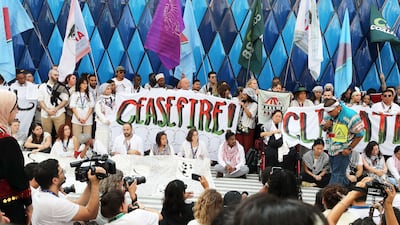
Dozens of people called for a ceasefire at the protest at Cop28. -
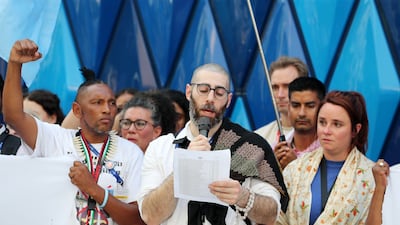
Tearful demonstrators read out the names of people killed in the Israel-Gaza conflict. -
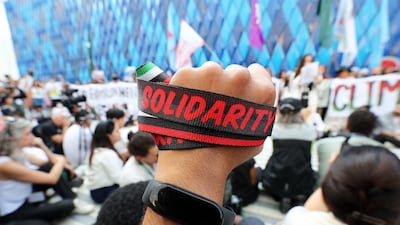
Activists chanted slogans, held up banners and took turns to address the cop during the protest. -
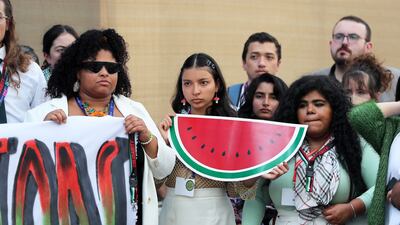
Many activists linked the Palestinian cause to a wider fight against climate change and injustice. -

The rally lasted for an hour at Cop28 on Sunday. -

Emotions ran high at the rally.


The International Monetary Fund and the World Bank have identified public-private risk-sharing as key to fostering private climate investment in emerging markets.
Investment guarantees from development banks that cover risks related to currency fluctuations and political instability could coax more investors to sign on for projects in such markets.
“A guarantee from the World Bank on currency volatility can allow the private sector to put the money into projects,” Mr Quinn said.
Last week, the World Bank committed to increasing its climate finance target to $40 billion by 2025, with 50 per cent dedicated to mitigation and the other half to adaptation.
However, Mr Dalio said backing from development banks would only solve part of the problem.
“Keep in mind, the World Bank [has] hardly any money relative to [the requirement]. The IMF don't have that much money,” he said.
“The governments will raise the money, they borrow the money and then they print the money, so we have a financial problem, right?”
Despite the risks, governments and investors have announced billion-dollar funds at Cop28 for projects related to climate mitigation.
The UAE, the event’s host, has launched a $30 billion fund for clean energy, backed by major US institutional investors such as BlackRock, Brookfield and TPG.
The money will go towards a new private investment vehicle, Alterra, which aims to raise $250 billion globally in the next six years to create a fairer climate-finance system.
The European Bank for Reconstruction and Development (EBRD) and the EU have announced new guarantee support of up to €1 billion ($1.1 billion) for green investment.
Bruce Douglas, chief executive of the Global Renewables Alliance, told The National the industry body was working with development banks such as the International Finance Corporation to mobilise financing to encourage investment in clean energy projects.
“There [are] many funds that exist now that are mobilising public-sector but also private-sector finance to enable renewables deployment in … more challenging markets,” he said.
For developing countries, the shift to low-carbon energy is further complicated by high debt loads, exacerbated by the Covid-19 pandemic.
The IMF’s financial stability report found 56 per cent of low-income countries and 25 per cent of emerging market countries are in or at high risk of debt distress.
“I don't know if climate funds which are too generic is a solution, but the transfer of funds from rich countries … is the key to success because otherwise it will not happen,” Mathias Burghardt, head of infrastructure at French investment firm Ardian, told The National.
“If we don't share the pain of the cost of the energy transition between people who are richer and those who have less income, that will not work."
‘The bridge’
UAE renewable energy company Masdar has been pushing ahead with projects across the globe, including in the Global South, broadly the regions of Latin America, Asia, Africa and Oceania.
The company is “the bridge” that links private capital to the usage of renewable energy, Niall Hannigan, Masdar's chief financial officer, told The National.
Masdar is using the capital it raised from the issuance of its green bond “solely” to finance projects in the Global South, he said.
“We are the party that will secure the opportunities,” Mr Hannigan said. "We are the party that engages with the governments [and] the development finance institutions … to create a framework that is sustainable and bankable."
Abdullah Jefri, senior manager for the GCC at IFC, said 80 per cent of the annual funding required for climate financing needs to come from the private sector.
"The other challenge is over the last [few] years, only 20 per cent of investments in renewable energy took place in developing countries and 80 per cent was in developed countries, while it needs to be the other way around," Mr Jefri said during a Cop28-related event in Dubai.

