Kenya's President William Ruto at the opening of the Africa Climate Summit 2023 in Nairobi. AFP

Africa to play key role in delivering Paris Agreement goals, officials say ahead of Cop28


  • English
  • Arabic

Africa will play a “fundamental role” in implementing the goals of the Paris Agreement on climate, officials said ahead of the Cop28 summit in the UAE in November.

The world must ensure that climate finance is more “available, affordable, and accessible” to all developing countries, including those in Africa, Cop28 President-designate Dr Sultan Al Jaber, Kenya's President William Ruto and African Union Commission chairman Moussa Mahamat said in a joint statement on Monday.

International investment must be “massively scaled up” to enable commitments to be turned into action across the continent, the statement, released at the Africa Climate Summit in Nairobi, said.

“Africa is a continent brimming with promise,” it said.

“It is blessed with abundant renewable energy potential that is waiting to be tapped. Africa’s 1.4 billion people represent 17 per cent of the world’s population, 60 per cent of which are under the age of 25 making it the youngest population in the world.

“But despite accounting for less than 3 per cent of the world’s energy-related carbon dioxide emissions to date and having the lowest emissions per capita of any region, Africa is also home to many of the most climate vulnerable countries.”

Developed countries must deliver on their commitments, including the $100 billion of annual climate finance, doubling adaptation finance and ensuring a strong replenishment of the Green Climate Fund, the statement said.

Africa’s installed renewable energy capacity is set to grow to more than 530 gigawatts by 2040, from about 54 gigawatts in 2020, according to the International Renewable Energy Agency (Irena).

Solar photovoltaic capacity will rise to 340 gigawatts and wind to 90 gigawatts.

At the summit on Monday, Irena, in collaboration with Kenya, the UAE, Denmark and Germany, also announced a new partnership pledging to boost renewable energy in Africa.

The Accelerated Partnership for Renewables in Africa (Apra), which also includes Ethiopia, Namibia, Rwanda, Sierra Leone and Zimbabwe, focuses on three crucial areas: mobilising finance, providing technical assistance and capacity building, and engaging the private sector.

Partners are inviting other countries as well as public and private sector organisations to join Apra to amplify efforts, lead ambitious climate action, and use effective green energy strategies, a separate statement said.

“Although Africa has 17 per cent of the world’s population, it has only received 2 per cent of worldwide investment in renewable energy,” said Irena director-general Francesco La Camera.

“This partnership recognises a key opportunity for African nations to tap into their abundant renewable energy and mineral potential to drive green industrialisation locally while reinforcing the energy transition worldwide.”

The UAE is supporting Africa's renewable energy push through initiatives such as Etihad 7, which aims to raise public and private sector funds to invest in the development of the sector. It aims to achieve 20 gigawatts of capacity to supply 100 million people across the continent with clean electricity by 2035.

As part of the deals signed under the umbrella of the Etihad 7 initiative, UAE clean energy company Masdar signed agreements in January with three African countries to develop renewable energy projects with a combined capacity of up to 5 gigawatts.

Masdar will develop renewable projects in Angola, Uganda and Zambia – with a capacity of 2 gigawatts each in Angola and Zambia, and 1 gigawatt in Uganda.

In March, Infinity Power, a joint venture between Egypt’s Infinity and Masdar, also completed the acquisition of the entire shareholding of Africa’s wind power platform Lekela Power and became the largest renewable energy company in the continent.

“Our efforts are focused on advancing a credible response to climate change that builds resilience and limits impacts on lives and livelihoods through clear and tangible outcomes on adaptation and loss and damage,” the statement said.

“This includes operationalising the loss and damage fund and funding arrangements at Cop28. We have to make every effort to realise the promise made at Cop27 in Egypt, including early capitalisation of the fund.”

Adaptation finance represents less than 10 per cent of all climate finance and this imbalance must be “urgently addressed”, it added.

Africa could be a key supplier of green hydrogen to Europe, which is currently looking to diversify its energy mix following the reduction of Russian natural gas supplies, according to Rystad Energy.

More than 52 green hydrogen projects have been announced in Africa, with production set to reach 7.2 million tonnes by the end of 2035, the Norway-based consultancy said in a report in March.

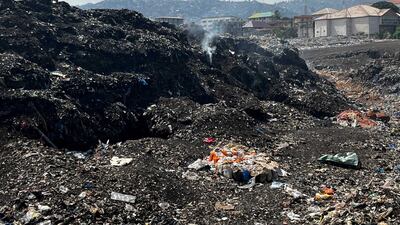
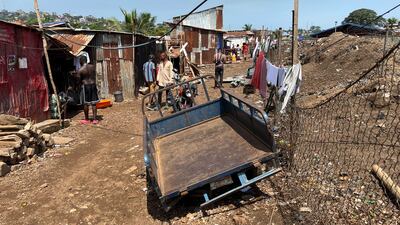
  • More than 2,000 people live on the Kolleh Town rubbish dump in central Freetown, Sierra Leone. Nick Webster / The National
    More than 2,000 people live on the Kolleh Town rubbish dump in central Freetown, Sierra Leone. Nick Webster / The National
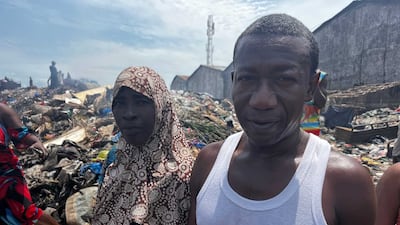
  • Kaditu Kariwallie, 55, a grandmother who raised her children and grandchildren on the site and Maligie Koroma, Freetown City Council supervisor at the Bomeh refuse site in Freetown Sierra Leone. Nick Webster / The National
    Kaditu Kariwallie, 55, a grandmother who raised her children and grandchildren on the site and Maligie Koroma, Freetown City Council supervisor at the Bomeh refuse site in Freetown Sierra Leone. Nick Webster / The National
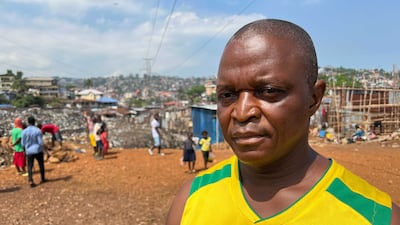
  • Daniel-Bob Jones, (yellow top) national chairman of community disaster management and Kolleh Town community chairman. Andy Scott / The National
    Daniel-Bob Jones, (yellow top) national chairman of community disaster management and Kolleh Town community chairman. Andy Scott / The National
  • Yassin Kargbo, Country Manager for Infinitum Energy. The company has a plan to strip the site of its recyclable materials and redevelop the site for its residents. Andy Scott / The National
    Yassin Kargbo, Country Manager for Infinitum Energy. The company has a plan to strip the site of its recyclable materials and redevelop the site for its residents. Andy Scott / The National
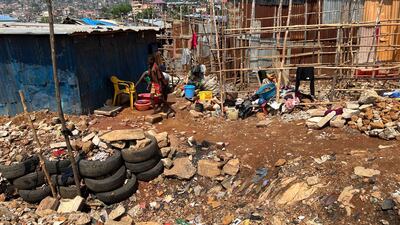
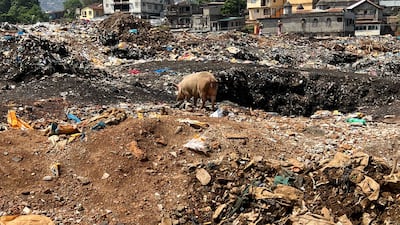
  • Kolleh Town landfill centre in Sierra Leone - home to more than 2,000 residents that mine the site for recyclable materials. Andy Scott / The National
    Kolleh Town landfill centre in Sierra Leone - home to more than 2,000 residents that mine the site for recyclable materials. Andy Scott / The National
  • Kolleh Town landfill centre in Sierra Leone - home to more than 2,000 residents that mine the site for recyclable materials. Andy Scott / The National
    Kolleh Town landfill centre in Sierra Leone - home to more than 2,000 residents that mine the site for recyclable materials. Andy Scott / The National
  • Kolleh Town landfill centre in Sierra Leone - home to more than 2,000 residents that mine the site for recyclable materials. Andy Scott / The National
    Kolleh Town landfill centre in Sierra Leone - home to more than 2,000 residents that mine the site for recyclable materials. Andy Scott / The National

Access to clean cooking is a major issue in Africa, where thousands of people die annually and millions suffer chronic health problems from illnesses linked to air pollution.

China, India and Indonesia have halved the number of their citizens who lack clean cooking access since 2010.

But in Africa, the number of people without clean cooking access has increased during the same period, the International Energy Agency intergovernmental organisation, said in a July report.

An annual investment of $8 billion will be required until 2030 to achieve universal access to clean cooking, the Paris-based agency has said.

Developing countries require about $1.7 trillion per year in the clean energy sector but only managed to attract foreign direct investment worth $544 billion in 2022, Unctad, the UN intergovernmental organisation that promotes the interests of developing countries in world trade, said in its World Investment Report in July.


Timeline

2012-2015

The company offers payments/bribes to win key contracts in the Middle East

May 2017

The UK SFO officially opens investigation into Petrofac’s use of agents, corruption, and potential bribery to secure contracts

September 2021

Petrofac pleads guilty to seven counts of failing to prevent bribery under the UK Bribery Act

October 2021

Court fines Petrofac £77 million for bribery. Former executive receives a two-year suspended sentence 

December 2024

Petrofac enters into comprehensive restructuring to strengthen the financial position of the group

May 2025

The High Court of England and Wales approves the company’s restructuring plan

July 2025

The Court of Appeal issues a judgment challenging parts of the restructuring plan

August 2025

Petrofac issues a business update to execute the restructuring and confirms it will appeal the Court of Appeal decision

October 2025

Petrofac loses a major TenneT offshore wind contract worth €13 billion. Holding company files for administration in the UK. Petrofac delisted from the London Stock Exchange

November 2025

180 Petrofac employees laid off in the UAE

Ten tax points to be aware of in 2026

1. Domestic VAT refund amendments: request your refund within five years

If a business does not apply for the refund on time, they lose their credit.

2. E-invoicing in the UAE

Businesses should continue preparing for the implementation of e-invoicing in the UAE, with 2026 a preparation and transition period ahead of phased mandatory adoption. 

3. More tax audits

Tax authorities are increasingly using data already available across multiple filings to identify audit risks. 

4. More beneficial VAT and excise tax penalty regime

Tax disputes are expected to become more frequent and more structured, with clearer administrative objection and appeal processes. The UAE has adopted a new penalty regime for VAT and excise disputes, which now mirrors the penalty regime for corporate tax.

5. Greater emphasis on statutory audit

There is a greater need for the accuracy of financial statements. The International Financial Reporting Standards standards need to be strictly adhered to and, as a result, the quality of the audits will need to increase.

6. Further transfer pricing enforcement

Transfer pricing enforcement, which refers to the practice of establishing prices for internal transactions between related entities, is expected to broaden in scope. The UAE will shortly open the possibility to negotiate advance pricing agreements, or essentially rulings for transfer pricing purposes. 

7. Limited time periods for audits

Recent amendments also introduce a default five-year limitation period for tax audits and assessments, subject to specific statutory exceptions. While the standard audit and assessment period is five years, this may be extended to up to 15 years in cases involving fraud or tax evasion. 

8. Pillar 2 implementation 

Many multinational groups will begin to feel the practical effect of the Domestic Minimum Top-Up Tax (DMTT), the UAE's implementation of the OECD’s global minimum tax under Pillar 2. While the rules apply for financial years starting on or after January 1, 2025, it is 2026 that marks the transition to an operational phase.

9. Reduced compliance obligations for imported goods and services

Businesses that apply the reverse-charge mechanism for VAT purposes in the UAE may benefit from reduced compliance obligations. 

10. Substance and CbC reporting focus

Tax authorities are expected to continue strengthening the enforcement of economic substance and Country-by-Country (CbC) reporting frameworks. In the UAE, these regimes are increasingly being used as risk-assessment tools, providing tax authorities with a comprehensive view of multinational groups’ global footprints and enabling them to assess whether profits are aligned with real economic activity. 

Contributed by Thomas Vanhee and Hend Rashwan, Aurifer

How to wear a kandura

Dos

  • Wear the right fabric for the right season and occasion 
  • Always ask for the dress code if you don’t know
  • Wear a white kandura, white ghutra / shemagh (headwear) and black shoes for work 
  • Wear 100 per cent cotton under the kandura as most fabrics are polyester

Don’ts 

  • Wear hamdania for work, always wear a ghutra and agal 
  • Buy a kandura only based on how it feels; ask questions about the fabric and understand what you are buying
What are the main cyber security threats?

Cyber crime - This includes fraud, impersonation, scams and deepfake technology, tactics that are increasingly targeting infrastructure and exploiting human vulnerabilities.
Cyber terrorism - Social media platforms are used to spread radical ideologies, misinformation and disinformation, often with the aim of disrupting critical infrastructure such as power grids.
Cyber warfare - Shaped by geopolitical tension, hostile actors seek to infiltrate and compromise national infrastructure, using one country’s systems as a springboard to launch attacks on others.

Tamkeen's offering
  • Option 1: 70% in year 1, 50% in year 2, 30% in year 3
  • Option 2: 50% across three years
  • Option 3: 30% across five years 
Updated: September 04, 2023, 1:59 PM