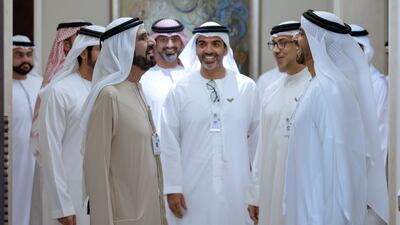
Sunjay Sudhir at the Indian Embassy in Abu Dhabi. Khushnum Bhandari / The National

Indian envoy backs UAE bid to make Cop28 a summit of action


Anjana Sankar
  • English
  • Arabic

Sunjay Sudhir, India's ambassador to the UAE, has backed the Emirates to ensure Cop28 is a summit of action and called on the global community to remain united in the fight against climate change.

He said an inclusive approach to crunch talks fostered by Dr Sultan Al Jaber, Cop28 President-designate, would be key to bringing about change at the conference and beyond.

The envoy said it was clear the world remained “off-track” in its goal to limit global temperature rises to no more than 1.5°C above pre-industrial levels, as set out by the Paris Agreement at Cop21.

World leaders, senior officials and climate advocates will convene at Cop28, which will be held at Expo City Dubai from November 30 to December 12.

We see the UAE being fully committed to making Cop28 a Cop of action
Sunjay Sudhir

Mr Sudhir dismissed concerns raised in some quarters over the UAE's hosting of the event and Dr Al Jaber's role leading the summit, due to his position as head of the Abu Dhabi National Oil Company.

“I do not see any irony in UAE hosting Cop. At times, Cop will be hosted by countries who are net exporters of fossil fuels and at other times by those who are not net importers [of fossil fuels],” Mr Sudhir told The National on Monday.

“We see the UAE being fully committed to making Cop28 a Cop of action and not mere assertions. Fossil fuels cannot be wished away. Let us be realistic and make fossil fuels a part of the solution.”

A letter signed by a number of members of the US Congress and the European Parliament called for the influence of oil and gas lobbyists to be curbed at this year's climate talks.

It called on Dr Sultan Al Jaber, the UAE’s Minister of Industry and Advanced Technology, to withdraw as the summit’s President-designate because he heads the Abu Dhabi National Oil Company.

The letter puts the signatories at odds with the US and EU’s top leadership.

“Dr Sultan Al Jaber is an experienced diplomat and business leader, including as chairman of renewable energy company Masdar,” a US government official told The National last week.

Nicholas Lyons, Lord Mayor of London, echoed those sentiments, saying the UAE had been “extraordinarily methodical” in its approach to its hosting duties.

“It's really timely this is being hosted by a hydrocarbon economy and it's being chaired by someone who chairs a hydrocarbon company with a background as the chief executive of a renewable technology company,” he said.

Mr Sudhir said Dr Jaber’s solid track record in renewables as the chief executive and chairman of Masdar and his participation in a number of previous Cop events demonstrated his credentials for the task in hand.

Dr Sultan Al Jaber, Cop28 head and Minister of Industry and Advanced Technology, delivers the keynote address at the recent UAE Climate Tech conference. Victor Besa / The National

“It is a qualification which I do not think any single individual can ever bring to the table,” said the envoy.

“Dr Sultan’s idea of creating an inclusive discourse is actually what the world needs today for action. All reports point to one single fact – the world is off track on the 1.5°C targets and the only way we can do anything about it is if everyone works together,” he added.

Call to support developing nations

Mr Sudhir underlined the importance of addressing the disproportionate impact of climate change on developing nations, which threatens to exacerbate poverty, inequality, food security, water availability, and health challenges.

He spoke of the need for the Global North – a term used to describe more developed nations such as those in North America and Europe – to deliver support to those in the Global South, spanning Latin America, Africa, Asia and Oceania.

The diplomat welcomed the UAE's call to Global North nations to fulfil their commitment of $100 billion for the Green Climate Fund.

The lopsided nature of the current climate action agenda, he said, predominantly benefits a small percentage of the world's population and overlooks the needs of the Global South.

“For the Global South, there are challenges of energy availability, accessibility and affordability.

“It is in need of technologies and focus on adaptation which can enable them to transition and meet their energy needs simultaneously. Unfortunately, Global North has hardly paid any attention to this fact,” he said.

Sunjay Sudhir, Indian ambassador to the UAE says the Global South has challenges of energy availability, accessibility and affordability which the Global North ignores. Khushnum Bhandari / The National

The ambassador stressed the critical juncture at which the world finds itself, where choices need to be balanced between the imperative to adhere to the 1.5°C pathway and the need for the Global South to grow and develop.

“The Global South, including Sids [Small Island Developing States] and other developing countries, have contributed least to climate change but they suffer some of the worst consequences and are most vulnerable,” he said.

'Carbon capture technology is effective'

When asked about the UAE's emphasis on the strategy of carbon capture and storage (CCUS) technology, Mr Sudhir said it its effective for countries still dependent on fossil fuels.

CCUS is a process in which carbon dioxide is stored permanently underground, or turned into solid minerals or other useful products.

“Expectations that energy transition in the Global South will happen directly to renewable energy are neither realistic nor within the reach of countries of the Global South,” he said.

“The role of clean fossil fuels will be an integral part of a just, fair, and equitable energy transition. Only an energy transition which considers the developmental needs of the Global South will be most effective.”

CCUS is part of India’s Long-Term Low Emissions and Development Strategies announced at Cop 27 in Sharm El Sheikh. This includes technology that can capture carbon from polluting industries, so it never reaches the atmosphere, as well as advancing similar technologies.

As India aspires to become a $10 trillion economy by 2030, Mr Sudhir said his country is committed to balancing net-zero targets with concrete climate action.

“India is a global energy transition leader. Just, fair and equitable energy transition is a critical pillar of India’s growth and development agenda.”

He said India had made significant strides in renewable energy, with doubled hydropower capacity, a 22-fold increase in solar installed capacity, and significant reductions in solar tariffs.

“India stands fourth globally in Renewable Energy installed capacity including large hydro power. Nearly 43 per cent of total installed capacity comes from non-fossil fuel sources,” he said.

“India has set a target to reduce the carbon intensity of the nation’s economy by at least 45 per cent by the end of the decade, achieve 50 per cent cumulative electric power installed by 2030 from renewables, and achieve net-zero carbon emissions by 2070.”

The National Green Hydrogen Mission launched by India with the aim to produce 5 million tonnes of green hydrogen annually will result in 50 million tonnes of cumulative CO2 emissions abatement, he said.

Sheikh Mohammed reviews Cop28 preparations – in pictures

  • At the UAE Government Meeting in November 2022, Sheikh Mohammed bin Rashid said the hosting of Cop28 will be the UAE's biggest event next year. Photos: Wam
    At the UAE Government Meeting in November 2022, Sheikh Mohammed bin Rashid said the hosting of Cop28 will be the UAE's biggest event next year. Photos: Wam
  • Cop28 will be the first time countries will assess the progress of the 2015 Paris climate accord to limit global warming.
    Cop28 will be the first time countries will assess the progress of the 2015 Paris climate accord to limit global warming.
  • The global event, which will take place at Expo City Dubai, will welcome more than 140 heads of state and government and 80,000 participants.
    The global event, which will take place at Expo City Dubai, will welcome more than 140 heads of state and government and 80,000 participants.
  • Dr Sultan Al Jaber, Minister of Industry and Advanced Technology, Special Envoy for Climate Change and chairman of Masdar, gave a presentation at the meeting outlining what will be involved in hosting one of the largest global events of the year.
    Dr Sultan Al Jaber, Minister of Industry and Advanced Technology, Special Envoy for Climate Change and chairman of Masdar, gave a presentation at the meeting outlining what will be involved in hosting one of the largest global events of the year.
The specs: 2018 Nissan 370Z Nismo

The specs: 2018 Nissan 370Z Nismo
Price, base / as tested: Dh182,178
Engine: 3.7-litre V6
Power: 350hp @ 7,400rpm
Torque: 374Nm @ 5,200rpm
Transmission: Seven-speed automatic
​​​​​​​Fuel consumption, combined: 10.5L / 100km

The specs

Engine: 4-litre twin-turbo V8

Transmission: eight-speed PDK

Power: 630bhp

Torque: 820Nm

Price: Dh683,200

On sale: now

What%20is%20cystic%20fibrosis%3F
%3Cul%3E%0A%3Cli%3ECystic%20fibrosis%20is%20a%20genetic%20disorder%20that%20affects%20the%20lungs%2C%20pancreas%20and%20other%20organs.%3C%2Fli%3E%0A%3Cli%3EIt%20causes%20the%20production%20of%20thick%2C%20sticky%20mucus%20that%20can%20clog%20the%20airways%20and%20lead%20to%20severe%20respiratory%20and%20digestive%20problems.%3C%2Fli%3E%0A%3Cli%3EPatients%20with%20the%20condition%20are%20prone%20to%20lung%20infections%20and%20often%20suffer%20from%20chronic%20coughing%2C%20wheezing%20and%20shortness%20of%20breath.%3C%2Fli%3E%0A%3Cli%3ELife%20expectancy%20for%20sufferers%20of%20cystic%20fibrosis%20is%20now%20around%2050%20years.%3C%2Fli%3E%0A%3C%2Ful%3E%0A

Mercer, the investment consulting arm of US services company Marsh & McLennan, expects its wealth division to at least double its assets under management (AUM) in the Middle East as wealth in the region continues to grow despite economic headwinds, a company official said.

Mercer Wealth, which globally has $160 billion in AUM, plans to boost its AUM in the region to $2-$3bn in the next 2-3 years from the present $1bn, said Yasir AbuShaban, a Dubai-based principal with Mercer Wealth.

Within the next two to three years, we are looking at reaching $2 to $3 billion as a conservative estimate and we do see an opportunity to do so,” said Mr AbuShaban.

Mercer does not directly make investments, but allocates clients’ money they have discretion to, to professional asset managers. They also provide advice to clients.

“We have buying power. We can negotiate on their (client’s) behalf with asset managers to provide them lower fees than they otherwise would have to get on their own,” he added.

Mercer Wealth’s clients include sovereign wealth funds, family offices, and insurance companies among others.

From its office in Dubai, Mercer also looks after Africa, India and Turkey, where they also see opportunity for growth.

Wealth creation in Middle East and Africa (MEA) grew 8.5 per cent to $8.1 trillion last year from $7.5tn in 2015, higher than last year’s global average of 6 per cent and the second-highest growth in a region after Asia-Pacific which grew 9.9 per cent, according to consultancy Boston Consulting Group (BCG). In the region, where wealth grew just 1.9 per cent in 2015 compared with 2014, a pickup in oil prices has helped in wealth generation.

BCG is forecasting MEA wealth will rise to $12tn by 2021, growing at an annual average of 8 per cent.

Drivers of wealth generation in the region will be split evenly between new wealth creation and growth of performance of existing assets, according to BCG.

Another general trend in the region is clients’ looking for a comprehensive approach to investing, according to Mr AbuShaban.

“Institutional investors or some of the families are seeing a slowdown in the available capital they have to invest and in that sense they are looking at optimizing the way they manage their portfolios and making sure they are not investing haphazardly and different parts of their investment are working together,” said Mr AbuShaban.

Some clients also have a higher appetite for risk, given the low interest-rate environment that does not provide enough yield for some institutional investors. These clients are keen to invest in illiquid assets, such as private equity and infrastructure.

“What we have seen is a desire for higher returns in what has been a low-return environment specifically in various fixed income or bonds,” he said.

“In this environment, we have seen a de facto increase in the risk that clients are taking in things like illiquid investments, private equity investments, infrastructure and private debt, those kind of investments were higher illiquidity results in incrementally higher returns.”

The Abu Dhabi Investment Authority, one of the largest sovereign wealth funds, said in its 2016 report that has gradually increased its exposure in direct private equity and private credit transactions, mainly in Asian markets and especially in China and India. The authority’s private equity department focused on structured equities owing to “their defensive characteristics.”

Who's who in Yemen conflict

Houthis: Iran-backed rebels who occupy Sanaa and run unrecognised government

Yemeni government: Exiled government in Aden led by eight-member Presidential Leadership Council

Southern Transitional Council: Faction in Yemeni government that seeks autonomy for the south

Habrish 'rebels': Tribal-backed forces feuding with STC over control of oil in government territory

COMPANY%20PROFILE
%3Cp%3E%3Cstrong%3ECompany%20name%3A%3C%2Fstrong%3E%20Alaan%3Cbr%3E%3Cstrong%3EStarted%3A%3C%2Fstrong%3E%202021%3Cbr%3E%3Cstrong%3EBased%3A%3C%2Fstrong%3E%20Dubai%3Cbr%3E%3Cstrong%3EFounders%3A%3C%2Fstrong%3E%20Parthi%20Duraisamy%20and%20Karun%20Kurien%3Cbr%3E%3Cstrong%3ESector%3A%3C%2Fstrong%3E%20FinTech%3Cbr%3E%3Cstrong%3EInvestment%20stage%3A%3C%2Fstrong%3E%20%247%20million%20raised%20in%20total%20%E2%80%94%20%242.5%20million%20in%20a%20seed%20round%20and%20%244.5%20million%20in%20a%20pre-series%20A%20round%3Cbr%3E%3Cbr%3E%3C%2Fp%3E%0A
Nayanthara: Beyond The Fairy Tale

Starring: Nayanthara, Vignesh Shivan, Radhika Sarathkumar, Nagarjuna Akkineni

Director: Amith Krishnan

Rating: 3.5/5

Ten tax points to be aware of in 2026

1. Domestic VAT refund amendments: request your refund within five years

If a business does not apply for the refund on time, they lose their credit.

2. E-invoicing in the UAE

Businesses should continue preparing for the implementation of e-invoicing in the UAE, with 2026 a preparation and transition period ahead of phased mandatory adoption. 

3. More tax audits

Tax authorities are increasingly using data already available across multiple filings to identify audit risks. 

4. More beneficial VAT and excise tax penalty regime

Tax disputes are expected to become more frequent and more structured, with clearer administrative objection and appeal processes. The UAE has adopted a new penalty regime for VAT and excise disputes, which now mirrors the penalty regime for corporate tax.

5. Greater emphasis on statutory audit

There is a greater need for the accuracy of financial statements. The International Financial Reporting Standards standards need to be strictly adhered to and, as a result, the quality of the audits will need to increase.

6. Further transfer pricing enforcement

Transfer pricing enforcement, which refers to the practice of establishing prices for internal transactions between related entities, is expected to broaden in scope. The UAE will shortly open the possibility to negotiate advance pricing agreements, or essentially rulings for transfer pricing purposes. 

7. Limited time periods for audits

Recent amendments also introduce a default five-year limitation period for tax audits and assessments, subject to specific statutory exceptions. While the standard audit and assessment period is five years, this may be extended to up to 15 years in cases involving fraud or tax evasion. 

8. Pillar 2 implementation 

Many multinational groups will begin to feel the practical effect of the Domestic Minimum Top-Up Tax (DMTT), the UAE's implementation of the OECD’s global minimum tax under Pillar 2. While the rules apply for financial years starting on or after January 1, 2025, it is 2026 that marks the transition to an operational phase.

9. Reduced compliance obligations for imported goods and services

Businesses that apply the reverse-charge mechanism for VAT purposes in the UAE may benefit from reduced compliance obligations. 

10. Substance and CbC reporting focus

Tax authorities are expected to continue strengthening the enforcement of economic substance and Country-by-Country (CbC) reporting frameworks. In the UAE, these regimes are increasingly being used as risk-assessment tools, providing tax authorities with a comprehensive view of multinational groups’ global footprints and enabling them to assess whether profits are aligned with real economic activity. 

Contributed by Thomas Vanhee and Hend Rashwan, Aurifer

Updated: May 30, 2023, 3:00 AM