

Yellow and amber health alerts have been issued across parts of the UK this weekend as the country, like many parts of Europe, experiences an extreme heatwave.
The warnings are in place until July 14 and weather forecasters at the UK's Met Office have warned that the heatwave is more widespread than in previous summers.
On Saturday, “temperatures are likely to locally approach 30°C over Northern Ireland and 31°C or even 32°C over parts of Scotland, away from eastern coasts”, said chief meteorologist Steve Willington.
June this year was the hottest on record for England, and July is on track to follow suit.

Heatwave deaths triple in Europe
Climate change tripled the number of heat-related deaths across European cities, according to a study from the World Weather Attribution group of researchers.
The researchers said heatwaves, which were up to 4ºC hotter across cities compared to a world without climate change, were “quietly devastating”.
The study, led by scientists at Imperial College London and the London School of Hygiene and Tropical Medicine, focused on 10 days of heat from June 23 to July 2.
It calculated that 1,500 of the 2,300 estimated heat deaths were the result of climate change – equating to a tripling of the number of deaths in the heatwave due to global warming.

Children, the elderly, and outdoor workers are particularly vulnerable. “Urban environments can exacerbate exposure for these groups, especially if access to cooling, health care, or shaded areas is limited,” said Dr Aseel Takshe, acting dean at the Canadian University Dubai's School of Health Sciences and Psychology.
-
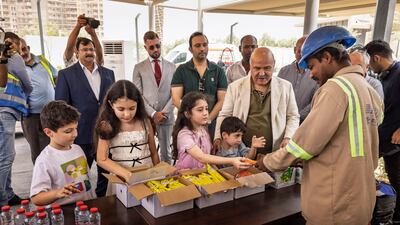
Mirwais Azizi and his family join volunteers distributing cold drinks and frozen treats to 4,000 workers at the Azizi Venice construction site in Dubai South, as part of the Al Freej Fridge initiative. All photos: Antonie Robertson/The National -
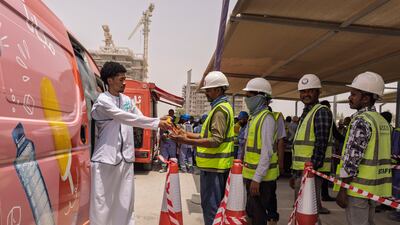
During the event, 12,500 items were distributed to more than 4,000 workers as temperatures approached 40°C -
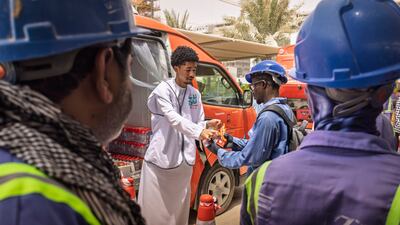
The initiative aims to distribute more than two million bottles of water, juice and frozen treats to Dubai’s frontline workers such as cleaners, construction workers, delivery drivers and landscapers over the summer months -
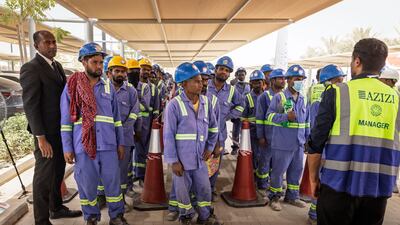
Dubai authorities are ramping up enforcement of the midday break rule, which prevents labourers from carrying out work under direct sunlight between 12pm and 3pm throughout the three-month period -
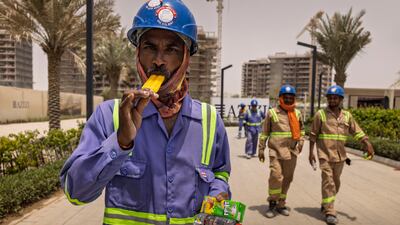
A worker enjoys an ice lolly. The initiative was launched by Ferjan Dubai with support from the Mohammed bin Rashid Al Maktoum Global Initiatives (MBRGI), UAE Water Aid Foundation (Suqia) and the UAE Food Bank -
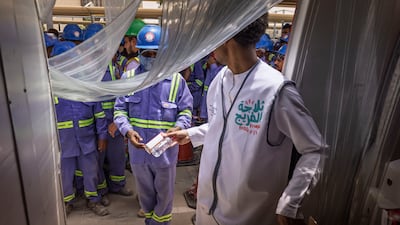
Refrigerated trucks deliver cold drinks to outdoor work sites and fridges are installed in workers' accommodation to maximise access to refreshments in the harsh summer heat. Antonie Robertson/The National


The UN Environment Programme (UNEP) Frontiers 2025 Report, published on Thursday, highlights that people aged 65 and above form an increasingly dominant part of the world population, particularly in urban areas of low- and middle-income countries.
The report states that annual levels of heat-related deaths among older people have risen by an estimated 85 per cent since the 1990s. Additional risks arise from deteriorating air quality and floods in low-lying coastal cities.
“Heatwaves are among the most frequent and deadly impacts of climate change, along with floods and shrinking ice cover,” said Inger Andersen, executive director of UNEP. “We must be prepared for the risks these impacts pose, especially for society’s most vulnerable, including older persons.”
How much heat can your body endure?
2024 was officially the hottest year on record, following what United Nations Secretary General Antonio Guterres called a decade of deadly heat.
“Humans are most comfortable and expend the least energy at temperatures between 18°C and 24°C,” added Dr Aseel Takshe. “The body’s ability to cool itself becomes compromised at high temperatures, particularly above 40°C.
“The critical survival limit is a 'wet-bulb' temperature of 35°C at 100 per cent humidity, where sweat no longer evaporates and core temperature rises dangerously. Even healthy adults cannot survive more than a few hours at this threshold.”
The UAE implements a midday break for outdoor workers during the summer months, from June 15 to September 15. The break, introduced in 2004, prohibits work under direct sunlight and in open-air spaces between 12.30pm and 3pm.

Dust storms add to danger
Data released on Saturday by Europe's weather watchdog, Copernicus, showed repeated long-range episodes of Saharan dust crossing into Europe and the Caribbean, significantly degrading air quality.
“So far in 2025, we have monitored repeated long-range transport of Saharan dust and high PM10 concentrations reaching Europe and the Caribbean,” said Mark Parrington, senior scientist at the Copernicus Atmosphere Monitoring Service.
PM10 refers to particulate matter with a diameter of 10 micrometres or less.
“These episodes can have a negative impact on air quality on both sides of the Atlantic, and subsequently represent potential risks to human health,” Mr Parrington added.
Lessons from the UAE: Planning for heat
In built-up environments, the situation is compounded by the urban heat island effect. “This effect is intensified by the scarcity of green spaces and the prevalence of heat-absorbing materials like concrete and asphalt,” Dr Takshe told The National.
Studies in the UAE show that urban areas can be 1.3°C to 4.5°C warmer than surrounding rural areas.
Dust storms coupled with urban heat build-up can be serious health risk, warned Dr Takshe. “Dust and pollution can trap heat and further worsen respiratory health, especially among vulnerable groups. The need for air conditioning and cooling increases sharply during heatwaves, leading to high energy consumption and potential stress on power infrastructure.”

How to stay safe during extreme heat
Staying safe in such environments requires personal and systemic action. At the individual level, hydration, staying indoors during peak heat and recognising signs of heat illness – such as dizziness, confusion, and rapid pulse – are essential. Lightweight, loose-fitting clothing and access to shaded or air-conditioned spaces can make a life-saving difference.
But cooling a city is not a task individuals can bear alone. Urban designs, infrastructure and public policy must align to address extreme heat. That means planting more trees, redesigning streets to allow natural air flow, and expanding green spaces that naturally lower surface temperatures.
Some of Dubai and Abu Dhabi's urban canyons – tall buildings that cast long shadows- reduce daytime heat exposure in parts of the city. But this is often offset by residual night-time heat.
“Adapting urban design – such as increasing vegetation, implementing cool roofs, and improving airflow – can help mitigate these effects but requires co-ordinated planning and investment,” Dr Takshe told The National. “Public awareness campaigns, establishment of community cooling centres and education on heat risks are essential for immediate relief and long-term resilience.”
According to the World Health Organisation, the recommended ambient temperature indoors is about 18°C.
Dr Takshe adds that humans are most comfortable and expend the least energy at between 18°C and 24°C. But for millions living in climate-vulnerable regions, maintaining such conditions without cooling infrastructure can be a challenge.

