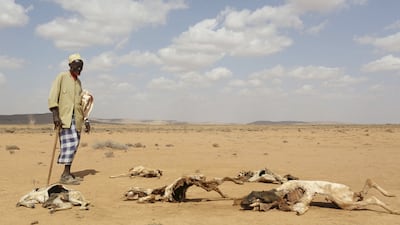
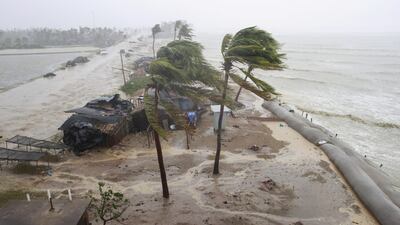
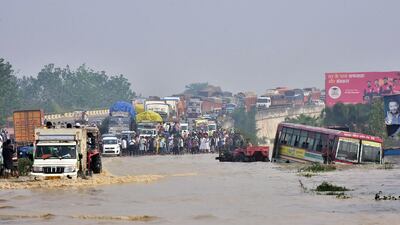
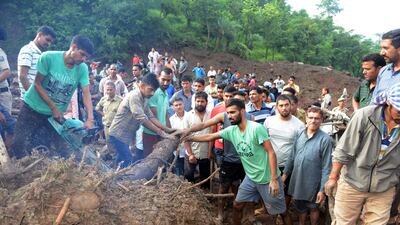
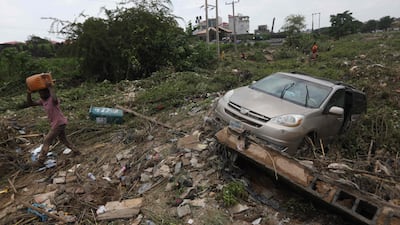
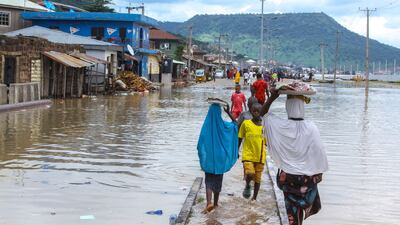
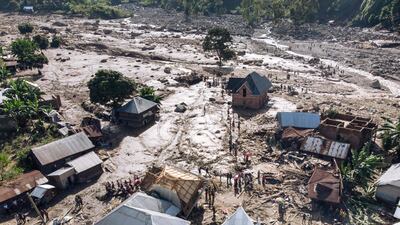
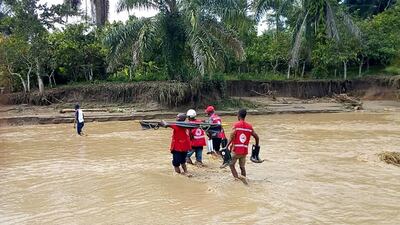
While the escalating impact of climate change is likely to have profound impact on people, with some estimates showing it could cause more than 15 million deaths between 2026 and 2050, the funding to tackle climate-driven health issues is still not enough.
Findings unveiled at the World Economic Forum on Tuesday showed that funds for climate and health, provided by the public, private, and philanthropic sectors, had increased to $7.1 billion in 2022, a significant jump from the less than $1 billion committed in 2018. However, experts say the funds are not landing where they are needed most.
Dr Naveen Rao, senior vice president of health at The Rockefeller Foundation, said the jump indicates the trend is moving in the right direction, but “the overall amount of funding still falls far short of what is needed to protect lives and livelihoods from the devastating impacts of climate change”.
“Donors from the public, private, and philanthropic sectors must increase their commitments to climate and health, while also making sure that funding reaches the communities that need it most,” said Dr Rao. The analysis assessed climate health projects.
Funds not reaching those who need it most
Less than 50 per cent of overall funding made it to low-income countries, according to the paper which was titled Resourcing Climate and Health Priorities: A Mapping of International Finance Flows, and compiled by philanthropist firm Foundation S – the Sanofi Collective, the UAE's Reaching the Last Mile, and The Rockefeller Foundation.
“Well-financed climate action is an opportunity to transform countries and economies and achieve health and well-being for all,” said Nassar Al Mubarak, chief executive of Reaching the Last Mile. “As the report demonstrates, now is the time to invest in more ambitious, co-ordinated and accessible funding, delivered where it is needed most.”
Vanina Laurent-Ledru, director general of Foundation S said that countries on the front lines of climate change urgently need more accessible financing to protect their population’s health.
“Business as usual is no longer an option. Public, private, and philanthropic collaborations can help to fast-track flexible finance directly to local communities so they can urgently build climate-resilient health systems,” she said.
The report called on donors, civil society, academia and policymakers to support countries in obtaining financing by increasing the overall amount available, support local decision makers as well as speeding up and simplifying the overall process.
The paper states that integrated planning of climate and health investments is a key success factor for countries to access funding. Currently, more than 90 per cent of Nationally Determined Contributions and National Adaptation Plans, which are national climate plans and targets under the UNFCC often include health considerations, but are often focused on goals such reducing emissions. Most countries lack a clear picture of the financing needed to address climate and health goals. The paper's authors stress a clear need to translate growing political commitment into actionable, financeable plans that enable the implementation of climate and health solutions across society.
Eliminating dangerous diseases
The Reaching the Last Mile initiative was launched in 2017 by President Sheikh Mohamed with the aim of tackling preventable diseases in low-income communities.
One of the programmes under Reaching the Last Mile is the Reaching the Last Mile Fund a multi-donor partnership with the Bill & Melinda Gates Foundation. At COP28, Reaching the Last Mile joined with the Gates Foundation and global partners to announce a landmark expansion of the fund from $100 million to a target $500 million.
Over the past decade, Sheikh Mohamed has pledged more than $470 million to enhance health outcomes globally, according to Reaching the Last Mile's website with the funds focusing on providing treatment and preventive care to communities without access to quality healthcare. The initiative specifically targets the elimination of diseases in the most remote and underserved regions.
Thanks to co-ordinated global efforts, Guinea worm disease and polio are on track to become the next human diseases to be eradicated, following smallpox’s successful eradication in 1980.
Nations at risk due to climate change – in pictures
How to apply for a drone permit
- Individuals must register on UAE Drone app or website using their UAE Pass
- Add all their personal details, including name, nationality, passport number, Emiratis ID, email and phone number
- Upload the training certificate from a centre accredited by the GCAA
- Submit their request
What are the regulations?
- Fly it within visual line of sight
- Never over populated areas
- Ensure maximum flying height of 400 feet (122 metres) above ground level is not crossed
- Users must avoid flying over restricted areas listed on the UAE Drone app
- Only fly the drone during the day, and never at night
- Should have a live feed of the drone flight
- Drones must weigh 5 kg or less
Who's who in Yemen conflict
Houthis: Iran-backed rebels who occupy Sanaa and run unrecognised government
Yemeni government: Exiled government in Aden led by eight-member Presidential Leadership Council
Southern Transitional Council: Faction in Yemeni government that seeks autonomy for the south
Habrish 'rebels': Tribal-backed forces feuding with STC over control of oil in government territory
Company%20profile
%3Cp%3EName%3A%20Tabby%3Cbr%3EFounded%3A%20August%202019%3B%20platform%20went%20live%20in%20February%202020%3Cbr%3EFounder%2FCEO%3A%20Hosam%20Arab%2C%20co-founder%3A%20Daniil%20Barkalov%3Cbr%3EBased%3A%20Dubai%2C%20UAE%3Cbr%3ESector%3A%20Payments%3Cbr%3ESize%3A%2040-50%20employees%3Cbr%3EStage%3A%20Series%20A%3Cbr%3EInvestors%3A%20Arbor%20Ventures%2C%20Mubadala%20Capital%2C%20Wamda%20Capital%2C%20STV%2C%20Raed%20Ventures%2C%20Global%20Founders%20Capital%2C%20JIMCO%2C%20Global%20Ventures%2C%20Venture%20Souq%2C%20Outliers%20VC%2C%20MSA%20Capital%2C%20HOF%20and%20AB%20Accelerator.%3Cbr%3E%3C%2Fp%3E%0A
THE SPECS
Cadillac XT6 2020 Premium Luxury
Engine: 3.6L V-6
Transmission: nine-speed automatic
Power: 310hp
Torque: 367Nm
Price: Dh280,000
The President's Cake
Director: Hasan Hadi
Starring: Baneen Ahmad Nayyef, Waheed Thabet Khreibat, Sajad Mohamad Qasem
Rating: 4/5
UAE currency: the story behind the money in your pockets
White hydrogen: Naturally occurring hydrogen
Chromite: Hard, metallic mineral containing iron oxide and chromium oxide
Ultramafic rocks: Dark-coloured rocks rich in magnesium or iron with very low silica content
Ophiolite: A section of the earth’s crust, which is oceanic in nature that has since been uplifted and exposed on land
Olivine: A commonly occurring magnesium iron silicate mineral that derives its name for its olive-green yellow-green colour
Recent winners
2002 Giselle Khoury (Colombia)
2004 Nathalie Nasralla (France)
2005 Catherine Abboud (Oceania)
2007 Grace Bijjani (Mexico)
2008 Carina El-Keddissi (Brazil)
2009 Sara Mansour (Brazil)
2010 Daniella Rahme (Australia)
2011 Maria Farah (Canada)
2012 Cynthia Moukarzel (Kuwait)
2013 Layla Yarak (Australia)
2014 Lia Saad (UAE)
2015 Cynthia Farah (Australia)
2016 Yosmely Massaad (Venezuela)
2017 Dima Safi (Ivory Coast)
2018 Rachel Younan (Australia)
Mercer, the investment consulting arm of US services company Marsh & McLennan, expects its wealth division to at least double its assets under management (AUM) in the Middle East as wealth in the region continues to grow despite economic headwinds, a company official said.
Mercer Wealth, which globally has $160 billion in AUM, plans to boost its AUM in the region to $2-$3bn in the next 2-3 years from the present $1bn, said Yasir AbuShaban, a Dubai-based principal with Mercer Wealth.
“Within the next two to three years, we are looking at reaching $2 to $3 billion as a conservative estimate and we do see an opportunity to do so,” said Mr AbuShaban.
Mercer does not directly make investments, but allocates clients’ money they have discretion to, to professional asset managers. They also provide advice to clients.
“We have buying power. We can negotiate on their (client’s) behalf with asset managers to provide them lower fees than they otherwise would have to get on their own,” he added.
Mercer Wealth’s clients include sovereign wealth funds, family offices, and insurance companies among others.
From its office in Dubai, Mercer also looks after Africa, India and Turkey, where they also see opportunity for growth.
Wealth creation in Middle East and Africa (MEA) grew 8.5 per cent to $8.1 trillion last year from $7.5tn in 2015, higher than last year’s global average of 6 per cent and the second-highest growth in a region after Asia-Pacific which grew 9.9 per cent, according to consultancy Boston Consulting Group (BCG). In the region, where wealth grew just 1.9 per cent in 2015 compared with 2014, a pickup in oil prices has helped in wealth generation.
BCG is forecasting MEA wealth will rise to $12tn by 2021, growing at an annual average of 8 per cent.
Drivers of wealth generation in the region will be split evenly between new wealth creation and growth of performance of existing assets, according to BCG.
Another general trend in the region is clients’ looking for a comprehensive approach to investing, according to Mr AbuShaban.
“Institutional investors or some of the families are seeing a slowdown in the available capital they have to invest and in that sense they are looking at optimizing the way they manage their portfolios and making sure they are not investing haphazardly and different parts of their investment are working together,” said Mr AbuShaban.
Some clients also have a higher appetite for risk, given the low interest-rate environment that does not provide enough yield for some institutional investors. These clients are keen to invest in illiquid assets, such as private equity and infrastructure.
“What we have seen is a desire for higher returns in what has been a low-return environment specifically in various fixed income or bonds,” he said.
“In this environment, we have seen a de facto increase in the risk that clients are taking in things like illiquid investments, private equity investments, infrastructure and private debt, those kind of investments were higher illiquidity results in incrementally higher returns.”
The Abu Dhabi Investment Authority, one of the largest sovereign wealth funds, said in its 2016 report that has gradually increased its exposure in direct private equity and private credit transactions, mainly in Asian markets and especially in China and India. The authority’s private equity department focused on structured equities owing to “their defensive characteristics.”
How to vote
Canadians living in the UAE can register to vote online and be added to the International Register of Electors.
They'll then be sent a special ballot voting kit by mail either to their address, the Consulate General of Canada to the UAE in Dubai or The Embassy of Canada in Abu Dhabi
Registered voters mark the ballot with their choice and must send it back by 6pm Eastern time on October 21 (2am next Friday)
ETFs explained
Exhchange traded funds are bought and sold like shares, but operate as index-tracking funds, passively following their chosen indices, such as the S&P 500, FTSE 100 and the FTSE All World, plus a vast range of smaller exchanges and commodities, such as gold, silver, copper sugar, coffee and oil.
ETFs have zero upfront fees and annual charges as low as 0.07 per cent a year, which means you get to keep more of your returns, as actively managed funds can charge as much as 1.5 per cent a year.
There are thousands to choose from, with the five biggest providers BlackRock’s iShares range, Vanguard, State Street Global Advisors SPDR ETFs, Deutsche Bank AWM X-trackers and Invesco PowerShares.
UAE currency: the story behind the money in your pockets