

Rising rates of carbon dioxide in the atmosphere are incompatible with keeping global warming below 1.5°C, a Met Office study has warned.
Using measurements taken at Mauna Loa, Hawaii stretching back to 1958, concentrations of the key greenhouse gas rose at their fastest annual levels in 2024, exceeding Met Office predictions for the year.
At Mauna Loa, a rise of 3.58 parts per million (ppm) was recorded, well above the predicted 2.84ppm from the Met Office. Satellite measurements also showed large increases worldwide.
The Met Office said the increase was down to record high emissions from fossil fuel burning, natural “sinks” such as tropical forests capturing less carbon, and wildfires.
The reduction in carbon absorbed by forests and the wildfires were driven by hot conditions linked to El Nino in the Pacific, which pushes up global temperatures, and climate change.
The Met Office, which has produced forecasts for carbon dioxide since 2016, predicts the rise from 2024 to 2025 will be less extreme than the increase recorded last year, at about 2.26ppm.
Global data suggests carbon dioxide emissions will reach 37.41 billion tonnes in 2024.
But even this slower rise will be too fast to stay on track for pathways laid out by the UN’s climate body, the Intergovernmental Panel on Climate Change (IPCC), that aim for warming to remain below 1.5°C of pre-industrial levels with no or little overshoot, the Met Office warned.
The IPCC also predicts temperatures will overshoot 1.5°C temporarily for a few decades before returning below the threshold by the end of this century.
To remain on track, Global Greenhouse Gas (GHG) emissions must drop by around 43 per cent by 2030, according to estimates.
Effects of climate change on Middle East - in pictures
-

Flooding in the Al Barsha area of Dubai. Chris Whiteoak / The National -
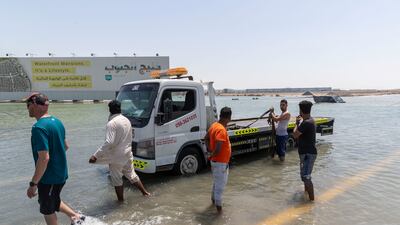
Vehicles being recovered near Al Maktoum airport in Dubai. Antonie Robertson / The National -

Flooding in the Al Barsha area of Dubai. Chris Whiteoak / The National -
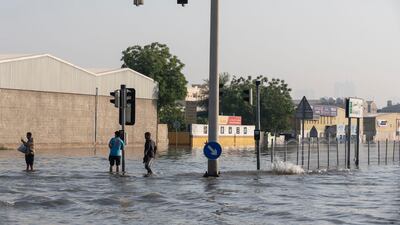
Flooding along Sheikh Zayed Road in Dubai. Antonie Robertson / The National -
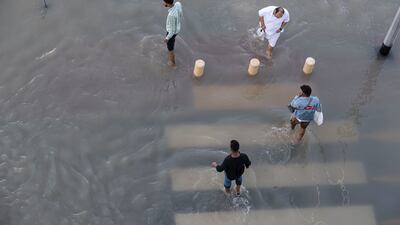
Flooding along Sheikh Zayed Road in Dubai. Antonie Robertson / The National -

Cars move through floodwater in Al Qudra, Dubai. Chris Whiteoak / The National -

Flooding on Dubai's Al Khail Road. Chris Whiteoak / The National -
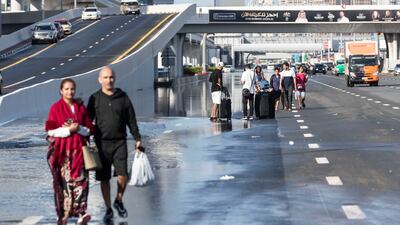
People abandon their cars on Sheikh Zayed Road due to heavy rain. Antonie Robertson/The National -

Flooding on Al Khail Road. Chris Whiteoak / The National -
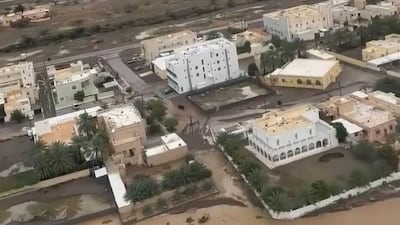
Flooding in Oman. Photo: Royal Oman Police -

A damaged car in Derna, Libya. Reuters -
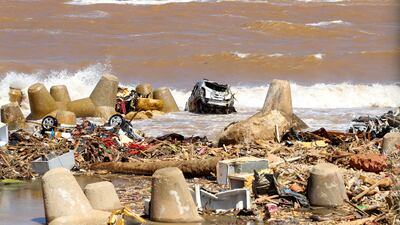
A destroyed vehicle in Derna. AFP -

Abdul Salam Ibrahim Al-Qadi walks on rubble in front of his house, searching for his missing father and brother, in Derna. Reuters -

An aerial view of the destruction in Derna. Reuters -
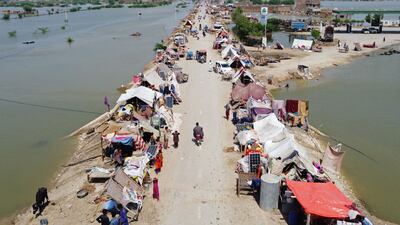
Flood-affected people taking refuge in a makeshift camp after heavy monsoon rains in Jaffarabad district of Balochistan province. AFP -
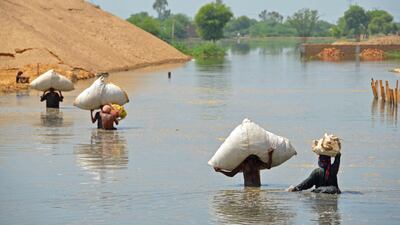
Internally displaced flood-affected people shift husk for their animals in a flood-hit area following heavy rains in Dera Allah Yar in Balochistan. AFP -
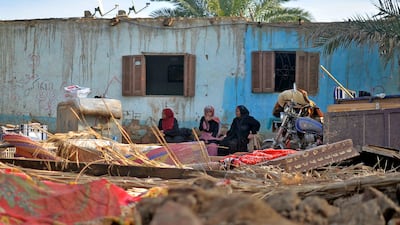
The aftermath of flooding in Egypt's southern city of Aswan, 920 kilometres south of the capital. AFP -

The Nile River from the top of Famine Stela, or Rock of Starvation, Egypt. Reuters -

Volunteers search for people in need following heavy rainfall in east Mosul, Iraq, in March 2020. Reuters -

People clean up after floods in Duhok, Iraq, on March 19. Reuters


But they will require greater reliance on technology or approaches, such as planting more forests, that reduce the overall level of carbon dioxide in the atmosphere.
The figures came after Copernicus, EU's climate change monitoring service, recently revealed that Earth’s temperature remained 1.5°C above the pre-industrial average in 2024, representing the first calendar-long breach of the milestone on record.
It said the global temperature average of 15.10°C was 0.12°C above 2023's level, the previous warmest year. It was also 1.60°C higher than the temperature estimate for the pre-fossil fuel era, from 1850 to 1900.
Scientists said the data suggested it was now “very likely” the world would fail to reach its 2060 global warming targets.
Pursuing efforts to prevent the world warming by more than the 1.5°C limit is one of the key commitments of the global Paris treaty, which countries agreed to in 2015 in a bid to avert the most dangerous effects of climate change.
Carbon dioxide in the atmosphere traps heat and higher levels of the gas trap more warmth, pushing up global temperatures over time, which causes rising sea levels, more extreme droughts, storms, floods, harm to wildlife and critical natural systems.
If global warming is to be limited to 1.5°C, the increase in carbon dioxide in the atmosphere needs to already be slowing to a rise of 1.8ppm a year this decade, before halting and starting to decline, according to IPCC calculations, the Met Office said.
But increases are averaging about 2.5ppm so far this decade, said the Met Office’s Prof Richard Betts, who leads the production of the forecast.
'Time is not on our side,' UN chief warns Cop29 - video
“Last week, it was confirmed that 2024 was the warmest year on record, with annual average temperatures higher than 1.5°C above pre-industrial levels for the first time,” he said.
“While this does not represent a failure to achieve the Paris Agreement target, as that would require breaching warming 1.5°C over a longer period and we may see a slightly cooler year in 2025, the long-term warming trend will continue because carbon dioxide is still building up in the atmosphere.”
He said a switch from El Nino to La Nina – which creates cooler, wetter conditions, particularly in the tropics – would mean forests and other natural systems soak up more carbon than last year, temporarily slowing the rise in levels of carbon dioxide in the atmosphere.
“However, stopping global warming needs the build-up of greenhouse gases in the air to come to a complete halt and then start to reduce,” he said. “Large, rapid emissions cuts could limit the extent to which global warming exceeds 1.5°C – but this needs urgent action internationally."
A study from 2022 found that carbon dioxide in the Earth's atmosphere was 50 per cent higher than the pre-Industrial Revolution era, reaching levels not seen in more than four million years.
Worsening warming
According to the Carbon Brief, if warming exceeds 1.5°C beyond 2100 and peaks at 1.89°C, sea levels will rise by 20cm at more than 70 per cent of the Earth's coastlines.
If warming continues to rise, peaking at 2.69°C by 2100, the world would pass a catastrophic point of no return, with the loss of all ice sheets, sea level rises of several metres, extreme heatwaves occurring most years and the drying out of the Amazon rainforest.
Warming of 4°C would result in unprecedented heatwaves, severe drought and major flooding, creating millions of global climate refugees. Wide-scale adaptation to global sea rise would also be necessary.

