The ruins of homes along the Gulf of Mexico after Hurricane Milton passed through the area in Manasota Key, Florida. Getty Images


Why the West must prepare for climate migration


  • English
  • Arabic

October 14, 2024

The idea of climate migration in the western media conjures images of desperate Africans straggling across the desert, or Bangladeshis sitting on their rooftops amid flooded fields. But as hurricanes and wildfires tear through apparently safe locales, climate migration is a feature of life in the US and Europe, too – even if the West doesn’t realise it yet.

One of the great trends of 20th century American life was the population move to the Sun Belt states such as California, Arizona and Florida, aided by widespread air conditioning, from the drought-stricken Mid-West in the 1930s, and the decaying – and colder – northern rust-belt from the 1970s. John Steinbeck’s classic novel The Grapes of Wrath follows one family of “Okies” (migrant farm workers) fleeing their parched farm in Oklahoma’s Dust-Bowl for a better life in California – where they encounter prejudice and exploitation.

Two major hurricanes have just struck the US. Milton hit low-lying Florida, which is no stranger to such storms. Helene, though, reached mountainous areas of inland North Carolina, usually thought to be safe, bringing catastrophic flooding and landslides and killing at least 227 people.

Although the science is complex and debated, World Weather Attribution found that global warming made Milton’s winds 10 per cent more powerful, and the hurricane 20 to 30 per cent rainier, while Helene was about 10 per cent more intense on these measures. This is the general pattern to be expected from increased evaporation from hotter tropical seas where hurricanes are born. There will be more powerful storms, and they will intensify rapidly.

The effect of the hurricanes is magnified by sea-level rise because of expanding warmer seas and melting glaciers. The storm surge they bring approaches coastlines already retreating. The US East and Gulf Coasts are undergoing an above-average relative sea-level rise because of post-glacial subsidence, the damming of sediment-bearing rivers, and the extraction of subsurface water and oil.

The effects of global warming are being felt across North America and Europe. Heatwaves are hitting more northerly cities that are not equipped for them. Traditional tourist areas in southern Europe are becoming unbearably hot in summer.

A long drought in California might return as the Pacific shifts back to La Niña conditions this year. Wildfires burn homes, cut off power, and bring choking smoke to the south-western US, New York and other areas adjacent to Canadian forests, Greece and Australia. Heavy rains strain dams and overtop rivers across central Europe, France, England and Wales, while April’s floods in Dubai and Sharjah are fresh in the memory.

While Europe mostly worries about rising heat, it’s also possible that changes in oceanic circulation could plunge it into a deep freeze. That would make parts of the continent uninhabitable and decimate agriculture.

While Europe and the US have become increasingly hostile to immigration, climate change impact – such as storms and droughts forcing farmers off the land in Central America, and the effect of water shortages across weak states in the Middle East and Sahel – also influences migration patterns. A World Bank paper found that more than 200 million people in poorer countries might migrate by 2050 because of climate change.

These climatic troubles are particularly damaging because they occur in low-income, poorly-governed or oppressive states that cannot deal with them effectively. Wealthier countries may think they are relatively immune.

But the costs of climate-related natural disasters are huge – $225 billion to $250 billion for Hurricane Helene, according to estimates from forecaster AccuWeather. Most of this is not covered by insurance. Uninsured properties can’t easily be sold or mortgaged.

That is one powerful force for climate migration within the nation: properties by the coast or on floodplains will become increasingly impossible to insure, or the budgetary cost of government-backed insurance will become unaffordable. Rich and high-profile neighbourhoods will probably be able to attract government funds while poorer areas are sacrificed.

Wealthy countries can cope with many of the effects of a changing climate through improvements to flood defences, seawalls, dams, air-conditioning, drip irrigation, changing cultivation to less water-hungry plants, better forest management and firefighting. A large part of these costs will be invisible, but will pose an ever-increasing drag on productivity and economic growth.

Migration within the US is relatively straightforward. In the EU and European economic area, it is legally quite easy, but there are barriers of language, culture and personal networks. Brexit Britain has foolishly cut itself off from such flexibility.

But the accelerating flight of large numbers of people will worsen social tensions and have powerful and unpredictable political consequences. Over the past two decades, about 3.2 million people, or nearly 1 per cent of the American population, have already moved to escape flooding, a paper in Nature found. Big states such as California, Texas and Florida report population growth slowing as climatic risks deter residents.

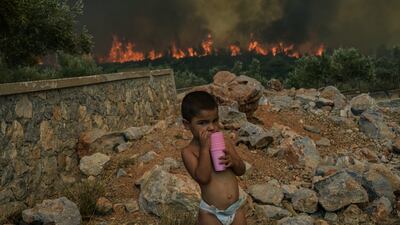
  • A child stands in a garden of as a wildfire burns, in the village of Agios Charalampos, near Athens. AFP
    A child stands in a garden of as a wildfire burns, in the village of Agios Charalampos, near Athens. AFP
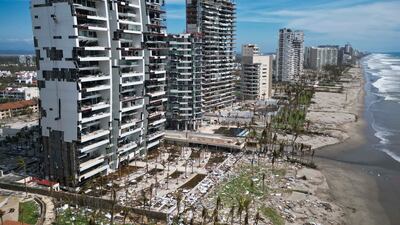
  • An aerial view of the damage caused by Hurricane Otis in Acapulco, Mexico. AFP
    An aerial view of the damage caused by Hurricane Otis in Acapulco, Mexico. AFP
  • A miner in a salt mine, where construction is under way to build the 700km long SuedLink electric power line to transport green energy from the northern coast to the country's south, at the Suedwestdeutsche Salzwerke salt mine in Germany. Reuters
    A miner in a salt mine, where construction is under way to build the 700km long SuedLink electric power line to transport green energy from the northern coast to the country's south, at the Suedwestdeutsche Salzwerke salt mine in Germany. Reuters
  • A garden pool is left hanging on a cliffside after torrential rain in the beachfront town of San Clemente, California. Reuters
    A garden pool is left hanging on a cliffside after torrential rain in the beachfront town of San Clemente, California. Reuters
  • A tree burns during a wildfire in Mandra, Greece. Reuters
    A tree burns during a wildfire in Mandra, Greece. Reuters
  • Decaying fishing trawlers known collectively as The Fleetwood Wrecks are seen at low tide on the banks of the River Wyre in Fleetwood. Reuters
    Decaying fishing trawlers known collectively as The Fleetwood Wrecks are seen at low tide on the banks of the River Wyre in Fleetwood. Reuters
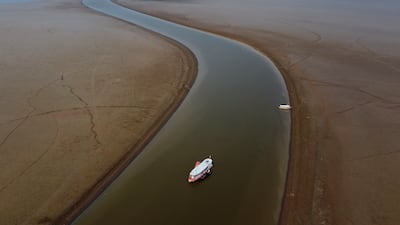
  • A ferry travels a section of the Amazon River affected by severe drought, near Manacapuru, Brazil. AP
    A ferry travels a section of the Amazon River affected by severe drought, near Manacapuru, Brazil. AP
  • Cracked ground of the Baells reservoir as drinking water supplies hit their lowest level since 1990 after an extreme drought in Catalonia, in the village of Cersc, Spain. Reuters
    Cracked ground of the Baells reservoir as drinking water supplies hit their lowest level since 1990 after an extreme drought in Catalonia, in the village of Cersc, Spain. Reuters

The best approach, of course, is to limit global warming as far as possible. But with at least a rise of 2ºC now a near-certainty, authorities need to plan ahead. Efforts so far are piecemeal and conventional. North Carolina, a swing state in the upcoming US election, even introduced a law in 2011 banning the use of updated estimates of sea-level rise by state agencies in land-use decisions.

Migration within wealthy countries and areas because of climate change is already a reality. Rather than listening to anti-immigration campaigners rallying against hordes of incomers from poorer regions, wealthy countries such as the US and those in Europe need to prepare for their own internally-displaced people. That’s better than the social dislocation and political dysfunction that a new wave of 21st century Okies will bring.

Robin M Mills is chief executive of Qamar Energy, and author of The Myth of the Oil Crisis

How to help

Send “thenational” to the following numbers or call the hotline on: 0502955999
2289 – Dh10
2252 – Dh 50
6025 – Dh20
6027 – Dh 100
6026 – Dh 200

The Melbourne Mercer Global Pension Index

The Melbourne Mercer Global Pension Index

Mazen Abukhater, principal and actuary at global consultancy Mercer, Middle East, says the company’s Melbourne Mercer Global Pension Index - which benchmarks 34 pension schemes across the globe to assess their adequacy, sustainability and integrity - included Saudi Arabia for the first time this year to offer a glimpse into the region.

The index highlighted fundamental issues for all 34 countries, such as a rapid ageing population and a low growth / low interest environment putting pressure on expected returns. It also highlighted the increasing popularity around the world of defined contribution schemes.

“Average life expectancy has been increasing by about three years every 10 years. Someone born in 1947 is expected to live until 85 whereas someone born in 2007 is expected to live to 103,” Mr Abukhater told the Mena Pensions Conference.

“Are our systems equipped to handle these kind of life expectancies in the future? If so many people retire at 60, they are going to be in retirement for 43 years – so we need to adapt our retirement age to our changing life expectancy.”

Saudi Arabia came in the middle of Mercer’s ranking with a score of 58.9. The report said the country's index could be raised by improving the minimum level of support for the poorest aged individuals and increasing the labour force participation rate at older ages as life expectancies rise.

Mr Abukhater said the challenges of an ageing population, increased life expectancy and some individuals relying solely on their government for financial support in their retirement years will put the system under strain.

“To relieve that pressure, governments need to consider whether it is time to switch to a defined contribution scheme so that individuals can supplement their own future with the help of government support,” he said.

White hydrogen: Naturally occurring hydrogenChromite: Hard, metallic mineral containing iron oxide and chromium oxideUltramafic rocks: Dark-coloured rocks rich in magnesium or iron with very low silica contentOphiolite: A section of the earth’s crust, which is oceanic in nature that has since been uplifted and exposed on landOlivine: A commonly occurring magnesium iron silicate mineral that derives its name for its olive-green yellow-green colour

NYBL PROFILE

Company name: Nybl 

Date started: November 2018

Founder: Noor Alnahhas, Michael LeTan, Hafsa Yazdni, Sufyaan Abdul Haseeb, Waleed Rifaat, Mohammed Shono

Based: Dubai, UAE

Sector: Software Technology / Artificial Intelligence

Initial investment: $500,000

Funding round: Series B (raising $5m)

Partners/Incubators: Dubai Future Accelerators Cohort 4, Dubai Future Accelerators Cohort 6, AI Venture Labs Cohort 1, Microsoft Scale-up 

COMPANY%20PROFILE
%3Cp%3E%3Cstrong%3ECompany%20name%3A%3C%2Fstrong%3E%203S%20Money%3Cbr%3E%3Cstrong%3EStarted%3A%3C%2Fstrong%3E%202018%3Cbr%3E%3Cstrong%3EBased%3A%3C%2Fstrong%3E%20London%3Cbr%3E%3Cstrong%3EFounders%3A%3C%2Fstrong%3E%20Ivan%20Zhiznevsky%2C%20Eugene%20Dugaev%20and%20Andrei%20Dikouchine%3Cbr%3E%3Cstrong%3ESector%3A%3C%2Fstrong%3E%20FinTech%3Cbr%3E%3Cstrong%3EInvestment%20stage%3A%3C%2Fstrong%3E%20%245.6%20million%20raised%20in%20total%3C%2Fp%3E%0A
GAC GS8 Specs

Engine: 2.0-litre 4cyl turbo

Power: 248hp at 5,200rpm

Torque: 400Nm at 1,750-4,000rpm

Transmission: 8-speed auto

Fuel consumption: 9.1L/100km

On sale: Now

Price: From Dh149,900

The burning issue

The internal combustion engine is facing a watershed moment – major manufacturer Volvo is to stop producing petroleum-powered vehicles by 2021 and countries in Europe, including the UK, have vowed to ban their sale before 2040. The National takes a look at the story of one of the most successful technologies of the last 100 years and how it has impacted life in the UAE.

Part three: an affection for classic cars lives on

Read part two: how climate change drove the race for an alternative 

Read part one: how cars came to the UAE

While you're here

Michael Young: Where is Lebanon headed?

Kareem Shaheen: I owe everything to Beirut

Raghida Dergham: We have to bounce back

UAE squad

Humaira Tasneem (c), Chamani Senevirathne (vc), Subha Srinivasan, NIsha Ali, Udeni Kuruppuarachchi, Chaya Mughal, Roopa Nagraj, Esha Oza, Ishani Senevirathne, Heena Hotchandani, Keveesha Kumari, Judith Cleetus, Chavi Bhatt, Namita D’Souza.

Countries offering golden visas

UK
Innovator Founder Visa is aimed at those who can demonstrate relevant experience in business and sufficient investment funds to set up and scale up a new business in the UK. It offers permanent residence after three years.

Germany
Investing or establishing a business in Germany offers you a residence permit, which eventually leads to citizenship. The investment must meet an economic need and you have to have lived in Germany for five years to become a citizen.

Italy
The scheme is designed for foreign investors committed to making a significant contribution to the economy. Requires a minimum investment of €250,000 which can rise to €2 million.

Switzerland
Residence Programme offers residence to applicants and their families through economic contributions. The applicant must agree to pay an annual lump sum in tax.

Canada
Start-Up Visa Programme allows foreign entrepreneurs the opportunity to create a business in Canada and apply for permanent residence. 

Updated: November 21, 2024, 12:27 PM