


The exceptional heatwaves across southern Europe and North America in July would have been virtually inconceivable without the influence of human-induced climate change, according to scientists.
Their studies also indicate that this climate change made the recent heatwave in China 50 times more probable.
After Earth's warmest June yet recorded, temperatures have risen alarmingly in the south-western US states and Mexico. In Phoenix, there are reports of fatalities caused by extreme burns from the scorching pavements and roads.
The Mediterranean has also been battling severe heatwaves, which have pushed temperatures well above 40ºC.
These conditions have triggered wildfires, leading to the evacuation of thousands in Greece.
Simultaneously, China experienced its highest recorded temperature of 52.2ºC, with many regions retaining temperatures above 35ºC, even throughout the night.
Scientists from World Weather Attribution, a UK and Netherlands-based group, warned that these heatwaves will only become more severe and frequent unless global fossil fuel consumption is reduced.
Their swift research discovered that in the absence of human-induced climate change, China's heatwave would have been a one-in-250-year event. Similarly, the heatwaves across the US, Mexico, and southern Europe would have been almost statistically impossible.
Aligning with previous studies, they highlighted that the heatwaves were approximately 2.5ºC warmer in southern Europe, 2ºC warmer in North America, and 2ºC warmer in China than they would have been without the warming effect of greenhouse gases.
Heatwaves, no longer a rarity, are predicted to occur once every 15 years in the US and Mexico, once every 10 years in southern Europe, and once every five years in China.
According to the scientists, if the global average temperature increases by 2ºC above pre-industrial levels – the less ambitious target of the Paris Agreement – heatwaves are projected to occur every two to five years.
Dr Friederike Otto, affiliated with the Grantham Institute for Climate Change and the Environment at Imperial College London, said: “The outcome of this attribution study is hardly shocking. The continuous burning of fossil fuels is leading to a warmer climate and more severe heatwaves. It's that straightforward.”
Dr Otto added: “These heatwaves do not signify runaway warming or imminent climate collapse. There is still time to secure a safe and prosperous future. However, we need to urgently quit burning fossil fuels and focus on decreasing vulnerability. If we fail, we risk tens of thousands of people dying from heat-related causes annually.”
-

A hot and dusty day in downtown Dubai. Temperatures in one desert region hit 50°C on Sunday, while the cities sweltered in 45°C heat. Pawan Singh / The National -

A swimmer dives into the Mediterranean Sea to cool off on a sweltering day in in Beirut, where it was 40°C this weekend. AP Photo -

Children cool off outside the Tokyo Skytree as temperatures hit the mid-30s. Japan issued heatstroke alerts to tens of millions of people on Sunday. AFP -

Beachgoers cool off in the ocean at a beach in Valencia, Spain. A new heat wave is to hit the country on Monday, with temperatures above 40°C expected in many places. EPA -

People cool off using water from a fountain on St Peter's Square in the Vatican City. AFP -

A man cools off in a fountain during a heat wave in Turin, Italy. EPA -
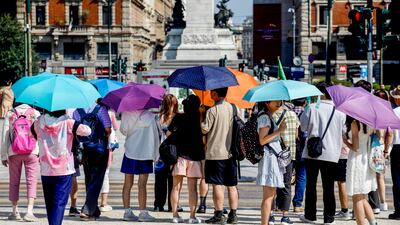
People use umbrellas to shield themselves from the sun in Milan, Italy. EPA -
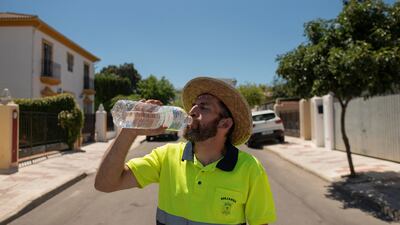
Spanish street sweeper Javier drinks water in Ronda. Temperatures will hit 40°C from Sunday to Tuesday on the Canary Islands and in Andalusia. AFP -

The heatwave in Greece, codenamed 'Kleon', has seen temperatures reach as high as 44°C over the past four days. EPA -

Temperatures have hit 35°C in Belgrade. AFP


Europe is warming faster than the global average due to its geographical position between the increasingly hotter Arctic and Saharan regions. It is estimated that more than 61,000 people succumbed to heat across the continent last summer.
Reports indicate hundreds of deaths due to this year's intense heat, but the true scope will not be determined soon because many regions do not maintain detailed records of heat-related deaths, and statisticians require time to ascertain the number of excess fatalities.
The scientists from World Weather Attribution emphasise the “urgent need” for heat action plans, particularly in urban areas, where temperatures often surpass those in surrounding regions – a phenomenon known as the urban heat island effect.
Sjoukje Philip, from the Royal Netherlands Meteorological Institute, said: “Our planet isn’t warming uniformly. Climate scientists are striving to comprehend the intricate relationships between escalating global and regional average temperatures.
“Our study demonstrates the significant influence of rapid warming on local European temperatures. It emphasises the pressing need for Europe to persistently implement adaptation and mitigation measures.”
-

An Arabian oryx takes refuge in the shade of a tree during a dusty hot day at a conservation area in Dubai. AP -

People cool off by swimming on Dubai's coast. AP -

People at the beach trying to escape the heat in Kuwait City. AFP -

A man cools off under an open-air shower in Baghdad. AP -

A man takes a block of ice out of an ice factory in Basra. AFP -

A boy dives into a river in the village of Albu Mustafa, near Hilla in central Iraq. AFP -
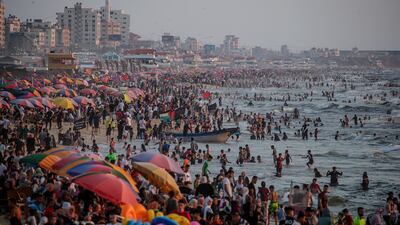
Palestinians spend time at the beach in Gaza City. EPA -

An Egyptian teen jumps into the water of the Nile on the outskirts of Cairo. EPA -

People row on the Nile during hot weather in the Qanater, on the outskirts of Cairo. EPA -

Libyans jet ski off the coast of Tripoli. AFP -

Fans in a general store in Algiers where the temperatures rose up to 30 degrees Celsius. AP -
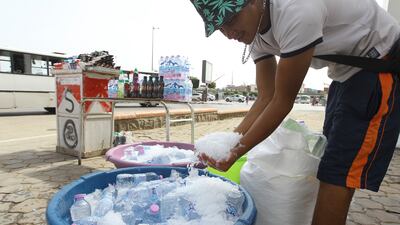
A street seller puts some ice on bottles of water in Algiers. AP Photo -

A child plays in a public fountain in Algiers. AP


UK braces for potential 40ºC heatwaves as climate crisis escalates
Climate experts have warned that extreme heat and temperatures surpassing 40ºC are becoming increasingly probable in the UK due to climate change.
The Met Office's upcoming State of the UK Climate report for 2022 is expected to document recorded temperatures of more than 40ºC for the first time, alongside numerous wildfires and a record number of heat-related deaths.
With the UK still reeling from the record summer temperatures of 2022, Dr Candice Howarth of the London School of Economics Grantham Research Institute on Climate Change and the Environment said that the country is underprepared for the increasingly likely extreme weather events.
Researchers also stress the growing urgency to implement heat action plans, which will be critical in mitigating the severe effects of climate change and ensuring the safety of the world's inhabitants.

