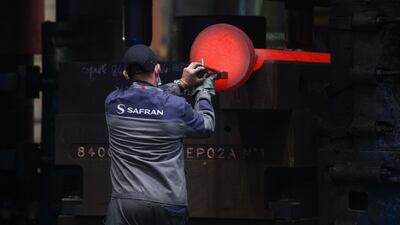
US aviation safety officials ordered unusual inspections of a sample of four Boeing 787s amid questions about quality issues on the company’s carbon-fiber widebody jetliner.
The Federal Aviation Administration wrote to Boeing on January 11, telling the company it was going to conduct Certificates of Airworthiness inspections on four 787s, according to a letter reviewed by Bloomberg News.
The final review before an aircraft is handed over to buyers, known as an AC, has traditionally been delegated to Boeing’s own employees.
“The FAA is taking a number of corrective actions to address 787 production issues,” the agency said in an emailed statement. “One of the actions is retaining the authority to issue ACs for four specific aircraft. We can extend the AC retention to other aircraft if we see the need.”
The agency didn’t say in its statement whether the inspections had begun or what, if anything, had been found. FAA also didn’t specify what “production issues” it had discovered.
Boeing rose 3.28 per cent to close at $263.59 Wednesday in New York. The stock dropped 3.9 per cent on Tuesday, the sharpest decline on the Dow Jones Industrial Average, after Bloomberg News reported that the company was testing cockpit windows on some 787s.
“We are encouraged by the progress our team is making on returning to delivery activities for the 787 programme,” Boeing said on Wednesday in an emailed statement. “We have engaged the FAA throughout this effort and will implement their direction for airworthiness certification approval of the initial airplanes as they have done in the past.”
The Chicago-based manufacturer hasn’t delivered any 787 models since October as it searches for tiny defects near where the fuselage sections were joined. Boeing mechanics and engineers are working to restart 787 Dreamliner deliveries by the end of this month, in line with what executives promised during a January earnings call.
Boeing and FAA have had tense relations in the past two years in the wake of the twin fatal crashes of the 737 Max that led to its 20-month grounding.
Several additional flaws were discovered on the 737 Max during the grounding, and the agency has brought multiple civil enforcement actions against the company recently. Boeing agreed to pay $6.6 million on February 25 because it failed to adhere to a 2015 agreement to improve its safety practices, including on its production lines.
Under longstanding practice, the FAA typically deputises Boeing employees to inspect planes as they come off the assembly line to ensure they are properly made and can be legally sold. FAA inspectors occasionally conduct a handful of the reviews to ensure they remain properly trained.
The FAA has issued a small number of airworthiness certificates for 787 Dreamliners every year since 2017, according to a person briefed on the matter. The annual checks have varied between two and four aircraft annually, the person said.
The AC approvals were being retained by FAA in this case as a result of the unspecified issues discovered on the 787 production lines, FAA said.
The FAA also retained the sign-offs for all 737 Max jets coming of Boeing’s assembly line starting in November 2019 after debris such as rags and tools were discovered in the planes during inspections.
Boeing has been forced to store more than 80 Dreamliners as they work with suppliers to identify the source of manufacturing flaws in the plane.

Queen
Nicki Minaj
(Young Money/Cash Money)
FIGHT CARD
1. Featherweight 66kg
Ben Lucas (AUS) v Ibrahim Kendil (EGY)
2. Lightweight 70kg
Mohammed Kareem Aljnan (SYR) v Alphonse Besala (CMR)
3. Welterweight 77kg
Marcos Costa (BRA) v Abdelhakim Wahid (MAR)
4. Lightweight 70kg
Omar Ramadan (EGY) v Abdimitalipov Atabek (KGZ)
5. Featherweight 66kg
Ahmed Al Darmaki (UAE) v Kagimu Kigga (UGA)
6. Catchweight 85kg
Ibrahim El Sawi (EGY) v Iuri Fraga (BRA)
7. Featherweight 66kg
Yousef Al Husani (UAE) v Mohamed Allam (EGY)
8. Catchweight 73kg
Mostafa Radi (PAL) v Abdipatta Abdizhali (KGZ)
9. Featherweight 66kg
Jaures Dea (CMR) v Andre Pinheiro (BRA)
10. Catchweight 90kg
Tarek Suleiman (SYR) v Juscelino Ferreira (BRA)
%20Ramez%20Gab%20Min%20El%20Akher
%3Cp%3E%3Cstrong%3ECreator%3A%3C%2Fstrong%3E%20Ramez%20Galal%3C%2Fp%3E%0A%3Cp%3E%3Cstrong%3EStarring%3A%3C%2Fstrong%3E%20Ramez%20Galal%3C%2Fp%3E%0A%3Cp%3E%3Cstrong%3EStreaming%20on%3A%20%3C%2Fstrong%3EMBC%20Shahid%3C%2Fp%3E%0A%3Cp%3E%3Cstrong%3ERating%3A%20%3C%2Fstrong%3E2.5%2F5%3C%2Fp%3E%0A
Results
6.30pm: Baniyas (PA) Group 2 Dh195,000 1,400m | Winner: ES Ajeeb, Sam Hitchcock (jockey), Ibrahim Aseel (trainer)
7.05pm: Maiden (TB) Dh165,000 1,400m | Winner: Al Shamkhah, Royston Ffrench, Sandeep Jadhav
7.40pm: Handicap (TB) Dh190,000 1,200m | Winner: Lavaspin, Richard Mullen, Satish Seemar
8.15pm: Maiden (TB) Dh165,000 1,200m | Winner: Kawasir, Dane O’Neill, Musabah Al Muhairi
8.50pm: Rated Conditions (TB) Dh240,000 1,600m | Winner: Cosmo Charlie, Pat Dobbs, Doug Watson
9.20pm: Handicap (TB) Dh165,000 1,400m | Winner: Bochart, Richard Mullen, Satish Seemar
10pm: Handicap (TB) Dh175,000 2,000m | Winner: Quartier Francais, Fernando Jara, Ali Rashid Al Raihe
Mercer, the investment consulting arm of US services company Marsh & McLennan, expects its wealth division to at least double its assets under management (AUM) in the Middle East as wealth in the region continues to grow despite economic headwinds, a company official said.
Mercer Wealth, which globally has $160 billion in AUM, plans to boost its AUM in the region to $2-$3bn in the next 2-3 years from the present $1bn, said Yasir AbuShaban, a Dubai-based principal with Mercer Wealth.
“Within the next two to three years, we are looking at reaching $2 to $3 billion as a conservative estimate and we do see an opportunity to do so,” said Mr AbuShaban.
Mercer does not directly make investments, but allocates clients’ money they have discretion to, to professional asset managers. They also provide advice to clients.
“We have buying power. We can negotiate on their (client’s) behalf with asset managers to provide them lower fees than they otherwise would have to get on their own,” he added.
Mercer Wealth’s clients include sovereign wealth funds, family offices, and insurance companies among others.
From its office in Dubai, Mercer also looks after Africa, India and Turkey, where they also see opportunity for growth.
Wealth creation in Middle East and Africa (MEA) grew 8.5 per cent to $8.1 trillion last year from $7.5tn in 2015, higher than last year’s global average of 6 per cent and the second-highest growth in a region after Asia-Pacific which grew 9.9 per cent, according to consultancy Boston Consulting Group (BCG). In the region, where wealth grew just 1.9 per cent in 2015 compared with 2014, a pickup in oil prices has helped in wealth generation.
BCG is forecasting MEA wealth will rise to $12tn by 2021, growing at an annual average of 8 per cent.
Drivers of wealth generation in the region will be split evenly between new wealth creation and growth of performance of existing assets, according to BCG.
Another general trend in the region is clients’ looking for a comprehensive approach to investing, according to Mr AbuShaban.
“Institutional investors or some of the families are seeing a slowdown in the available capital they have to invest and in that sense they are looking at optimizing the way they manage their portfolios and making sure they are not investing haphazardly and different parts of their investment are working together,” said Mr AbuShaban.
Some clients also have a higher appetite for risk, given the low interest-rate environment that does not provide enough yield for some institutional investors. These clients are keen to invest in illiquid assets, such as private equity and infrastructure.
“What we have seen is a desire for higher returns in what has been a low-return environment specifically in various fixed income or bonds,” he said.
“In this environment, we have seen a de facto increase in the risk that clients are taking in things like illiquid investments, private equity investments, infrastructure and private debt, those kind of investments were higher illiquidity results in incrementally higher returns.”
The Abu Dhabi Investment Authority, one of the largest sovereign wealth funds, said in its 2016 report that has gradually increased its exposure in direct private equity and private credit transactions, mainly in Asian markets and especially in China and India. The authority’s private equity department focused on structured equities owing to “their defensive characteristics.”
Business Insights
- As per the document, there are six filing options, including choosing to report on a realisation basis and transitional rules for pre-tax period gains or losses.
- SMEs with revenue below Dh3 million per annum can opt for transitional relief until 2026, treating them as having no taxable income.
- Larger entities have specific provisions for asset and liability movements, business restructuring, and handling foreign permanent establishments.
Ready Player One
Dir: Steven Spielberg
Starring: Tye Sheridan, Olivia Cooke, Ben Mendelsohn, Mark Rylance
Ten tax points to be aware of in 2026
1. Domestic VAT refund amendments: request your refund within five years
If a business does not apply for the refund on time, they lose their credit.
2. E-invoicing in the UAE
Businesses should continue preparing for the implementation of e-invoicing in the UAE, with 2026 a preparation and transition period ahead of phased mandatory adoption.
3. More tax audits
Tax authorities are increasingly using data already available across multiple filings to identify audit risks.
4. More beneficial VAT and excise tax penalty regime
Tax disputes are expected to become more frequent and more structured, with clearer administrative objection and appeal processes. The UAE has adopted a new penalty regime for VAT and excise disputes, which now mirrors the penalty regime for corporate tax.
5. Greater emphasis on statutory audit
There is a greater need for the accuracy of financial statements. The International Financial Reporting Standards standards need to be strictly adhered to and, as a result, the quality of the audits will need to increase.
6. Further transfer pricing enforcement
Transfer pricing enforcement, which refers to the practice of establishing prices for internal transactions between related entities, is expected to broaden in scope. The UAE will shortly open the possibility to negotiate advance pricing agreements, or essentially rulings for transfer pricing purposes.
7. Limited time periods for audits
Recent amendments also introduce a default five-year limitation period for tax audits and assessments, subject to specific statutory exceptions. While the standard audit and assessment period is five years, this may be extended to up to 15 years in cases involving fraud or tax evasion.
8. Pillar 2 implementation
Many multinational groups will begin to feel the practical effect of the Domestic Minimum Top-Up Tax (DMTT), the UAE's implementation of the OECD’s global minimum tax under Pillar 2. While the rules apply for financial years starting on or after January 1, 2025, it is 2026 that marks the transition to an operational phase.
9. Reduced compliance obligations for imported goods and services
Businesses that apply the reverse-charge mechanism for VAT purposes in the UAE may benefit from reduced compliance obligations.
10. Substance and CbC reporting focus
Tax authorities are expected to continue strengthening the enforcement of economic substance and Country-by-Country (CbC) reporting frameworks. In the UAE, these regimes are increasingly being used as risk-assessment tools, providing tax authorities with a comprehensive view of multinational groups’ global footprints and enabling them to assess whether profits are aligned with real economic activity.
Contributed by Thomas Vanhee and Hend Rashwan, Aurifer
Dunki
%3Cp%3E%3Cstrong%3EDirector%3A%3C%2Fstrong%3E%20Rajkumar%20Hirani%C2%A0%3C%2Fp%3E%0A%3Cp%3E%3Cstrong%3EStarring%3A%3C%2Fstrong%3E%20Shah%20Rukh%20Khan%2C%20Taapsee%20Pannu%2C%20Vikram%20Kochhar%20and%20Anil%20Grover%3C%2Fp%3E%0A%3Cp%3E%3Cstrong%3ERating%3A%3C%2Fstrong%3E%204%2F5%3C%2Fp%3E%0A
MATCH INFO
Everton 2 Southampton 1
Everton: Walcott (15'), Richarlison (31' )
Southampton: Ings (54')
Man of the match: Theo Walcott (Everton)
UAE players with central contracts
Rohan Mustafa, Ashfaq Ahmed, Chirag Suri, Rameez Shahzad, Shaiman Anwar, Adnan Mufti, Mohammed Usman, Ghulam Shabbir, Ahmed Raza, Qadeer Ahmed, Amir Hayat, Mohammed Naveed and Imran Haider.