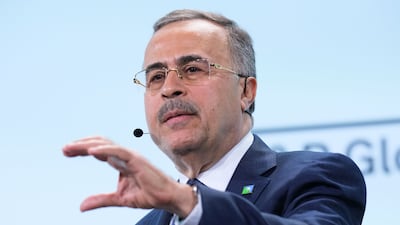
Energy market insiders who gathered in a vast underground ballroom in central London this week were united in support of a new emphasis on resilience in the oil industry.
The duration of the US-Iran war has changed the industry from "a just-in-time to a just-in-case" sector, TotalEnergies chief executive Patrick Pouyanne told the Energy Intelligence Forum.
Amin Nasser, chief executive of Aramco, said that throughout the crisis conditions, the producer has not cancelled one committed delivery, thanks to a number of routes to market and, in the case of the East-West pipeline, a vast capacity. This comes despite the supply problems caused by the blockades in the Strait of Hormuz and, more recently, the Bab Al Mandeb strait.

“It [the pipeline] has multiple lines with a lot of redundancy and flexibility built in and, because of that, all our customers are getting all their shipments required,” he said.
“When this crisis happened, we said, “OK, we have three routes. Is that enough?” Mr Nasser added. “Maybe not for the future. And this is the responsibility of the current generation, to think of a fourth and a fifth export way out.”

Sheikh Nawaf Al Sabah, chief executive of Kuwait Petroleum Corporation (KPC), pointed out the value of having its own tanker fleet, which dates back to the 1990s. “I think there is a major difference that we are able to accomplish through our tankers by having these tankers owned by us,” Mr Al Sabah said.
“We control where they go and the crews are our own crews. They, of course, all have the discretion of deciding whether they want to go through a passage or not.”
An emerging picture of new codes of conduct from the US-Iran war stretches across customers, consuming nations, producers and product classes.
Vaclav Bartuska, the Czech ambassador to the UK, said the long-term forces of change bear some resemblance to calculations last seen between the US and former Soviet Union.
“We are relearning the escalation ladder, which was the basis of the Cold War for 40 years,” he told The National. “You know the level to which you escalate, that you deter, but also don't cause too much pain into the other side.
“The Soviet Union and the United States developed a code, a language of how to hit each other without actually having open war between them. That's how the whole Cold War looked. The Soviet Union and United States managed to spend 40 years in Cold War without killing the world. They had proxy wars. They had plenty of conflicts. They managed not to have a direct escalation among themselves. This could be actually very long confrontation. It could also end next day,” he said.
During the gas dispute between Russia and Ukraine in January 2009, Mr Bartuska was involved in negotiations with Russian, Ukrainian and European Union leadership, when the Czech Republic held the EU Presidency. He also served as the Czech Republic's ambassador-at-large for energy security.

Ichiro Takahara, chairman and chief executive of Japan's strategic reserves specialist operator, Jogmec, said diversification to avoid “chokepoints” was one priority in the country's stockpiling policy.
He added that relations with resilient suppliers, such as Aramco and KPC, would include co-operation to build storage depots closer to customers in places such as Japan. Another Japanese executive, Takayuki Ueda, president of Inpex, said buyers now had wider considerations concerning diversification as well as resilience. “What matters for our buyers is security of supply,” he said. “They usually point out diversification of supply sources is important. However, they also emphasise the security and resilience of entire supply chain.”
Countries with differing strengths must work together to boost supply undertakings, said Kevin Gallagher, managing director of Australian company Santos. “There's a real clarity and understanding with policymakers in Australia that more pragmatic rather than ideological policies when it comes to energy development and energy supply going forward is what was required,” he said.
Mr Gallagher predicted Australia would “take its foot off the hose” that has restricted oil and gas exploration in recent years.
The Russian invasion of Ukraine in 2022 led European legislators to seek new energy deals in the Gulf – but the current war has narrowed those options.
Mr Bartuska said European governments were likely to pursue a diversification of suppliers. “This is not a crisis yet. We have been through much worse, and European countries didn't start this conflict and are not taking direct part in it,” he said.
Rising oil and gas prices would make some previously marginal projects more economically viable.
“There are quite a few projects around the world which were basically on the threshold between being relevant and not,” Mr Bartuska said. “I think higher prices will make them sustainable economically. From Latin America, from African countries, make projects in Asia, Australia, the US. There are quite a few resources which are not yet reserves, or they are becoming reserves, which means economically viable, thanks to the situation now.”
“I think, in general, the European perception of war changed in 2022 with the start of the Russian war against Ukraine, and we now see huge attacks by drones and missiles very regularly,” he said.
“There are also plenty of hybrid or hidden warfare and hidden attacks or deniable attacks against our installations. We are much more careful about what's happening in our countries, trying to deter another attack in the same time, not to escalate too much.”
He said western misconception of Iran was driving the inability to reach a truce – as well as a desire from the US and Iran sides to keep the war going.
“I don't know if both sides actually want the end of confrontation. I'm not sure of that. It's been going on since the end of February. It's now October,” he said.