Hotels in the UAE were the world's second busiest after China in 2020 due to government efforts to contain the spread of the Covid-19 virus, encourage domestic tourism and take measures to accelerate the sector's recovery, the Ministry of Economy said.
The country hosted 14.8 million guests who spent an average of 3.7 nights at 1,089 establishments last year for a hotel occupancy rate of 54.7 per cent, according to the World Tourism Organisation and the Emirates Tourism Council.
“The UAE was able to quickly contain the outbreak’s impact on the local tourism sector,” said Belhoul Al Falasi, chairman of the Emirates Tourism Council and Minister of State for Entrepreneurship and SMEs.
“The country’s success was a result of relying on innovation and agility in its efforts to provide incentives, launch initiatives and create opportunities to accelerate the recovery of the tourism sector and boost its contribution to gross domestic product.”
The UAE – a regional tourism hub – outpaced the global average occupancy rate of 37 per cent and the Middle East’s 43 per cent, according to WTO and ETC data.
Strengthening domestic tourism is essential for ensuring the tourism sector's full recovery
The global tourism industry was among the hardest hit by the pandemic, which shut borders, grounded aircraft and dented travel demand.
Chinese hotels grabbed top spot with an occupancy rate of 58 per cent while the US was third at 37 per cent.
Rounding off the top five where Mexico with 32 per cent and Turkey with 30 per cent.
Hotels in the UAE embarked on campaigns to promote domestic tourism, which contributed Dh41 billion ($11bn) to the national economy last year – a figure that is expected to double over the next few years, the Ministry of Economy said.
“Strengthening domestic tourism is essential for ensuring the tourism sector’s full recovery and driving faster economic recuperation,” said Mr Al Falasi.
“The UAE can benefit from its advanced infrastructure, modern facilities and wide range of services and activities to promote itself as a tourist destination with a lot to offer visitors – be they UAE residents or travellers from abroad.”
The data also showed that the UAE suffered the smallest decline in tourist traffic last year, with activity falling by 45.2 per cent.
Thailand recorded the biggest drop (83 per cent), followed by the UK (82 per cent), Spain (78 per cent) and the US at 77 per cent.
The next stage of the sector’s rebound will include initiatives to maintain its strong performance and boost recovery, said Mr Al Falasi.
The UAE’s “world’s coolest winter” campaign that began last year attracted about a million domestic tourists and generated Dh1bn in revenue.
Now, it will focus on international tourists once global lockdowns are lifted.
“The tourism sector’s accomplishments over the past year are a result of the notable efforts made by all relevant parties to promote the sector at the federal and local levels,” said Mr Al Falasi.
The UAE is among the top countries in terms of Covid-19 vaccination rates and testing, which have helped to create a safe environment for tourists, he said.
The country had vaccinated 8,923,543 people, with a vaccine distribution rate of 90.22 doses for every 100 people as of Friday.
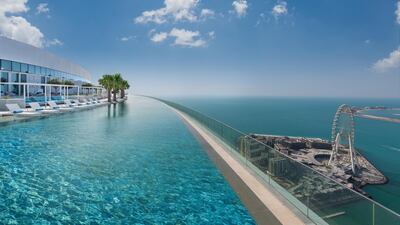
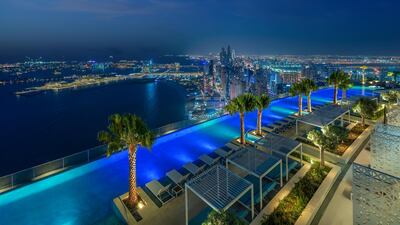
Dubai's Address Beach Resort earns Guinness World Record for highest infinity pool - in pictures
'Jurassic%20World%20Dominion'
%3Cp%3EDirector%3A%20Colin%20Trevorrow%3C%2Fp%3E%0A%3Cp%3EStars%3A%20Sam%20Neill%2C%20Laura%20Dern%2C%20Jeff%20Goldblum%2C%20Bryce%20Dallas%20Howard%2C%20Chris%20Pratt%3C%2Fp%3E%0A%3Cp%3ERating%3A%204%2F5%3C%2Fp%3E%0A
Mercer, the investment consulting arm of US services company Marsh & McLennan, expects its wealth division to at least double its assets under management (AUM) in the Middle East as wealth in the region continues to grow despite economic headwinds, a company official said.
Mercer Wealth, which globally has $160 billion in AUM, plans to boost its AUM in the region to $2-$3bn in the next 2-3 years from the present $1bn, said Yasir AbuShaban, a Dubai-based principal with Mercer Wealth.
“Within the next two to three years, we are looking at reaching $2 to $3 billion as a conservative estimate and we do see an opportunity to do so,” said Mr AbuShaban.
Mercer does not directly make investments, but allocates clients’ money they have discretion to, to professional asset managers. They also provide advice to clients.
“We have buying power. We can negotiate on their (client’s) behalf with asset managers to provide them lower fees than they otherwise would have to get on their own,” he added.
Mercer Wealth’s clients include sovereign wealth funds, family offices, and insurance companies among others.
From its office in Dubai, Mercer also looks after Africa, India and Turkey, where they also see opportunity for growth.
Wealth creation in Middle East and Africa (MEA) grew 8.5 per cent to $8.1 trillion last year from $7.5tn in 2015, higher than last year’s global average of 6 per cent and the second-highest growth in a region after Asia-Pacific which grew 9.9 per cent, according to consultancy Boston Consulting Group (BCG). In the region, where wealth grew just 1.9 per cent in 2015 compared with 2014, a pickup in oil prices has helped in wealth generation.
BCG is forecasting MEA wealth will rise to $12tn by 2021, growing at an annual average of 8 per cent.
Drivers of wealth generation in the region will be split evenly between new wealth creation and growth of performance of existing assets, according to BCG.
Another general trend in the region is clients’ looking for a comprehensive approach to investing, according to Mr AbuShaban.
“Institutional investors or some of the families are seeing a slowdown in the available capital they have to invest and in that sense they are looking at optimizing the way they manage their portfolios and making sure they are not investing haphazardly and different parts of their investment are working together,” said Mr AbuShaban.
Some clients also have a higher appetite for risk, given the low interest-rate environment that does not provide enough yield for some institutional investors. These clients are keen to invest in illiquid assets, such as private equity and infrastructure.
“What we have seen is a desire for higher returns in what has been a low-return environment specifically in various fixed income or bonds,” he said.
“In this environment, we have seen a de facto increase in the risk that clients are taking in things like illiquid investments, private equity investments, infrastructure and private debt, those kind of investments were higher illiquidity results in incrementally higher returns.”
The Abu Dhabi Investment Authority, one of the largest sovereign wealth funds, said in its 2016 report that has gradually increased its exposure in direct private equity and private credit transactions, mainly in Asian markets and especially in China and India. The authority’s private equity department focused on structured equities owing to “their defensive characteristics.”
Quick%20facts
%3Cul%3E%0A%3Cli%3EStorstockholms%20Lokaltrafik%20(SL)%20offers%20free%20guided%20tours%20of%20art%20in%20the%20metro%20and%20at%20the%20stations%3C%2Fli%3E%0A%3Cli%3EThe%20tours%20are%20free%20of%20charge%3B%20all%20you%20need%20is%20a%20valid%20SL%20ticket%2C%20for%20which%20a%20single%20journey%20(valid%20for%2075%20minutes)%20costs%2039%20Swedish%20krone%20(%243.75)%3C%2Fli%3E%0A%3Cli%3ETravel%20cards%20for%20unlimited%20journeys%20are%20priced%20at%20165%20Swedish%20krone%20for%2024%20hours%3C%2Fli%3E%0A%3Cli%3EAvoid%20rush%20hour%20%E2%80%93%20between%209.30%20am%20and%204.30%20pm%20%E2%80%93%20to%20explore%20the%20artwork%20at%20leisure%3C%2Fli%3E%0A%3C%2Ful%3E%0A
Real estate tokenisation project
Dubai launched the pilot phase of its real estate tokenisation project last month.
The initiative focuses on converting real estate assets into digital tokens recorded on blockchain technology and helps in streamlining the process of buying, selling and investing, the Dubai Land Department said.
Dubai’s real estate tokenisation market is projected to reach Dh60 billion ($16.33 billion) by 2033, representing 7 per cent of the emirate’s total property transactions, according to the DLD.
Bert van Marwijk factfile
Born: May 19 1952
Place of birth: Deventer, Netherlands
Playing position: Midfielder
Teams managed:
1998-2000 Fortuna Sittard
2000-2004 Feyenoord
2004-2006 Borussia Dortmund
2007-2008 Feyenoord
2008-2012 Netherlands
2013-2014 Hamburg
2015-2017 Saudi Arabia
2018 Australia
Major honours (manager):
2001/02 Uefa Cup, Feyenoord
2007/08 KNVB Cup, Feyenoord
World Cup runner-up, Netherlands
Kalra's feat
- Becomes fifth batsman to score century in U19 final
- Becomes second Indian to score century in U19 final after Unmukt Chand in 2012
- Scored 122 in youth Test on tour of England
- Bought by Delhi Daredevils for base price of two million Indian rupees (Dh115,000) in 2018 IPL auction
TO ALL THE BOYS: ALWAYS AND FOREVER
Directed by: Michael Fimognari
Starring: Lana Condor and Noah Centineo
Two stars
GIANT REVIEW
Starring: Amir El-Masry, Pierce Brosnan
Director: Athale
Rating: 4/5
Palestine and Israel - live updates
BUNDESLIGA FIXTURES
Friday Stuttgart v Cologne (Kick-off 10.30pm UAE)
Saturday RB Leipzig v Hertha Berlin (5.30pm)
Mainz v Borussia Monchengladbach (5.30pm)
Bayern Munich v Eintracht Frankfurt (5.30pm)
Union Berlin v SC Freiburg (5.30pm)
Borussia Dortmund v Schalke (5.30pm)
Sunday Wolfsburg v Arminia (6.30pm)
Werder Bremen v Hoffenheim (9pm)
Bayer Leverkusen v Augsburg (11.30pm)
The language of diplomacy in 1853
Treaty of Peace in Perpetuity Agreed Upon by the Chiefs of the Arabian Coast on Behalf of Themselves, Their Heirs and Successors Under the Mediation of the Resident of the Persian Gulf, 1853
(This treaty gave the region the name “Trucial States”.)
We, whose seals are hereunto affixed, Sheikh Sultan bin Suggar, Chief of Rassool-Kheimah, Sheikh Saeed bin Tahnoon, Chief of Aboo Dhebbee, Sheikh Saeed bin Buyte, Chief of Debay, Sheikh Hamid bin Rashed, Chief of Ejman, Sheikh Abdoola bin Rashed, Chief of Umm-ool-Keiweyn, having experienced for a series of years the benefits and advantages resulting from a maritime truce contracted amongst ourselves under the mediation of the Resident in the Persian Gulf and renewed from time to time up to the present period, and being fully impressed, therefore, with a sense of evil consequence formerly arising, from the prosecution of our feuds at sea, whereby our subjects and dependants were prevented from carrying on the pearl fishery in security, and were exposed to interruption and molestation when passing on their lawful occasions, accordingly, we, as aforesaid have determined, for ourselves, our heirs and successors, to conclude together a lasting and inviolable peace from this time forth in perpetuity.
Taken from Britain and Saudi Arabia, 1925-1939: the Imperial Oasis, by Clive Leatherdale
RESULTS
5pm: Sheikh Mansour bin Zayed Al Nahyan Racing Festival Purebred Arabian Cup Conditions (PA) Dh 200,000 (Turf) 1,600m
Winner: Hameem, Adrie de Vries (jockey), Abdallah Al Hammadi (trainer)
5.30pm: Sheikha Fatima bint Mubarak Cup Conditions (PA) Dh 200,000 (T) 1,600m
Winner: Winked, Connor Beasley, Abdallah Al Hammadi
6pm: Sheikh Sultan bin Zayed Al Nahyan National Day Cup Listed (TB) Dh 380,000 (T) 1,600m
Winner: Boerhan, Ryan Curatolo, Nicholas Bachalard
6.30pm: Sheikh Sultan bin Zayed Al Nahyan National Day Group 3 (PA) Dh 500,000 (T) 1,600m
Winner: AF Alwajel, Tadhg O’Shea, Ernst Oertel
7pm: Sheikh Sultan bin Zayed Al Nahyan National Day Jewel Crown Group 1 (PA) Dh 5,000,000 (T) 2,200m
Winner: Messi, Pat Dobbs, Timo Keersmaekers
7.30pm: Sheikh Mansour bin Zayed Al Nahyan Racing Festival Handicap (PA) Dh 150,000 (T) 1,400m
Winner: Harrab, Ryan Curatolo, Jean de Roualle
8pm: Wathba Stallions Cup Handicap (PA) Dh 100,000 (T) 1,400m
Winner: AF Alareeq, Connor Beasley, Ahmed Al Mehairbi