


The hotel market in the Middle East has emerged as the strongest in the world this year judging by industry performance metrics such as occupancy, revenue per available room (RevPar) and average room rate, according to hospitality data analytics firm STR.
Regional hotels' average room rate reached $160 year-to-date in 2023, compared to $142 for US hotels, $141 for European hotels and $90 for their Asia-Pacific counterpart, according to Philip Wooller, area director for the Middle East and Africa at STR.
Average room rate for hotels in Dubai, the Middle East's travel and tourism hub, exceeded the regional average with $171, while occupancy reached 76 per cent, he said at the Dubai Lodging Outlook event held in partnership with STR on Monday.
Abu Dhabi hotels' average room rates reached $130, while occupancy reached 70 per cent in the year-to-date period of 2023.
Jeddah took the region's top spot with its hotels recording an average room rate of $220, according to data by London-based STR.
“As it stands, you can argue that the Middle East is the strongest hotel market in the world,” Mr Wooller said.
The Middle East's tourism sector has recorded the strongest post-pandemic rebound in the world despite persistent global economic headwinds, according to an August report by HSBC.
The region, home to the biggest Arab economy Saudi Arabia and the global leisure and commercial hub of the UAE, is unique in recording a “total recovery” in terms of tourist arrivals in the first quarter of 2023, the bank said.
The number of tourist arrivals to the Middle East in the first three months of this year climbed 15 per cent on the levels recorded in 2019.
HSBC said the Middle East has the highest share of gross domestic product from tourism globally, at 5 per cent, suggesting that “the region may reap the rewards of the ongoing recovery in the year ahead”.
In Dubai, hotels' RevPar growth is forecast at 1.6 per cent year-on-year for 2023, according to Kelsey Fenerty, analytics manager at STR.
This growth has been largely driven by occupancy, which is expected to return to its long-run average this year even as the full-year average daily rate (ADR) has declined relative to 2022, she said.
For 2024, STR projects Dubai hotels' RevPar growth of 1.9 per cent year-over-year, with growth more balanced between occupancy and ADR, Ms Fenerty said.
The number of international visitors to Dubai exceeded the pre-Covid-19 pandemic levels in the first half of 2023 as the emirate's hospitality and tourism sector posted a record performance.
International visits to Dubai rose 20 per cent on an annual basis in the January to June period, the Dubai Media Office said in August, citing the latest data from Dubai’s Department of Economy and Tourism (DET).
The emirate welcomed 8.55 million international visitors during the period, the best first-half performance yet, exceeding the pre-pandemic figure of 8.36 million tourists in the first half of 2019.
Growth in the UAE's hospitality and tourism industry comes on the back of the country's economic growth of 3.8 per cent on an annual basis in the first quarter of this year, boosted by its strong non-oil sector.
The UAE's Brics membership will also help the country to pursue its annual growth target of 7 per cent or more and double the size of its economy by 2031, Abdulla bin Touq, the Minister of Economy, said last month.
Saudi Arabia, the Arab world's largest economy, grew by 1.2 per cent in the second quarter of this year, a slightly faster pace than the initial estimates, driven by a sharp expansion in the non-oil sector.
The kingdom is developing non-oil sectors such as entertainment, culture and sports to create jobs, boost quality of life, lure high-skilled talent and attract tourists.
The move is part of the Saudi Vision 2030 strategy that seeks to reduce the country's dependence on oil, overhaul the economy, build new industries and invest in existing high-value sectors. That economic transformation includes investing billions of dollars to develop the country's tourism sector, entertainment infrastructure and its aviation industry.
-
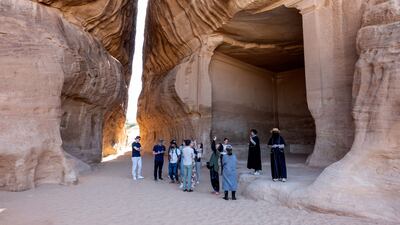
Tourists take a tour of the ancient Nabataean site of Hegra in AlUla, Saudi Arabia. Bloomberg -
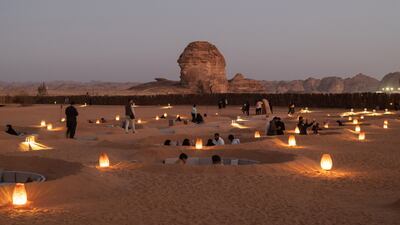
Outdoor seating at the Harrat Viewpoint in AlUla. Bloomberg -
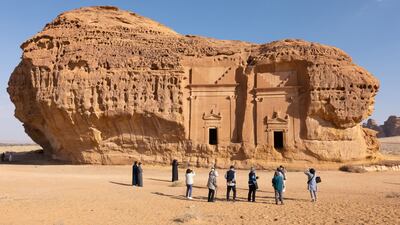
Hegra’s Tomb of Lihyan in AlUla. Bloomberg -
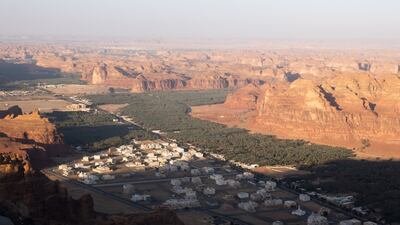
The ancient archeological site of AlUla is seen from the Harrat Viewpoint. Bloomberg -
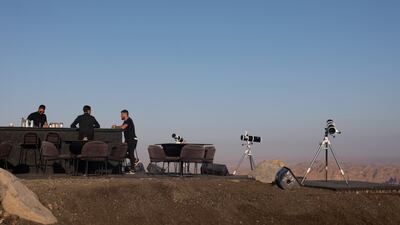
Staff of the Okto restaurant at the Harrat Viewpoint observation site. Bloomberg -
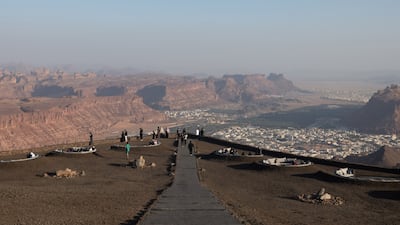
Tourists at the Harrat Viewpoint. Bloomberg -
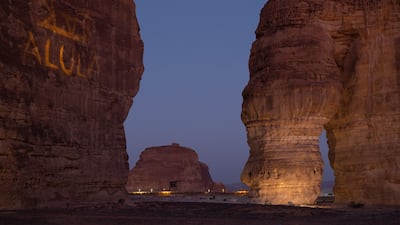
Evening illuminations at the Elephant Rock site, also known as Jabal Alfil. Bloomberg -
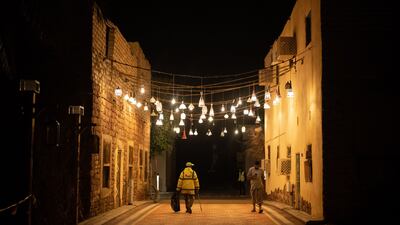
The restored Old Town of AlUla. Bloomberg -
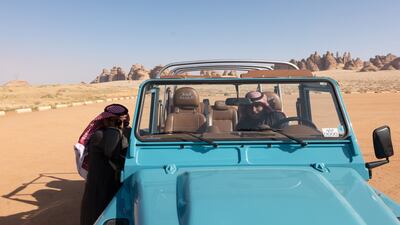
Private drivers wait for tourists. Bloomberg -

An ice cream van parked at the ancient archeological site. AFP



