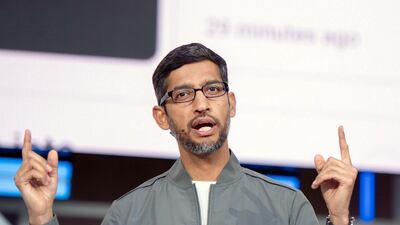
Google chief executive Sundar Pichai said Covid-19 pandemic has forced the company to rethink its strategy. AFP

Google to invest $10bn in India to accelerate digital economy


Alkesh Sharma
  • English
  • Arabic

Google will invest $10 billion (Dh36.7bn) in India to help the South Asian country accelerate the development of its digital economy, the company’s chief executive Sundar Pichai said on Monday.

The Google for India Digitisation Fund will see the Alphabet-owned company invest the sum over the next five to seven years.

"This is a reflection of our confidence in the future of India and its digital economy," Mr Pichai said.

“Today, people in India no longer have to wait for technology … a whole new generation of technologies are happening in India first.”

The California-based company said the investment will be made through a mix of equity investments and partnerships, as well as operational, infrastructure and ecosystem upgrades. It will focus on four areas crucial to India’s digitisation journey.

These include enabling affordable access and information for every Indian in their own local language, building new products and services relevant to local needs, empowering businesses and leveraging technology and artificial intelligence in areas for social good such as health, education and agriculture.

Mr Pichai, who was born and educated in India, said there is a huge scope for digital growth in India, which is home to more than 1.3 billion population.

“Just four years ago, only one-third of all small businesses had an online presence … today, 26 million SMBs are now discoverable on Search and Maps, driving connections with more than 150 million users every month.”

Low-cost smartphones, affordable internet data and a large telecoms infrastructure have paved the way for new opportunities, he added.

Mr Pichai said the Covid-19 pandemic has forced the company to rethink “how we work and how we live”.

“There’s no question we are facing a difficult moment today … but times of challenge can lead to incredible moments of innovation. Our goal is to ensure India not only benefits from the next wave of innovation, but leads it,” he said.

Google, like other technology giants, is eyeing a share of India's booming internet market. The country has more than 500 million internet users and more than 450 million active smartphone users, according to the Internet and Mobile Association of India.

Such massive potential has led Google's rivals Facebook and Amazon to plough billions into the country's internet economy. Facebook invested $5.7bn in Reliance's Jio Platforms in April while Amazon committed to invest $1bn in India in January.

Google, which launched in India in 2004, has also successfully rolled out several of its services like Google Pay and literacy programme Internet Sathi in the country.

The search engine giant's investment comes as Prime Minister Narendra Modi's Digital India initiative looks to promote adoption of digital services across the country.

Mr Pichai said on Monday that Google continues to see a massive opportunity in India for innovation.

"There’s still more work to do in order to make the internet affordable and useful for a billion Indians … from improving voice input and computing for all of India’s languages, to inspiring and supporting a whole new generation of entrepreneurs," he said.


Founders: Abdulmajeed Alsukhan, Turki Bin Zarah and Abdulmohsen Albabtain.

Based: Riyadh

Offices: UAE, Vietnam and Germany

Founded: September, 2020

Number of employees: 70

Sector: FinTech, online payment solutions

Funding to date: $116m in two funding rounds  

Investors: Checkout.com, Impact46, Vision Ventures, Wealth Well, Seedra, Khwarizmi, Hala Ventures, Nama Ventures and family offices

COMPANY PROFILE
Name: HyperSpace
 
Started: 2020
 
Founders: Alexander Heller, Rama Allen and Desi Gonzalez
 
Based: Dubai, UAE
 
Sector: Entertainment 
 
Number of staff: 210 
 
Investment raised: $75 million from investors including Galaxy Interactive, Riyadh Season, Sega Ventures and Apis Venture Partners
How to wear a kandura

Dos

  • Wear the right fabric for the right season and occasion 
  • Always ask for the dress code if you don’t know
  • Wear a white kandura, white ghutra / shemagh (headwear) and black shoes for work 
  • Wear 100 per cent cotton under the kandura as most fabrics are polyester

Don’ts 

  • Wear hamdania for work, always wear a ghutra and agal 
  • Buy a kandura only based on how it feels; ask questions about the fabric and understand what you are buying
THE BIO

Favourite car: Koenigsegg Agera RS or Renault Trezor concept car.

Favourite book: I Am Pilgrim by Terry Hayes or Red Notice by Bill Browder.

Biggest inspiration: My husband Nik. He really got me through a lot with his positivity.

Favourite holiday destination: Being at home in Australia, as I travel all over the world for work. It’s great to just hang out with my husband and family.


Ten tax points to be aware of in 2026

1. Domestic VAT refund amendments: request your refund within five years

If a business does not apply for the refund on time, they lose their credit.

2. E-invoicing in the UAE

Businesses should continue preparing for the implementation of e-invoicing in the UAE, with 2026 a preparation and transition period ahead of phased mandatory adoption. 

3. More tax audits

Tax authorities are increasingly using data already available across multiple filings to identify audit risks. 

4. More beneficial VAT and excise tax penalty regime

Tax disputes are expected to become more frequent and more structured, with clearer administrative objection and appeal processes. The UAE has adopted a new penalty regime for VAT and excise disputes, which now mirrors the penalty regime for corporate tax.

5. Greater emphasis on statutory audit

There is a greater need for the accuracy of financial statements. The International Financial Reporting Standards standards need to be strictly adhered to and, as a result, the quality of the audits will need to increase.

6. Further transfer pricing enforcement

Transfer pricing enforcement, which refers to the practice of establishing prices for internal transactions between related entities, is expected to broaden in scope. The UAE will shortly open the possibility to negotiate advance pricing agreements, or essentially rulings for transfer pricing purposes. 

7. Limited time periods for audits

Recent amendments also introduce a default five-year limitation period for tax audits and assessments, subject to specific statutory exceptions. While the standard audit and assessment period is five years, this may be extended to up to 15 years in cases involving fraud or tax evasion. 

8. Pillar 2 implementation 

Many multinational groups will begin to feel the practical effect of the Domestic Minimum Top-Up Tax (DMTT), the UAE's implementation of the OECD’s global minimum tax under Pillar 2. While the rules apply for financial years starting on or after January 1, 2025, it is 2026 that marks the transition to an operational phase.

9. Reduced compliance obligations for imported goods and services

Businesses that apply the reverse-charge mechanism for VAT purposes in the UAE may benefit from reduced compliance obligations. 

10. Substance and CbC reporting focus

Tax authorities are expected to continue strengthening the enforcement of economic substance and Country-by-Country (CbC) reporting frameworks. In the UAE, these regimes are increasingly being used as risk-assessment tools, providing tax authorities with a comprehensive view of multinational groups’ global footprints and enabling them to assess whether profits are aligned with real economic activity. 

Contributed by Thomas Vanhee and Hend Rashwan, Aurifer