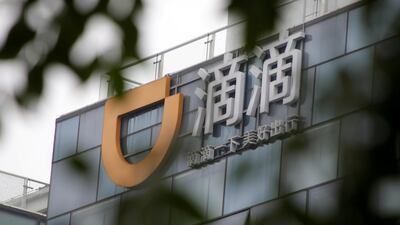
Didi Chuxing's headquarters in Beijing. The company is shying away from a New York listing and looking at a Hong Kong IPO that may value it at more than $60 billion. Reuters

China's Didi eyes 2021 Hong Kong IPO with more than $60bn valuation


  • English
  • Arabic

China's top ride-hailing firm Didi Chuxing is considering Hong Kong for a multibillion-dollar initial public offering next year, dropping previous aims to list in New York amid rising Sino-US tension, people with knowledge of the matter said.

Didi, backed by technology investment giants SoftBank, Alibaba and Tencent, has started initial talks with investment banks for the long-awaited IPO, according to three people. It's looking to formally appoint lead banks for the float in the coming months, two of them said.

The people spoke on condition of anonymity as the information, including the identity of the banks, was private.

The people said Didi is targeting a valuation of more than $60 billion by the time of IPO launch, expected as soon as in the first half of 2021. Founded eight years ago, Didi began generating healthy profit in the second quarter this year and some investors are now keen to cash in, said one of the people.

Didi is also considering a new fundraising round ahead of the IPO in a bid to boost its valuation, two of the people said. In the private secondary market, some of its shares are trading well below a valuation of $56bn it reached in 2017.

The new timetable for the IPO and the private fundraising round ahead of it have not been reported before.

Asked by Reuters to comment, Didi said it doesn't have any "definitive" IPO plan or timeline. The people familiar with the matter cautioned the IPO plan could change due to market conditions.

The plan also comes after Didi walked away from talks on merging with domestic rival Meituan, according to four separate sources, amid disagreement on the valuation of the merged business and management lines. These four people declined to be identified because the information was private.

Meituan declined to comment. Didi said it had not engaged in any merger discussion with Meituan.

Didi, which merged with then main rival Kuaidi in 2015 to create a smartphone-based transport services giant, counts as its core business a mobile app, where users can hail taxis, privately owned cars, car-pool options and even buses in some cities.

Didi had for years aimed for a US IPO because of the prestige of a New York listing, the presence of comparable peers like Uber and Lyft and a deeper capital pool, according to two of the people.

Uber and Didi have long-standing links: Uber in 2016 sold its operation to Didi in exchange for a 17.5 per cent stake in the Chinese firm, which in turn made a $1bn investment in Uber.

All three people familiar with the matter said Didi has now opted to consider Hong Kong for the listing amid deteriorating US-China relations that have left tech firms like TikTok owner ByteDance in the crosshairs.

US-listed Chinese companies now also face tightened scrutiny and stricter audit requirements there.

Uninspiring stock performances by Uber and Lyft have also discouraged Didi from seeking a US IPO, said two of the people. Uber and Lyft are both trading below their IPO price, with Lyft shares down more than two-thirds since listing.

If completed, Didi's IPO would further burnish Hong Kong's status as a capital markets hub, with $28.8bn worth of IPOs and secondary listings carried out in the city between the start of this year and mid-October, Refinitiv data showed.

That helped Hong Kong grab the second spot in the global stock exchange league table - after Nasdaq - despite the city reeling from a coronavirus pandemic-hit economy and anti-government protests.

Didi's listing plan comes as Ant Group prepares to raise about $35bn in a dual listing in Hong Kong and Shanghai in the coming weeks, in what would be the world's largest IPO.


How%20to%20avoid%20getting%20scammed
%3Cul%3E%0A%3Cli%3ENever%20click%20on%20links%20provided%20via%20app%20or%20SMS%2C%20even%20if%20they%20seem%20to%20come%20from%20authorised%20senders%20at%20first%20glance%3C%2Fli%3E%0A%3Cli%3EAlways%20double-check%20the%20authenticity%20of%20websites%3C%2Fli%3E%0A%3Cli%3EEnable%20Two-Factor%20Authentication%20(2FA)%20for%20all%20your%20working%20and%20personal%20services%3C%2Fli%3E%0A%3Cli%3EOnly%20use%20official%20links%20published%20by%20the%20respective%20entity%3C%2Fli%3E%0A%3Cli%3EDouble-check%20the%20web%20addresses%20to%20reduce%20exposure%20to%20fake%20sites%20created%20with%20domain%20names%20containing%20spelling%20errors%3C%2Fli%3E%0A%3C%2Ful%3E%0A
Sly%20Cooper%20and%20the%20Thievius%20Raccoonus
%3Cp%3E%3Cstrong%3EDeveloper%3A%3C%2Fstrong%3E%20Sucker%20Punch%20Productions%3Cbr%3E%3Cstrong%3EPublisher%3A%3C%2Fstrong%3E%20Sony%20Computer%20Entertainment%3Cbr%3E%3Cstrong%3EConsole%3A%3C%2Fstrong%3E%20PlayStation%202%20to%205%3Cbr%3E%3Cstrong%3ERating%3A%3C%2Fstrong%3E%205%2F5%3C%2Fp%3E%0A
In numbers: China in Dubai

The number of Chinese people living in Dubai: An estimated 200,000

Number of Chinese people in International City: Almost 50,000

Daily visitors to Dragon Mart in 2018/19: 120,000

Daily visitors to Dragon Mart in 2010: 20,000

Percentage increase in visitors in eight years: 500 per cent

What is blockchain?

Blockchain is a form of distributed ledger technology, a digital system in which data is recorded across multiple places at the same time. Unlike traditional databases, DLTs have no central administrator or centralised data storage. They are transparent because the data is visible and, because they are automatically replicated and impossible to be tampered with, they are secure.

The main difference between blockchain and other forms of DLT is the way data is stored as ‘blocks’ – new transactions are added to the existing ‘chain’ of past transactions, hence the name ‘blockchain’. It is impossible to delete or modify information on the chain due to the replication of blocks across various locations.

Blockchain is mostly associated with cryptocurrency Bitcoin. Due to the inability to tamper with transactions, advocates say this makes the currency more secure and safer than traditional systems. It is maintained by a network of people referred to as ‘miners’, who receive rewards for solving complex mathematical equations that enable transactions to go through.

However, one of the major problems that has come to light has been the presence of illicit material buried in the Bitcoin blockchain, linking it to the dark web.

Other blockchain platforms can offer things like smart contracts, which are automatically implemented when specific conditions from all interested parties are reached, cutting the time involved and the risk of mistakes. Another use could be storing medical records, as patients can be confident their information cannot be changed. The technology can also be used in supply chains, voting and has the potential to used for storing property records.