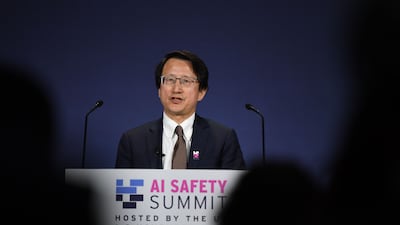
Despite his fears over the rise of AI, Elon Musk said 'we can aspire to guide it in a direction that's beneficial to humanity'. Reuters

Elon Musk: AI poses major threat to humanity


Gillian Duncan
  • English
  • Arabic

Artificial intelligence could spell the end of humanity, Elon Musk warned at the world’s first summit on AI safety.

The billionaire said he believes the technology poses an “existential risk” because it will be the first time in history that humans will have faced anything more intelligent than themselves.

He issued the stark warning on Wednesday at the event at Bletchley Park, where British codebreakers, including Alan Turing, used early forms of computer intelligence to break the Enigma code used by the Nazis during the Second World War.

Delegates agreed on a world-first statement – the Bletchley Declaration on AI Safety - which warned of "particular safety risks" at the frontier of general-purpose AI that can perform a wide variety of tasks.

In total, 27 government representatives are attending the summit, including from the UAE, Canada, China, France, Germany, the US and India. US Vice President Kamala Harris made a separate speech in London calling for AI to be used "in service of the public interest" and warning it was capable of both "profound good" and "profound harm".

"I think AI is one of the biggest threats [to humans],” Mr Musk said while attending the summit organised by UK Prime Minister Rishi Sunak.

"We have for the first time the situation where we have something that is going to be far smarter than the smartest human.

"We're not stronger or faster than other creatures but we are more intelligent and here we are for the first time, really in human history, with something that is going to be far more intelligent than us.

"It's not clear to me if we can control such a thing but I think we can aspire to guide it in a direction that's beneficial to humanity.

"But I do think it's one of the existential risks that we face and it is potentially the most pressing one if you look at the timescale and rate of advancement – the summit is timely and I applaud the Prime Minister for holding it."

Mr Musk added that he hoped the two-day summit could be used to establish an "international consensus" on insight into AI, so that a "third-party referee" could be established in the sector "who can observe what leading AI companies are doing and at least sound the alarm if they have concerns".

His comments came amid concerns raised by King Charles in a video message opening the two-day summit, who said AI poses opportunities but also "significant risks" that must be addressed urgently.

He likened the "rapid rise of powerful artificial intelligence" to the world's greatest scientific breakthroughs and spoke of its transformational potential.

The AI Safety Summit at Bletchley Park - in pictures

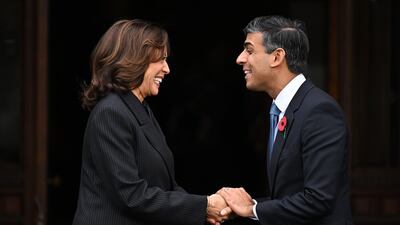
  • British Prime Minister Rishi Sunak greets US Vice President Kamala Harris on the second day of the UK's Artificial Intelligence Safety Summit at Bletchley Park. Getty Images
    British Prime Minister Rishi Sunak greets US Vice President Kamala Harris on the second day of the UK's Artificial Intelligence Safety Summit at Bletchley Park. Getty Images
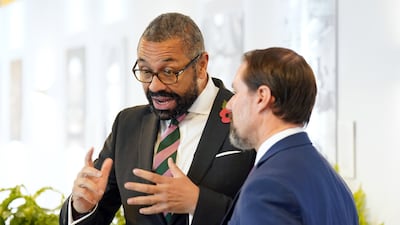
  • British Foreign Secretary James Cleverly talks to an attendee. The summit is being attended by industry leaders and government officials. PA
    British Foreign Secretary James Cleverly talks to an attendee. The summit is being attended by industry leaders and government officials. PA
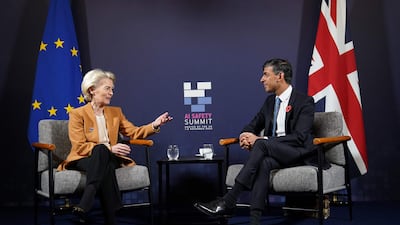
  • Mr Sunak speaks with President of the European Commission Ursula von der Leyen. AFP
    Mr Sunak speaks with President of the European Commission Ursula von der Leyen. AFP
  • Mr Sunak welcomes Italy's Prime Minister Giorgia Meloni. PA
    Mr Sunak welcomes Italy's Prime Minister Giorgia Meloni. PA
  • UN Secretary General Antonio Guterres with Mr Sunak. Getty Images
    UN Secretary General Antonio Guterres with Mr Sunak. Getty Images
  • Mr Sunak arrives at Bletchley Park on day two of the summit. EPA
    Mr Sunak arrives at Bletchley Park on day two of the summit. EPA
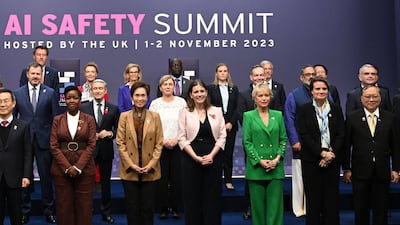
  • Michelle Donelan, front centre, UK Secretary of State for Science, Innovation and Technology, with international digital ministers at the start of the AI Safety Summit. Getty Images
    Michelle Donelan, front centre, UK Secretary of State for Science, Innovation and Technology, with international digital ministers at the start of the AI Safety Summit. Getty Images
  • King Charles III addresses delegates in a recorded video message. AP
    King Charles III addresses delegates in a recorded video message. AP
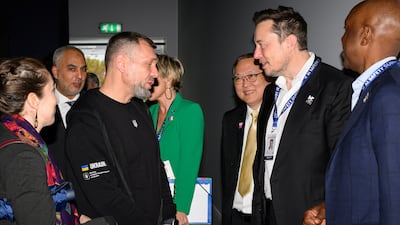
  • Ukraine's Deputy Minister for Digital Transformation, Georgii Dubynskyi, speaks to Elon Musk, owner of SpaceX, Tesla and X. Reuters
    Ukraine's Deputy Minister for Digital Transformation, Georgii Dubynskyi, speaks to Elon Musk, owner of SpaceX, Tesla and X. Reuters
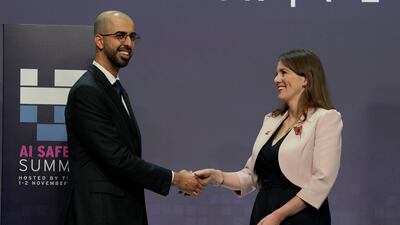
  • Ms Donelan with Omar Al Olama, UAE Minister of State for AI, Digital Economy and Remote Work Applications. AP
    Ms Donelan with Omar Al Olama, UAE Minister of State for AI, Digital Economy and Remote Work Applications. AP
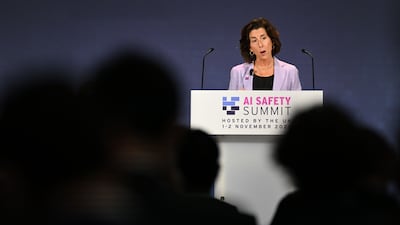
  • US Secretary of Commerce Gina Raimondo. Getty Images
    US Secretary of Commerce Gina Raimondo. Getty Images
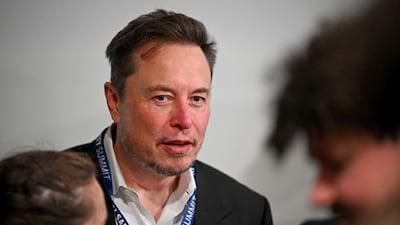
  • Mr Musk attends the first plenary session of the AI Safety Summit at Bletchley Park. PA
    Mr Musk attends the first plenary session of the AI Safety Summit at Bletchley Park. PA
  • Ms Donelan greets Georgii Dubynskyi, Ukraine's Deputy Minister for Digital Transformation. PA
    Ms Donelan greets Georgii Dubynskyi, Ukraine's Deputy Minister for Digital Transformation. PA
  • Wu Zhaohui, China's vice minister of science and technology, addresses the AI Safety Summit. Bloomberg
    Wu Zhaohui, China's vice minister of science and technology, addresses the AI Safety Summit. Bloomberg
  • Bletchley Park, home of Britain's codebreakers during the Second World War, on the first day of the AI Safety Summit. Getty Images
    Bletchley Park, home of Britain's codebreakers during the Second World War, on the first day of the AI Safety Summit. Getty Images

In footage recorded at Buckingham Palace before he left for his state visit to Kenya, the king said: "We are witnessing one of the greatest technological leaps in the history of human endeavour.

"The rapid rise of powerful artificial intelligence is considered by many of the greatest thinkers of our age to be no less significant, no less important, than the discovery of electricity, the splitting of the atom, the creation of the worldwide web, or even the harnessing of fire."

He added: "AI holds the potential to completely transform life as we know it to help us better treat, and perhaps even cure, conditions like cancer, heart disease and Alzheimer's; to hasten our journey towards net zero and realise a new era of potentially limitless clean, green energy – even just to help us make our everyday lives a bit easier.

"However, if we are to realise the untold benefits of AI, then we must work together on combating its significant risks too."

King Charles thanked those attending for laying the foundation for a consensus to ensure "this immensely powerful technology is, indeed, a force for good in this world".

He said transitions such as AI always presented "profound challenges, especially in preparing for unintended consequences".

Earlier, the UK's Secretary of State for Science, Innovation and Technology, Michelle Donelan, said the summit would open the door to a new age of AI.

Bletchley Park - in pictures

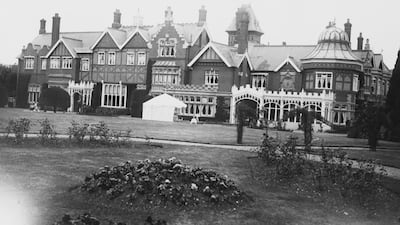
  • Bletchley Park, pictured in 1926, became the centre of allied code-breaking activities during the Second World War, where Germany's Enigma and Lorenz codes, both considered unbreakable, were deciphered. All photos: Getty Images
    Bletchley Park, pictured in 1926, became the centre of allied code-breaking activities during the Second World War, where Germany's Enigma and Lorenz codes, both considered unbreakable, were deciphered. All photos: Getty Images
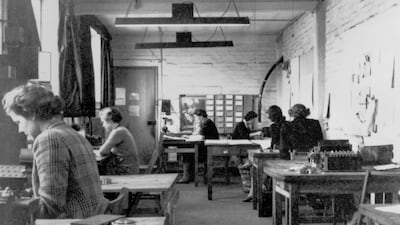
  • The machine room in hut six of Bletchley Park in 1943. Cryptographers at the centre intercepted and deciphered top-secret military communiques between Hitler and his armed forces
    The machine room in hut six of Bletchley Park in 1943. Cryptographers at the centre intercepted and deciphered top-secret military communiques between Hitler and his armed forces
  • The control panels of Colossus, the world's first electronic programmable computer, at Bletchley Park in 1943. Codebreakers at Bletchley cracked Germany's Lorenz code with the help of Colossus
    The control panels of Colossus, the world's first electronic programmable computer, at Bletchley Park in 1943. Codebreakers at Bletchley cracked Germany's Lorenz code with the help of Colossus
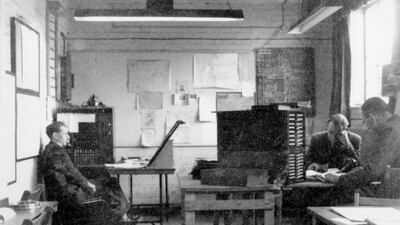
  • The intercept control room in hut six at Bletchley Park in 1943
    The intercept control room in hut six at Bletchley Park in 1943
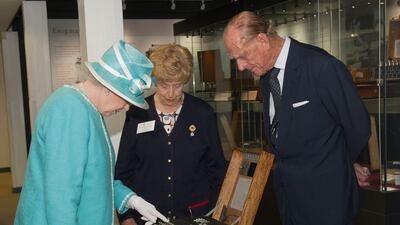
  • Queen Elizabeth II presses the button to start the enigma codebreaking machine as Prince Philip, Duke of Edinburgh, and wartime operator Ruth Bourne look on during a visit to Bletchley Park in 2011
    Queen Elizabeth II presses the button to start the enigma codebreaking machine as Prince Philip, Duke of Edinburgh, and wartime operator Ruth Bourne look on during a visit to Bletchley Park in 2011
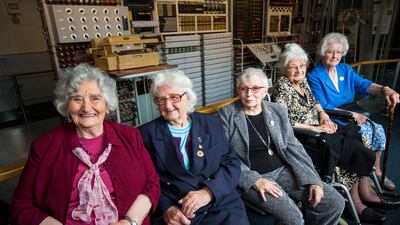
  • Former 'Wrens' and Colossus operators at Bletchley Park in 2016
    Former 'Wrens' and Colossus operators at Bletchley Park in 2016
  • Jacqui Garrad, the commercial director at The National Museum of Computing, demonstrates how Colossus was used
    Jacqui Garrad, the commercial director at The National Museum of Computing, demonstrates how Colossus was used
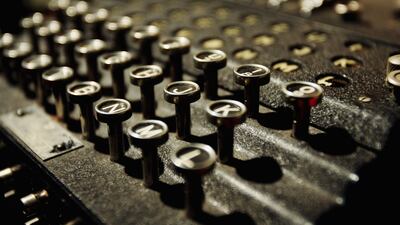
  • The Enigma coding machine that was used by the Germans during the Second World War
    The Enigma coding machine that was used by the Germans during the Second World War

Mercer, the investment consulting arm of US services company Marsh & McLennan, expects its wealth division to at least double its assets under management (AUM) in the Middle East as wealth in the region continues to grow despite economic headwinds, a company official said.

Mercer Wealth, which globally has $160 billion in AUM, plans to boost its AUM in the region to $2-$3bn in the next 2-3 years from the present $1bn, said Yasir AbuShaban, a Dubai-based principal with Mercer Wealth.

Within the next two to three years, we are looking at reaching $2 to $3 billion as a conservative estimate and we do see an opportunity to do so,” said Mr AbuShaban.

Mercer does not directly make investments, but allocates clients’ money they have discretion to, to professional asset managers. They also provide advice to clients.

“We have buying power. We can negotiate on their (client’s) behalf with asset managers to provide them lower fees than they otherwise would have to get on their own,” he added.

Mercer Wealth’s clients include sovereign wealth funds, family offices, and insurance companies among others.

From its office in Dubai, Mercer also looks after Africa, India and Turkey, where they also see opportunity for growth.

Wealth creation in Middle East and Africa (MEA) grew 8.5 per cent to $8.1 trillion last year from $7.5tn in 2015, higher than last year’s global average of 6 per cent and the second-highest growth in a region after Asia-Pacific which grew 9.9 per cent, according to consultancy Boston Consulting Group (BCG). In the region, where wealth grew just 1.9 per cent in 2015 compared with 2014, a pickup in oil prices has helped in wealth generation.

BCG is forecasting MEA wealth will rise to $12tn by 2021, growing at an annual average of 8 per cent.

Drivers of wealth generation in the region will be split evenly between new wealth creation and growth of performance of existing assets, according to BCG.

Another general trend in the region is clients’ looking for a comprehensive approach to investing, according to Mr AbuShaban.

“Institutional investors or some of the families are seeing a slowdown in the available capital they have to invest and in that sense they are looking at optimizing the way they manage their portfolios and making sure they are not investing haphazardly and different parts of their investment are working together,” said Mr AbuShaban.

Some clients also have a higher appetite for risk, given the low interest-rate environment that does not provide enough yield for some institutional investors. These clients are keen to invest in illiquid assets, such as private equity and infrastructure.

“What we have seen is a desire for higher returns in what has been a low-return environment specifically in various fixed income or bonds,” he said.

“In this environment, we have seen a de facto increase in the risk that clients are taking in things like illiquid investments, private equity investments, infrastructure and private debt, those kind of investments were higher illiquidity results in incrementally higher returns.”

The Abu Dhabi Investment Authority, one of the largest sovereign wealth funds, said in its 2016 report that has gradually increased its exposure in direct private equity and private credit transactions, mainly in Asian markets and especially in China and India. The authority’s private equity department focused on structured equities owing to “their defensive characteristics.”

Frankenstein in Baghdad
Ahmed Saadawi
​​​​​​​Penguin Press

CREW
%3Cp%3E%3Cstrong%3EDirector%3A%20%3C%2Fstrong%3ERajesh%20A%20Krishnan%3C%2Fp%3E%0A%3Cp%3E%3Cstrong%3EStarring%3A%20%3C%2Fstrong%3ETabu%2C%20Kareena%20Kapoor%20Khan%2C%20Kriti%20Sanon%26nbsp%3B%3C%2Fp%3E%0A%3Cp%3E%3Cstrong%3ERating%3A%3C%2Fstrong%3E%203.5%2F5%3C%2Fp%3E%0A
Tax authority targets shisha levy evasion

The Federal Tax Authority will track shisha imports with electronic markers to protect customers and ensure levies have been paid.

Khalid Ali Al Bustani, director of the tax authority, on Sunday said the move is to "prevent tax evasion and support the authority’s tax collection efforts".

The scheme’s first phase, which came into effect on 1st January, 2019, covers all types of imported and domestically produced and distributed cigarettes. As of May 1, importing any type of cigarettes without the digital marks will be prohibited.

He said the latest phase will see imported and locally produced shisha tobacco tracked by the final quarter of this year.

"The FTA also maintains ongoing communication with concerned companies, to help them adapt their systems to meet our requirements and coordinate between all parties involved," he said.

As with cigarettes, shisha was hit with a 100 per cent tax in October 2017, though manufacturers and cafes absorbed some of the costs to prevent prices doubling.

Updated: November 01, 2023, 3:37 PM