

A new artificial intelligence research lab aims to solve the field’s most pressing problems by drawing inspiration from the animal kingdom – like the movements of a school of fish or the co-ordination of a colony of bees.
As many of the top companies in the field seek to outdo each other by building ever-larger AI systems, Sakana, which takes its name from the Japanese word for fish, thinks it may be able to do more with less data.
The start-up plans to make several smaller AI models, the kind of technology that powers products like ChatGPT, and have them work together. The idea is that a “swarm” of programmes could be as smart as the massive undertakings from larger organisations.
Founded by two prominent industry researchers, former Google employees David Ha and Llion Jones, Sakana’s approach could potentially lead to AI that’s cheaper to train and use than existing technology. That includes generative AI, which has captivated Silicon Valley with its ability to spit out text and images in response to prompts.
The new venture’s approach contrasts with that of companies like OpenAI, which might feed all its data into one large AI programme, rather than a series of littler ones.
“Ants move around and dynamically form a bridge by themselves, which might not be the strongest bridge, but they can do it right away and adapt to the environments,” Mr Ha said.
“I think this sort of adaptation is one of the very powerful concepts that we see in natural algorithms.”
Mr Ha and Mr Jones are marquee names in the world of AI research.
Mr Jones, a Tokyo-based AI researcher, co-authored one of Google’s most influential papers in the field, “Attention Is All You Need”, which underpins many of today’s most popular AI products.
Mr Ha, also based in Tokyo, was previously Stability AI’s head of research. Before that, he focused on generative AI while working as a scientist at Alphabet's Google Brain in Japan.
Sakana is still in the early stages: It has not yet built an AI model and does not have an office. The plan is to open one in Tokyo soon, Mr Ha said.
The company declined to comment about its fundraising status.
But the ideas Sakana is working with are more established. Near the end of his time at Google, Mr Ha and a colleague launched a project called “sensory neurone as a transformer”, and had a fleet of small AI models to work together to play a game, rather than using one large model.
Other researchers have also taken inspiration from the workings of the human brain. The term “artificial neural networks”, for example, refers to AI models programmed to process information in a way that is roughly analogous to how people do, by using trial and error.
“The human brain still works better than our best AI,” Mr Jones said. “So, clearly the human brain is doing something right that we haven't quite caught on to yet.”
-
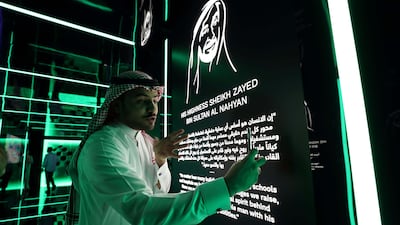
An official at the launch of Mohamed bin Zayed University of Artificial intelligence in Masdar City, Abu Dhabi. AI is central to the UAE's economic growth agenda. Chris Whiteoak / The National -
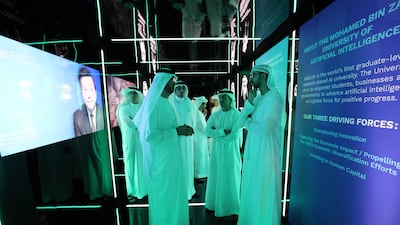
From left, Dr Sultan Al Jaber, Dr Ahmad Al Falasi and Omar Al Olama at the launch of the university. Chris Whiteoak / The National -

The university has teamed up with IBM to open a research centre at its Masdar City campus. Chris Whiteoak / The National -
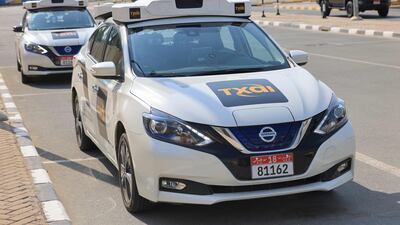
Self-driving taxis in Abu Dhabi. The UAE intends to become one of the leading AI nations by 2031. AFP -
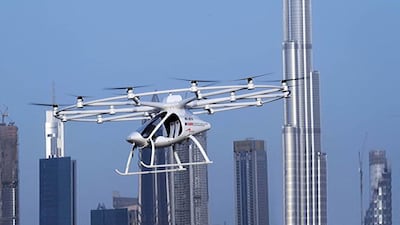
MBZUAI has developed a curriculum and programmes that support academic research to contribute to tackling real-world challenges. AFP -

A robot outside the Dutch pavilion at the Expo 2020 Dubai. New districts are being built in the UAE, with artificial intelligence at their core. AFP -

Ajman's first self-driving bus goes on its first official drive with Sheikh Rashid bin Humaid, director of the Ajman Municipality and Planning Department, and Mr Al Olama onboard. -
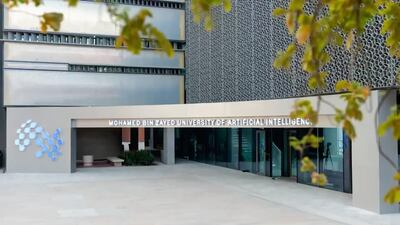
MBZUAI is the only graduate-level university in the world singularly focused on developing AI tools. Photo: MBZUAI -

Through the IBM Skills Academy programme, MBZUAI will have access to lectures, labs, industry use cases and design-thinking sessions. Photo: MBZUAI -
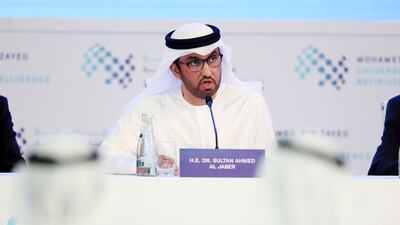
Dr Al Jaber, Minister of Industry and Advanced Technology and chairman of the MBZUAI board of trustees, has in the past emphasised the UAE's plans to use AI as a transformative tool to support its development. Chris Whiteoak / The National -

MBZUAI offers an executive programme to equip UAE government and business leaders with practical skills to tap into the benefits of cutting-edge technology. AFP


Mr Jones and Mr Ha sat near each other in Google’s Tokyo offices, and the pair stayed in touch after Mr Ha left the company. Following their years at the internet behemoth, they eventually gravitated towards start-ups.
Mr Ha’s role at Stability AI meant he was spending a lot of time building research teams, he said, and he longed to return to conducting research. And Mr Jones felt fenced in at Google.
“It’s unfortunately true to say I have so much more velocity outside of Google,” he said, noting that the need to secure approvals and resources could slow the process of working on innovative technology at a large company.
When Mr Ha suggested that they found a start-up, he said: “It just made a lot of sense to me.”

