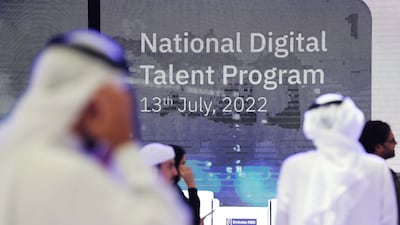
The UAE is promoting the use of technology in daily activities and transactions, and is a leader in the region on this front. Leslie Pableo / The National

Digital transformation investment in Middle East, Turkey and Africa to top $74bn by 2026


Alvin R Cabral
  • English
  • Arabic

Investments in digital transformation across the Middle East, Turkey and Africa (Meta) region is projected to surpass $74 billion by 2026, helping organisations achieve long-term stability and growth, a new study from the International Data Corporation (IDC) has found.

Spending on such initiatives is expected to grow at a compound annual rate of about 16 per cent over a five-year period through 2026, and would account for more than 43 per cent of total information and communications technology investments, the US research firm said on Thursday.

That growth rate would be more than double over the 2021-2026 period. More notably, digital transformation investments by organisations would grow eight times more than the overall economy in 2023, the IDC said.

For many organisations, the spending they initiated at the onset of the Covid-19 pandemic has put them in a better position to respond and adapt to the rapidly-changing economic landscape, said Jyoti Lalchandani, group vice president and Meta regional managing director at IDC.

"The digital and tech investments they made during the pandemic to build resilience could be put to test in 2023 across key business dimensions such as customer experience, operations and financial management, among others," he said.

"The implementation of further digitalisation in critical areas and a more rapid shift to a 'digital business' approach will be key to separating the thrivers from the survivors."

Enterprises and governments have lauded the critical role digital transformation plays in the economy and society, as the world prepares for a future largely powered by technology.

The global digital transformation market is projected to hit about $3.95 trillion by 2030, from about $608 billion last year, growing at a compound annual rate of more than 23 per cent, according to data from Grand View Research.

The UAE and Saudi Arabia, the Arab world's two biggest economies, have rolled out several initiatives to promote the use of technology in daily activities and transactions, and are leaders in the region on this front.

At least 30 per cent of the focus of executive teams will be on growing innovation and operating a truly digital business, the IDC study said.

  • Omar Al Olama, Minister of State for Digital Economy, AI and Remote Working System, speaking during the launch of Emirates NBD's National Digital Talent Programme. All photos: Pawan Singh / The National
    Omar Al Olama, Minister of State for Digital Economy, AI and Remote Working System, speaking during the launch of Emirates NBD's National Digital Talent Programme. All photos: Pawan Singh / The National
  • Guests at the launch of Emirates NBD's National Digital Talent Programme.
    Guests at the launch of Emirates NBD's National Digital Talent Programme.
  • Saud Al Dhawyani, senior VP, chief technology officer, Emirates NBD; Prof Hamid MK Al Naimiy, chancellor of the University of Sharjah; Dr Addel Al Ameri, vice president, strategy & future, Higher Colleges of Technology; Miguel Rio Tinto, group chief information officer, Emirates NBD; Saeed Ali Abdullah, Emirates NBD student; and Eman Abdulrazzaq, group chief, human resources officer, Emirates NBD.
    Saud Al Dhawyani, senior VP, chief technology officer, Emirates NBD; Prof Hamid MK Al Naimiy, chancellor of the University of Sharjah; Dr Addel Al Ameri, vice president, strategy & future, Higher Colleges of Technology; Miguel Rio Tinto, group chief information officer, Emirates NBD; Saeed Ali Abdullah, Emirates NBD student; and Eman Abdulrazzaq, group chief, human resources officer, Emirates NBD.
  • Abdulla Qassem, group chief operating officer, Emirates NBD, told 'The National' how young Emiratis would be attracted to the private sector owing to remote working conditions.
    Abdulla Qassem, group chief operating officer, Emirates NBD, told 'The National' how young Emiratis would be attracted to the private sector owing to remote working conditions.
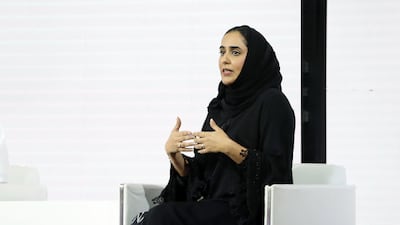
  • Eman Abdulrazzaq, group chief, human resources officer, Emirates NBD, speaking during the launch of the National Digital Talent Programme.
    Eman Abdulrazzaq, group chief, human resources officer, Emirates NBD, speaking during the launch of the National Digital Talent Programme.

Automation will be at the forefront of the process, which in turn would help reduce the cost of IT operations, address labour challenges and shortages, and increase the pace of innovation, it said.

"No matter what the economy throws at us over the coming 12 months, organisations must not lose sight of their digital aspirations," Mr Lalchandani said.

The focus should be on enabling clear and measurable outcomes, and digital spending needs to transition from building to scaling, he said.


What is blockchain?

Blockchain is a form of distributed ledger technology, a digital system in which data is recorded across multiple places at the same time. Unlike traditional databases, DLTs have no central administrator or centralised data storage. They are transparent because the data is visible and, because they are automatically replicated and impossible to be tampered with, they are secure.

The main difference between blockchain and other forms of DLT is the way data is stored as ‘blocks’ – new transactions are added to the existing ‘chain’ of past transactions, hence the name ‘blockchain’. It is impossible to delete or modify information on the chain due to the replication of blocks across various locations.

Blockchain is mostly associated with cryptocurrency Bitcoin. Due to the inability to tamper with transactions, advocates say this makes the currency more secure and safer than traditional systems. It is maintained by a network of people referred to as ‘miners’, who receive rewards for solving complex mathematical equations that enable transactions to go through.

However, one of the major problems that has come to light has been the presence of illicit material buried in the Bitcoin blockchain, linking it to the dark web.

Other blockchain platforms can offer things like smart contracts, which are automatically implemented when specific conditions from all interested parties are reached, cutting the time involved and the risk of mistakes. Another use could be storing medical records, as patients can be confident their information cannot be changed. The technology can also be used in supply chains, voting and has the potential to used for storing property records.

Need to know

The flights: Flydubai flies from Dubai to Kilimanjaro airport via Dar es Salaam from Dh1,619 return including taxes. The trip takes 8 hours. 

The trek: Make sure that whatever tour company you select to climb Kilimanjaro, that it is a reputable one. The way to climb successfully would be with experienced guides and porters, from a company committed to quality, safety and an ethical approach to the mountain and its staff. Sonia Nazareth booked a VIP package through Safari Africa. The tour works out to $4,775 (Dh17,538) per person, based on a 4-person booking scheme, for 9 nights on the mountain (including one night before and after the trek at Arusha). The price includes all meals, a head guide, an assistant guide for every 2 trekkers, porters to carry the luggage, a cook and kitchen staff, a dining and mess tent, a sleeping tent set up for 2 persons, a chemical toilet and park entrance fees. The tiny ration of heated water provided for our bath in our makeshift private bathroom stall was the greatest luxury. A standard package, also based on a 4-person booking, works out to $3,050 (Dh11,202) per person.

When to go: You can climb Kili at any time of year, but the best months to ascend  are  January-February and September-October.  Also good are July and August, if you’re tolerant of the colder weather that winter brings.

Do not underestimate the importance of kit. Even if you’re travelling at a relatively pleasant time, be geared up for the cold and the rain.

Indika
%3Cp%3E%3Cstrong%3EDeveloper%3A%3C%2Fstrong%3E%2011%20Bit%20Studios%3Cbr%3E%3Cstrong%3EPublisher%3A%3C%2Fstrong%3E%20Odd%20Meter%3Cbr%3E%3Cstrong%3EConsole%3A%3C%2Fstrong%3E%20PlayStation%205%2C%20PC%20and%20Xbox%20series%20X%2FS%3Cbr%3E%3Cstrong%3ERating%3A%3C%2Fstrong%3E%204%2F5%3C%2Fp%3E%0A
Ten tax points to be aware of in 2026

1. Domestic VAT refund amendments: request your refund within five years

If a business does not apply for the refund on time, they lose their credit.

2. E-invoicing in the UAE

Businesses should continue preparing for the implementation of e-invoicing in the UAE, with 2026 a preparation and transition period ahead of phased mandatory adoption. 

3. More tax audits

Tax authorities are increasingly using data already available across multiple filings to identify audit risks. 

4. More beneficial VAT and excise tax penalty regime

Tax disputes are expected to become more frequent and more structured, with clearer administrative objection and appeal processes. The UAE has adopted a new penalty regime for VAT and excise disputes, which now mirrors the penalty regime for corporate tax.

5. Greater emphasis on statutory audit

There is a greater need for the accuracy of financial statements. The International Financial Reporting Standards standards need to be strictly adhered to and, as a result, the quality of the audits will need to increase.

6. Further transfer pricing enforcement

Transfer pricing enforcement, which refers to the practice of establishing prices for internal transactions between related entities, is expected to broaden in scope. The UAE will shortly open the possibility to negotiate advance pricing agreements, or essentially rulings for transfer pricing purposes. 

7. Limited time periods for audits

Recent amendments also introduce a default five-year limitation period for tax audits and assessments, subject to specific statutory exceptions. While the standard audit and assessment period is five years, this may be extended to up to 15 years in cases involving fraud or tax evasion. 

8. Pillar 2 implementation 

Many multinational groups will begin to feel the practical effect of the Domestic Minimum Top-Up Tax (DMTT), the UAE's implementation of the OECD’s global minimum tax under Pillar 2. While the rules apply for financial years starting on or after January 1, 2025, it is 2026 that marks the transition to an operational phase.

9. Reduced compliance obligations for imported goods and services

Businesses that apply the reverse-charge mechanism for VAT purposes in the UAE may benefit from reduced compliance obligations. 

10. Substance and CbC reporting focus

Tax authorities are expected to continue strengthening the enforcement of economic substance and Country-by-Country (CbC) reporting frameworks. In the UAE, these regimes are increasingly being used as risk-assessment tools, providing tax authorities with a comprehensive view of multinational groups’ global footprints and enabling them to assess whether profits are aligned with real economic activity. 

Contributed by Thomas Vanhee and Hend Rashwan, Aurifer

How to avoid crypto fraud
  • Use unique usernames and passwords while enabling multi-factor authentication.
  • Use an offline private key, a physical device that requires manual activation, whenever you access your wallet.
  • Avoid suspicious social media ads promoting fraudulent schemes.
  • Only invest in crypto projects that you fully understand.
  • Critically assess whether a project’s promises or returns seem too good to be true.
  • Only use reputable platforms that have a track record of strong regulatory compliance.
  • Store funds in hardware wallets as opposed to online exchanges.
Updated: December 23, 2022, 3:30 AM