Apple's high brand loyalty and its Watch's 'excellent connection among supported iOS devices' has helped the brand dominate the market. Reuters

Global smartwatch shipments up 13% in Q1 2022 as Apple continues to dominate the market


Alvin R Cabral
  • English
  • Arabic

Global shipments of smartwatches rose 13 per cent to about 33.7 million units in the first quarter of 2022, as Apple continued to dominate the segment, a new study from Counterpoint Research showed.

The market is expected to continue its growth for the whole of this year as manufacturers develop more devices to cater to the need of those conscious about their health and well-being, the Hong Kong-based data provider said in its quarterly report on wearables on Tuesday.

However, the expansion is expected to slow down this year. While smartwatch shipments surged 28 per cent in 2021 — a multifold increase from 2 per cent in 2020 — it is projected to halve to 14 per cent at the end of 2022 and then inch up to 15 per cent next year.

The slowdown already begun in the first quarter, largely due to Russia's military offensive in Ukraine, which has disrupted supply chains and led to inflation hitting record levels.

“Although the global smartwatch market experienced little growth in 2020 due to the impact of Covid-19, it has continued to perform well since its rebound last year,” Sujeong Lim, associate director at Counterpoint, wrote in the report.

“The market was able to record rapid growth by amplifying consumers’ interest in health and fitness. During this period, new manufacturers entered the market, bringing in more models, designs and price points. This has been another factor that has enabled market growth by broadening consumer choice,” the study said.

Wearables have increasingly become part of people's daily routines, as they converge with other consumer technology devices, including smartphones, computers, home appliances and even automobiles.

The global wearable technology market is expected to hit more than $380 billion by 2028, from almost $116bn in 2021, at a compound annual growth rate of 18.5 per cent, according to research firm Facts and Factors.

Smartwatches are propelling the market's growth, as more consumers use them to track their health metrics, it said.

Counterpoint's report showed that, geographically, most major regions posted annual growth, with North America bagging the biggest market share at 29 per cent, followed by China (23 per cent), the EU (18 per cent) and the Asia-Pacific, excluding China and India (14 per cent).

Europe's performance was flat. While Apple and Samsung continued to grow in the continent, other major brands such as Fitbit and Garmin declined.

India grew the fastest, rising by more than 7 per cent. The Middle East and Africa region only had a 2 per cent share, above Latin America's 1 per cent.

The smartwatch market is expected to “regain energy” in the coming months with major brands scheduled to release new hardware, Counterpoint said.

Apple is expected to introduce the Watch Series 8 — which is said to include a new rugged high-end version — around the time of the next iPhone's launch in September.

The California-based company is projected to maintain and further increase its market share, Mr Lim said, citing Apple's high brand loyalty and the Watch's “high performance” and “excellent connection among supported iOS devices”.

.
.

“This popularity appears to be higher among the younger generation, making Apple an irreplaceable market leader … We believe that Apple’s market share is likely to rise further by the end of this year,” he said.

Samsung, meanwhile, is expected to unveil a new Galaxy Watch at its August Unpacked event, in which it will also reveal its new foldable smartphones.

But arguably the most interesting launch will come from Google, which announced its first Pixel Watch during its I/O 2022 conference in May. The device is scheduled to be released in the autumn.

“There has been a lot of market interest in the details,” Counterpoint said of the Pixel Watch.

“Although Google did not mention the price or detailed specifications, user-friendly software such as Google Maps, Google Wallet and Emergency SoS and the body designed in the shape of a circular dome are enough to be attractive options for users in many ways.”

[The Apple Watch's] popularity appears to be higher among the younger generation, making Apple an irreplaceable market leader ... we believe that Apple’s market share is likely to rise further by the end of this year
Sujeong Lim,
associate director at Counterpoint Research

Apple also continued to play a major role in the true wireless stereo (TWS) headset category, due to the popularity of its AirPods line-up.

The global TWS market grew 4 per cent annually in the first quarter of 2022, showing little volume change. However, it was more dynamic in value terms, Counterpoint said.

Devices priced between $50 and $100 fared better than low-priced products (less than $50), while ultra-premium products — those above $150 — sold more than the premium ($100 to $150) segment, as consumers are looking for more features.

“As the TWS market matures, consumers are becoming more discerning and are tending to focus on aspects important to them such as brand image, new functions, sound quality, weight and battery life, rather than simply cheap products,” Counterpoint said.

In the virtual reality (VR) headset market, the Meta Quest 2 — which was previously known as the Oculus Quest 2 — became the first VR device to cross 10 million units shipped, Counterpoint said in the report.

Meta — the parent company of Facebook and which acquired the Oculus brand in 2018 — had five VR headsets in the top eight, with a combined 18 million units shipped. The Sony PlayStation VR was second with 6.6 million, while the HTC Vive came in third with 3.3 million units.

  • Rainbow Winters, a fashion design house founded by Amy Winters, incorporates technology into the clothes. Using sensors and smart textiles that adapt in response to sounds, stretch or sunlight and water, her designs can change colour and pattern. Courtesy Amy Winters
    Rainbow Winters, a fashion design house founded by Amy Winters, incorporates technology into the clothes. Using sensors and smart textiles that adapt in response to sounds, stretch or sunlight and water, her designs can change colour and pattern. Courtesy Amy Winters
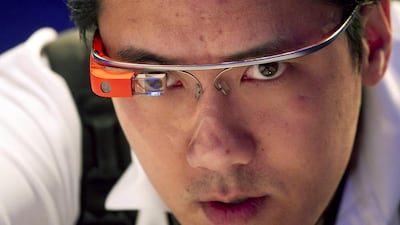
  • Vincent Nguyen of SlashGear wears a Google Glass while covering the introduction of the Microsoft Surface 2 in September. Mark Lennihan / AP Photo
    Vincent Nguyen of SlashGear wears a Google Glass while covering the introduction of the Microsoft Surface 2 in September. Mark Lennihan / AP Photo
  • For aspiring health nuts and to inspire couch potatoes to get active, any of these four fitness trackers will record not only the steps taken on any given day but also sleep patterns to calorie intake, mood and progress toward exercise goals. Richard Drew / AP Photo
    For aspiring health nuts and to inspire couch potatoes to get active, any of these four fitness trackers will record not only the steps taken on any given day but also sleep patterns to calorie intake, mood and progress toward exercise goals. Richard Drew / AP Photo
  • Panasonic’s HX-A100, a wearable camera, on display at the 2013 International Consumer Electronics Show in Las Vegas, Nevada. David Becker / Getty Images / AFP
    Panasonic’s HX-A100, a wearable camera, on display at the 2013 International Consumer Electronics Show in Las Vegas, Nevada. David Becker / Getty Images / AFP
  • UK-based designer Amy Winters, who founded fashion design house Rainbow Winters, incorporates technology into the clothes. Using sensors and smart textiles that adapt in response to sounds, stretch or sunlight and water, her designs can change colour and pattern. Courtesy Amy Winters
    UK-based designer Amy Winters, who founded fashion design house Rainbow Winters, incorporates technology into the clothes. Using sensors and smart textiles that adapt in response to sounds, stretch or sunlight and water, her designs can change colour and pattern. Courtesy Amy Winters
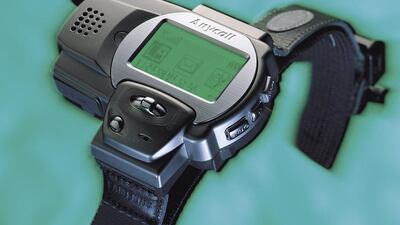
  • Samsung’s first watch phone, Samsung SPH-WP10, was made in 1999. Samsung Electronics / Handout via Reuters
    Samsung’s first watch phone, Samsung SPH-WP10, was made in 1999. Samsung Electronics / Handout via Reuters
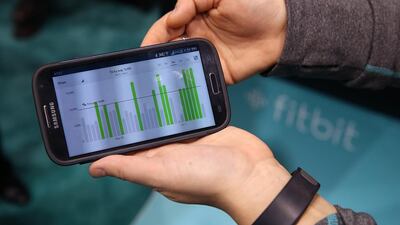
  • Data collected from the Fitbit Force is displayed on a smartphone at the 2014 International Consumer Electronics Show in Las Vegas, Nevada. Fitbit has issued a voluntary recall on its Force wristbands after reports began surfacing in January that the device was causing a painful skin irritation for some users. Justin Sullivan / Getty Images / AFP
    Data collected from the Fitbit Force is displayed on a smartphone at the 2014 International Consumer Electronics Show in Las Vegas, Nevada. Fitbit has issued a voluntary recall on its Force wristbands after reports began surfacing in January that the device was causing a painful skin irritation for some users. Justin Sullivan / Getty Images / AFP
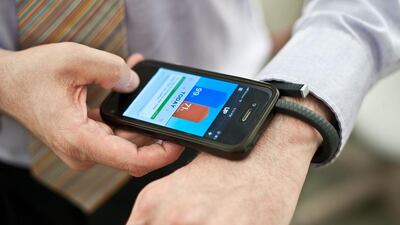
  • A man uses an UP fitness wristband and its smartphone application. Jawbone in 2012 released redesigned UP wristbands that combine fashion with smartphone lifestyles. UP apps tailored for Apple or Android mobile devices collect data from the bands to let people get pictures of activity, sleep, eating, and even moods on any given day or over time. Nicholas Kamm / AFP
    A man uses an UP fitness wristband and its smartphone application. Jawbone in 2012 released redesigned UP wristbands that combine fashion with smartphone lifestyles. UP apps tailored for Apple or Android mobile devices collect data from the bands to let people get pictures of activity, sleep, eating, and even moods on any given day or over time. Nicholas Kamm / AFP
Essentials

The flights
Emirates, Etihad and Malaysia Airlines all fly direct from the UAE to Kuala Lumpur and on to Penang from about Dh2,300 return, including taxes. 
 

Where to stay
In Kuala Lumpur, Element is a recently opened, futuristic hotel high up in a Norman Foster-designed skyscraper. Rooms cost from Dh400 per night, including taxes. Hotel Stripes, also in KL, is a great value design hotel, with an infinity rooftop pool. Rooms cost from Dh310, including taxes. 


In Penang, Ren i Tang is a boutique b&b in what was once an ancient Chinese Medicine Hall in the centre of Little India. Rooms cost from Dh220, including taxes.
23 Love Lane in Penang is a luxury boutique heritage hotel in a converted mansion, with private tropical gardens. Rooms cost from Dh400, including taxes. 
In Langkawi, Temple Tree is a unique architectural villa hotel consisting of antique houses from all across Malaysia. Rooms cost from Dh350, including taxes.

RESULTS

2pm: Maiden Dh 60,000 (Dirt) 1,400m. Winner: Masaali, Pat Dobbs (jockey), Doug Watson (trainer).

2.30pm: Handicap Dh 76,000 (D) 1,400m. Winner: Almoreb, Dane O’Neill, Ali Rashid Al Raihe.

3pm: Handicap Dh 64,000 (D) 1,200m. Winner: Imprison, Fabrice Veron, Rashed Bouresly.

3.30pm: Shadwell Farm Conditions Dh 100,000 (D) 1,000m. Winner: Raahy, Adrie de Vries, Jaber Ramadhan.

4pm: Maiden Dh 60,000 (D) 1,000m. Winner: Cross The Ocean, Richard Mullen, Satish Seemar.

4.30pm: Handicap 64,000 (D) 1,950m. Winner: Sa’Ada, Fernando Jara, Ahmad bin Harmash.

Get stories like this one in your inbox each morning.

Sign up for our daily newsletter here

Tickets

Tickets for the 2019 Asian Cup are available online, via www.asiancup2019.com

How the UAE gratuity payment is calculated now

Employees leaving an organisation are entitled to an end-of-service gratuity after completing at least one year of service.

The tenure is calculated on the number of days worked and does not include lengthy leave periods, such as a sabbatical. If you have worked for a company between one and five years, you are paid 21 days of pay based on your final basic salary. After five years, however, you are entitled to 30 days of pay. The total lump sum you receive is based on the duration of your employment.

1. For those who have worked between one and five years, on a basic salary of Dh10,000 (calculation based on 30 days):

a. Dh10,000 ÷ 30 = Dh333.33. Your daily wage is Dh333.33

b. Dh333.33 x 21 = Dh7,000. So 21 days salary equates to Dh7,000 in gratuity entitlement for each year of service. Multiply this figure for every year of service up to five years.

2. For those who have worked more than five years

c. 333.33 x 30 = Dh10,000. So 30 days’ salary is Dh10,000 in gratuity entitlement for each year of service.

Note: The maximum figure cannot exceed two years total salary figure.

It's Monty Python's Crashing Rocket Circus

To the theme tune of the famous zany British comedy TV show, SpaceX has shown exactly what can go wrong when you try to land a rocket.

The two minute video posted on YouTube is a compilation of crashes and explosion as the company, created by billionaire Elon Musk, refined the technique of reusable space flight.

SpaceX is able to land its rockets on land  once they have completed the first stage of their mission, and is able to resuse them multiple times - a first for space flight.

But as the video, How Not to Land an Orbital Rocket Booster, demonstrates, it was a case if you fail, try and try again.

Mercer, the investment consulting arm of US services company Marsh & McLennan, expects its wealth division to at least double its assets under management (AUM) in the Middle East as wealth in the region continues to grow despite economic headwinds, a company official said.

Mercer Wealth, which globally has $160 billion in AUM, plans to boost its AUM in the region to $2-$3bn in the next 2-3 years from the present $1bn, said Yasir AbuShaban, a Dubai-based principal with Mercer Wealth.

Within the next two to three years, we are looking at reaching $2 to $3 billion as a conservative estimate and we do see an opportunity to do so,” said Mr AbuShaban.

Mercer does not directly make investments, but allocates clients’ money they have discretion to, to professional asset managers. They also provide advice to clients.

“We have buying power. We can negotiate on their (client’s) behalf with asset managers to provide them lower fees than they otherwise would have to get on their own,” he added.

Mercer Wealth’s clients include sovereign wealth funds, family offices, and insurance companies among others.

From its office in Dubai, Mercer also looks after Africa, India and Turkey, where they also see opportunity for growth.

Wealth creation in Middle East and Africa (MEA) grew 8.5 per cent to $8.1 trillion last year from $7.5tn in 2015, higher than last year’s global average of 6 per cent and the second-highest growth in a region after Asia-Pacific which grew 9.9 per cent, according to consultancy Boston Consulting Group (BCG). In the region, where wealth grew just 1.9 per cent in 2015 compared with 2014, a pickup in oil prices has helped in wealth generation.

BCG is forecasting MEA wealth will rise to $12tn by 2021, growing at an annual average of 8 per cent.

Drivers of wealth generation in the region will be split evenly between new wealth creation and growth of performance of existing assets, according to BCG.

Another general trend in the region is clients’ looking for a comprehensive approach to investing, according to Mr AbuShaban.

“Institutional investors or some of the families are seeing a slowdown in the available capital they have to invest and in that sense they are looking at optimizing the way they manage their portfolios and making sure they are not investing haphazardly and different parts of their investment are working together,” said Mr AbuShaban.

Some clients also have a higher appetite for risk, given the low interest-rate environment that does not provide enough yield for some institutional investors. These clients are keen to invest in illiquid assets, such as private equity and infrastructure.

“What we have seen is a desire for higher returns in what has been a low-return environment specifically in various fixed income or bonds,” he said.

“In this environment, we have seen a de facto increase in the risk that clients are taking in things like illiquid investments, private equity investments, infrastructure and private debt, those kind of investments were higher illiquidity results in incrementally higher returns.”

The Abu Dhabi Investment Authority, one of the largest sovereign wealth funds, said in its 2016 report that has gradually increased its exposure in direct private equity and private credit transactions, mainly in Asian markets and especially in China and India. The authority’s private equity department focused on structured equities owing to “their defensive characteristics.”

Ten tax points to be aware of in 2026

1. Domestic VAT refund amendments: request your refund within five years

If a business does not apply for the refund on time, they lose their credit.

2. E-invoicing in the UAE

Businesses should continue preparing for the implementation of e-invoicing in the UAE, with 2026 a preparation and transition period ahead of phased mandatory adoption. 

3. More tax audits

Tax authorities are increasingly using data already available across multiple filings to identify audit risks. 

4. More beneficial VAT and excise tax penalty regime

Tax disputes are expected to become more frequent and more structured, with clearer administrative objection and appeal processes. The UAE has adopted a new penalty regime for VAT and excise disputes, which now mirrors the penalty regime for corporate tax.

5. Greater emphasis on statutory audit

There is a greater need for the accuracy of financial statements. The International Financial Reporting Standards standards need to be strictly adhered to and, as a result, the quality of the audits will need to increase.

6. Further transfer pricing enforcement

Transfer pricing enforcement, which refers to the practice of establishing prices for internal transactions between related entities, is expected to broaden in scope. The UAE will shortly open the possibility to negotiate advance pricing agreements, or essentially rulings for transfer pricing purposes. 

7. Limited time periods for audits

Recent amendments also introduce a default five-year limitation period for tax audits and assessments, subject to specific statutory exceptions. While the standard audit and assessment period is five years, this may be extended to up to 15 years in cases involving fraud or tax evasion. 

8. Pillar 2 implementation 

Many multinational groups will begin to feel the practical effect of the Domestic Minimum Top-Up Tax (DMTT), the UAE's implementation of the OECD’s global minimum tax under Pillar 2. While the rules apply for financial years starting on or after January 1, 2025, it is 2026 that marks the transition to an operational phase.

9. Reduced compliance obligations for imported goods and services

Businesses that apply the reverse-charge mechanism for VAT purposes in the UAE may benefit from reduced compliance obligations. 

10. Substance and CbC reporting focus

Tax authorities are expected to continue strengthening the enforcement of economic substance and Country-by-Country (CbC) reporting frameworks. In the UAE, these regimes are increasingly being used as risk-assessment tools, providing tax authorities with a comprehensive view of multinational groups’ global footprints and enabling them to assess whether profits are aligned with real economic activity. 

Contributed by Thomas Vanhee and Hend Rashwan, Aurifer

The Perfect Couple

Starring: Nicole Kidman, Liev Schreiber, Jack Reynor

Creator: Jenna Lamia

Rating: 3/5

Tamkeen's offering
  • Option 1: 70% in year 1, 50% in year 2, 30% in year 3
  • Option 2: 50% across three years
  • Option 3: 30% across five years 
The burning issue

The internal combustion engine is facing a watershed moment – major manufacturer Volvo is to stop producing petroleum-powered vehicles by 2021 and countries in Europe, including the UK, have vowed to ban their sale before 2040. The National takes a look at the story of one of the most successful technologies of the last 100 years and how it has impacted life in the UAE.

Read part three: the age of the electric vehicle begins

Read part two: how climate change drove the race for an alternative 

Read part one: how cars came to the UAE

Updated: July 27, 2022, 6:42 AM