As of Wednesday, Microsoft will no longer support the once-dominant Internet Explorer browser. AP

Goodbye Internet Explorer: Microsoft retires the once-dominant browser


Ian Oxborrow
  • English
  • Arabic

Internet Explorer is set to settle into the technology graveyard.

The Microsoft browser was first released in 1995 during an era of dial-up modems and well before the launch of smartphones and iPads.

It was offered with the technology company’s Windows operating system that came pre-installed in millions of computers.

In the early 1990s, its market share was at more than 90 per cent but faster rivals such as Google Chrome and Firefox moved in and gradually took over.

In May, Chrome accounted for 65 per cent of the market compared to Safari's 19 per cent and Mozilla Firefox's 3.26 per cent, according to data from Statcounter.

Meanwhile, Internet Explorer accounted for only 0.64 per cent, the same percentage as in 2021.

Microsoft confirmed last year that Internet Explorer 11 — the latest version — “will be retired and go out of support on June 15, 2022, for certain versions of Windows 10".

Microsoft deems the future to be tied to its Edge browser, which was launched in 2015.

“Not only is Microsoft Edge a faster, more secure and more modern browsing experience than Internet Explorer, but it is also able to address a key concern: compatibility for older, legacy websites and applications,” Sean Lyndersay, general manager of Microsoft Edge Enterprise, said in a blog post.

“Microsoft Edge has Internet Explorer mode [“IE mode”] built in, so you can access those legacy Internet Explorer-based websites and applications straight from Microsoft Edge.”

However, ending the Internet Explorer application could cause problems for businesses in Japan, according to a Bloomberg report.

A survey in March found that 49 per cent of companies in Japan still use Internet Explorer. Among them, the most common use was for in-house management, data exchange and accounting systems.

All of those should have been updated or transitioned to different software in the time since Microsoft announced the retirement plans for Internet Explorer a year ago, but according to local media reports, many companies have failed to take action so far.

_____________________________

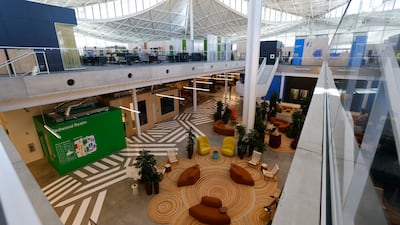
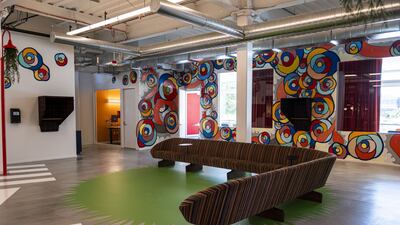
Inside Google's new self-developed Bay View campus

  • A bicycle path along Google's new Bay View campus. EPA
    A bicycle path along Google's new Bay View campus. EPA
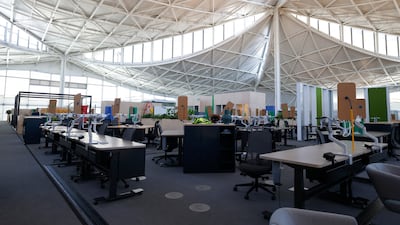
  • Workstations in Google's new Bay View campus building. EPA
    Workstations in Google's new Bay View campus building. EPA
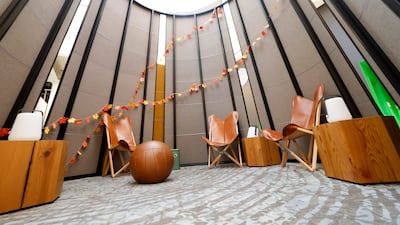
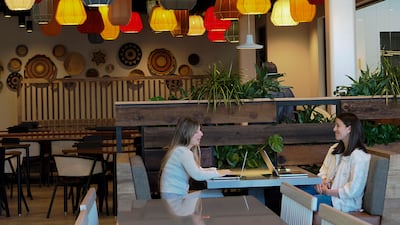
  • Sitting area at Google's Campfire Corner in Google's new Bay View campus. EPA
    Sitting area at Google's Campfire Corner in Google's new Bay View campus. EPA
  • Sitting area at Google's Campfire Corner in Google's new Bay View campus building. EPA
    Sitting area at Google's Campfire Corner in Google's new Bay View campus building. EPA
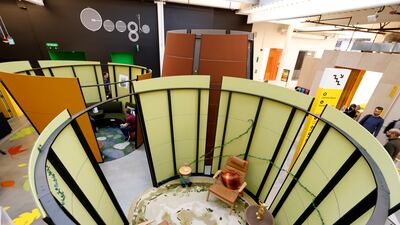
  • Interior view in Google's new Bay View campus building. EPA
    Interior view in Google's new Bay View campus building. EPA
  • Interior view of Google's Campfire Corner in Google's new Bay View campus building. EPA
    Interior view of Google's Campfire Corner in Google's new Bay View campus building. EPA
  • Interior view in Google's new Bay View campus building. EPA
    Interior view in Google's new Bay View campus building. EPA
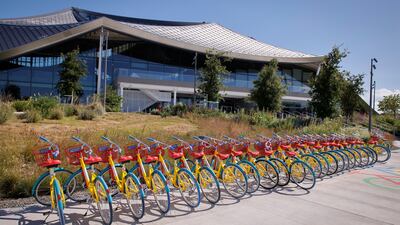
  • An exterior view of building BV200 and Google shared bicycles during a tour of Google's new Bay View Campus. Reuters
    An exterior view of building BV200 and Google shared bicycles during a tour of Google's new Bay View Campus. Reuters
  • A seating area in Google's new Bay View campus building. EPA
    A seating area in Google's new Bay View campus building. EPA
  • Google announced the opening of its new Bay View campus in Silicon Valley, representing the company's first time developing its own major campus. EPA
    Google announced the opening of its new Bay View campus in Silicon Valley, representing the company's first time developing its own major campus. EPA
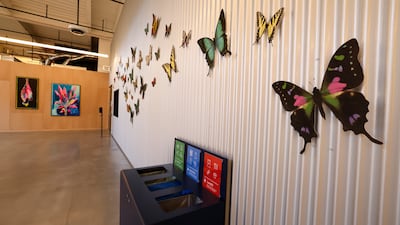
  • Art work in Google's new Bay View campus. EPA
    Art work in Google's new Bay View campus. EPA
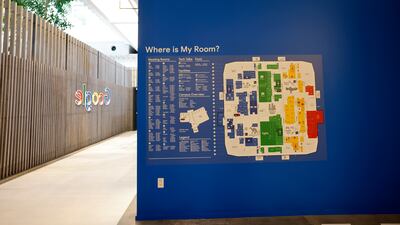
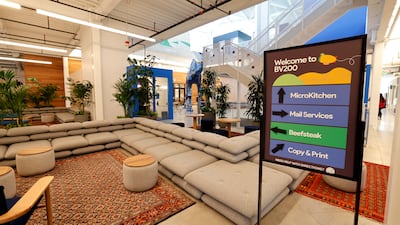
  • An Office directory in Google's new Bay View campus. EPA
    An Office directory in Google's new Bay View campus. EPA
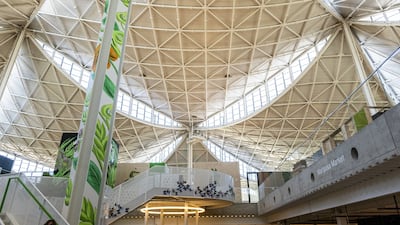
  • Interior and ceiling view of BV200, Google's new Bay View campus building. EPA
    Interior and ceiling view of BV200, Google's new Bay View campus building. EPA
  • The Google bicycle Pedal Park inside Google's new Bay View campus building. EPA
    The Google bicycle Pedal Park inside Google's new Bay View campus building. EPA
  • Binary code and art work on the window of Google's new Bay View campus. EPA
    Binary code and art work on the window of Google's new Bay View campus. EPA
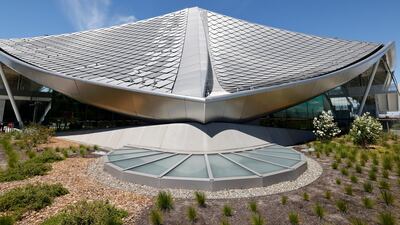
  • The side of Google's new Bay View campus building. EPA
    The side of Google's new Bay View campus building. EPA
  • An outdoor weight room in front of Google's new Bay View campus. EPA
    An outdoor weight room in front of Google's new Bay View campus. EPA
  • Binary code on the window of Google's new Bay View campus. EPA
    Binary code on the window of Google's new Bay View campus. EPA
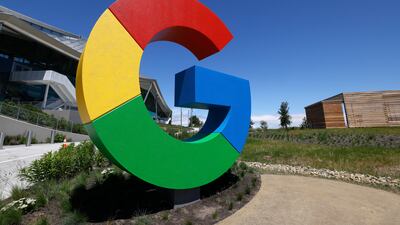
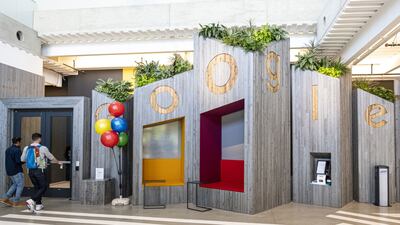
  • The Google logo in front of Google's Bay View Building. EPA
    The Google logo in front of Google's Bay View Building. EPA
  • An interior view of BV200, Google's new Bay View campus. EPA
    An interior view of BV200, Google's new Bay View campus. EPA
  • An Interior view of BV200, Google's new Bay View campus building. EPA
    An Interior view of BV200, Google's new Bay View campus building. EPA
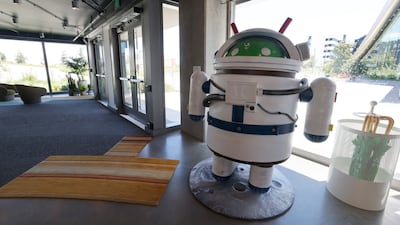
  • A Google Android bot in the lobby of BV100, Google's new Bay View campus. EPA
    A Google Android bot in the lobby of BV100, Google's new Bay View campus. EPA
  • The Bay View campus was designed by architects Bjarke Ingels Group (BIG) and Heatherwick Studio, as well as Google's design and engineering teams and spans 42 acres adjacent to the open space, two office buildings, and 1,000-person event centre. EPA
    The Bay View campus was designed by architects Bjarke Ingels Group (BIG) and Heatherwick Studio, as well as Google's design and engineering teams and spans 42 acres adjacent to the open space, two office buildings, and 1,000-person event centre. EPA
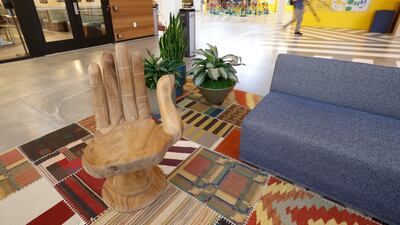
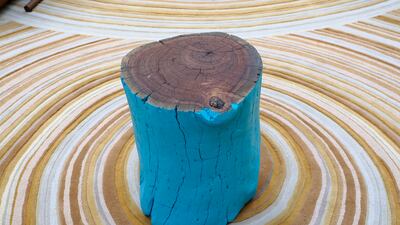
  • A coffee table made out of a wood stump in the sitting area at BV200, Google's new Bay View campus. EPA
    A coffee table made out of a wood stump in the sitting area at BV200, Google's new Bay View campus. EPA
  • Google employees in the cafeteria area in Mountain View, California. EPA
    Google employees in the cafeteria area in Mountain View, California. EPA
  • A Google employee in the cafeteria area in Mountain View, California. EPA
    A Google employee in the cafeteria area in Mountain View, California. EPA
  • A worker inside Google's new Bay View campus in Mountain View, California. Bloomberg
    A worker inside Google's new Bay View campus in Mountain View, California. Bloomberg
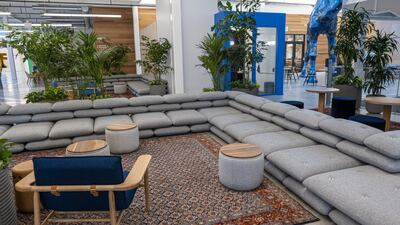
  • A seating area inside Google's new Bay View campus. Bloomberg
    A seating area inside Google's new Bay View campus. Bloomberg
  • Inside Google's new Bay View campus in Mountain View, California. Bloomberg
    Inside Google's new Bay View campus in Mountain View, California. Bloomberg
  • Workers inside Google's new Bay View campus. Bloomberg
    Workers inside Google's new Bay View campus. Bloomberg
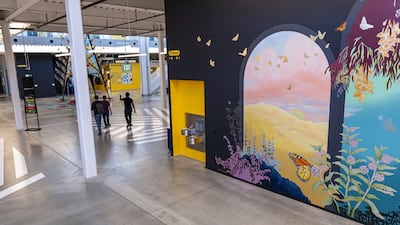
  • A mural inside Google's new Bay View campus in Mountain View, California. Bloomberg
    A mural inside Google's new Bay View campus in Mountain View, California. Bloomberg
  • Inside Google's new Bay View campus in Mountain View, California. Bloomberg
    Inside Google's new Bay View campus in Mountain View, California. Bloomberg
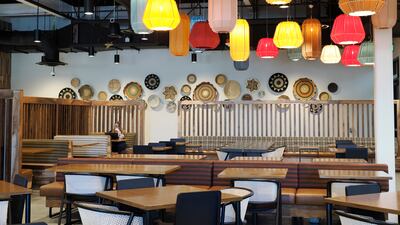
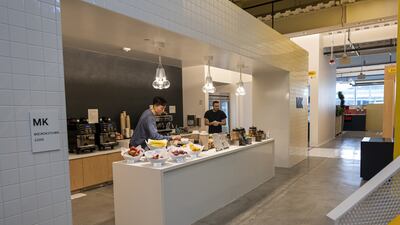
  • Workers in one of the many dining areas inside Google's new Bay View campus in Mountain View, California. Bloomberg
    Workers in one of the many dining areas inside Google's new Bay View campus in Mountain View, California. Bloomberg
  • Inside Google's new Bay View campus in Mountain View, California. Bloomberg
    Inside Google's new Bay View campus in Mountain View, California. Bloomberg
  • Desks inside Google's new Bay View campus. Bloomberg
    Desks inside Google's new Bay View campus. Bloomberg
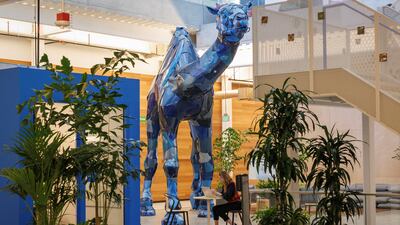
  • One of nine pieces of art created by Bay Area artists for the campus. Reuters
    One of nine pieces of art created by Bay Area artists for the campus. Reuters
Common OCD symptoms and how they manifest

Checking: the obsession or thoughts focus on some harm coming from things not being as they should, which usually centre around the theme of safety. For example, the obsession is “the building will burn down”, therefore the compulsion is checking that the oven is switched off.

Contamination: the obsession is focused on the presence of germs, dirt or harmful bacteria and how this will impact the person and/or their loved ones. For example, the obsession is “the floor is dirty; me and my family will get sick and die”, the compulsion is repetitive cleaning.

Orderliness: the obsession is a fear of sitting with uncomfortable feelings, or to prevent harm coming to oneself or others. Objectively there appears to be no logical link between the obsession and compulsion. For example,” I won’t feel right if the jars aren’t lined up” or “harm will come to my family if I don’t line up all the jars”, so the compulsion is therefore lining up the jars.

Intrusive thoughts: the intrusive thought is usually highly distressing and repetitive. Common examples may include thoughts of perpetrating violence towards others, harming others, or questions over one’s character or deeds, usually in conflict with the person’s true values. An example would be: “I think I might hurt my family”, which in turn leads to the compulsion of avoiding social gatherings.

Hoarding: the intrusive thought is the overvaluing of objects or possessions, while the compulsion is stashing or hoarding these items and refusing to let them go. For example, “this newspaper may come in useful one day”, therefore, the compulsion is hoarding newspapers instead of discarding them the next day.

Source: Dr Robert Chandler, clinical psychologist at Lighthouse Arabia

Tips to keep your car cool
  • Place a sun reflector in your windshield when not driving
  • Park in shaded or covered areas
  • Add tint to windows
  • Wrap your car to change the exterior colour
  • Pick light interiors - choose colours such as beige and cream for seats and dashboard furniture

  • Avoid leather interiors as these absorb more heat
The figures behind the event

1) More than 300 in-house cleaning crew

2) 165 staff assigned to sanitise public areas throughout the show

3) 1,000 social distancing stickers

4) 809 hand sanitiser dispensers placed throughout the venue

Mercer, the investment consulting arm of US services company Marsh & McLennan, expects its wealth division to at least double its assets under management (AUM) in the Middle East as wealth in the region continues to grow despite economic headwinds, a company official said.

Mercer Wealth, which globally has $160 billion in AUM, plans to boost its AUM in the region to $2-$3bn in the next 2-3 years from the present $1bn, said Yasir AbuShaban, a Dubai-based principal with Mercer Wealth.

Within the next two to three years, we are looking at reaching $2 to $3 billion as a conservative estimate and we do see an opportunity to do so,” said Mr AbuShaban.

Mercer does not directly make investments, but allocates clients’ money they have discretion to, to professional asset managers. They also provide advice to clients.

“We have buying power. We can negotiate on their (client’s) behalf with asset managers to provide them lower fees than they otherwise would have to get on their own,” he added.

Mercer Wealth’s clients include sovereign wealth funds, family offices, and insurance companies among others.

From its office in Dubai, Mercer also looks after Africa, India and Turkey, where they also see opportunity for growth.

Wealth creation in Middle East and Africa (MEA) grew 8.5 per cent to $8.1 trillion last year from $7.5tn in 2015, higher than last year’s global average of 6 per cent and the second-highest growth in a region after Asia-Pacific which grew 9.9 per cent, according to consultancy Boston Consulting Group (BCG). In the region, where wealth grew just 1.9 per cent in 2015 compared with 2014, a pickup in oil prices has helped in wealth generation.

BCG is forecasting MEA wealth will rise to $12tn by 2021, growing at an annual average of 8 per cent.

Drivers of wealth generation in the region will be split evenly between new wealth creation and growth of performance of existing assets, according to BCG.

Another general trend in the region is clients’ looking for a comprehensive approach to investing, according to Mr AbuShaban.

“Institutional investors or some of the families are seeing a slowdown in the available capital they have to invest and in that sense they are looking at optimizing the way they manage their portfolios and making sure they are not investing haphazardly and different parts of their investment are working together,” said Mr AbuShaban.

Some clients also have a higher appetite for risk, given the low interest-rate environment that does not provide enough yield for some institutional investors. These clients are keen to invest in illiquid assets, such as private equity and infrastructure.

“What we have seen is a desire for higher returns in what has been a low-return environment specifically in various fixed income or bonds,” he said.

“In this environment, we have seen a de facto increase in the risk that clients are taking in things like illiquid investments, private equity investments, infrastructure and private debt, those kind of investments were higher illiquidity results in incrementally higher returns.”

The Abu Dhabi Investment Authority, one of the largest sovereign wealth funds, said in its 2016 report that has gradually increased its exposure in direct private equity and private credit transactions, mainly in Asian markets and especially in China and India. The authority’s private equity department focused on structured equities owing to “their defensive characteristics.”

How has net migration to UK changed?

The figure was broadly flat immediately before the Covid-19 pandemic, standing at 216,000 in the year to June 2018 and 224,000 in the year to June 2019.

It then dropped to an estimated 111,000 in the year to June 2020 when restrictions introduced during the pandemic limited travel and movement.

The total rose to 254,000 in the year to June 2021, followed by steep jumps to 634,000 in the year to June 2022 and 906,000 in the year to June 2023.

The latest available figure of 728,000 for the 12 months to June 2024 suggests levels are starting to decrease.

The 15 players selected

Muzzamil Afridi, Rahman Gul, Rizwan Haider (Dezo Devils); Shahbaz Ahmed, Suneth Sampath (Glory Gladiators); Waqas Gohar, Jamshaid Butt, Shadab Ahamed (Ganga Fighters); Ali Abid, Ayaz Butt, Ghulam Farid, JD Mahesh Kumara (Hiranni Heros); Inam Faried, Mausif Khan, Ashok Kumar (Texas Titans

The Brutalist

Director: Brady Corbet

Stars: Adrien Brody, Felicity Jones, Guy Pearce, Joe Alwyn

Rating: 3.5/5

UAE currency: the story behind the money in your pockets
Defence review at a glance

• Increase defence spending to 2.5% of GDP by 2027 but given “turbulent times it may be necessary to go faster”

• Prioritise a shift towards working with AI and autonomous systems

• Invest in the resilience of military space systems.

• Number of active reserves should be increased by 20%

• More F-35 fighter jets required in the next decade

• New “hybrid Navy” with AUKUS submarines and autonomous vessels

Updated: June 16, 2022, 4:04 AM