

Apple has made the latest versions of its operating systems available to users, and the biggest update is the ability to unlock iPhones while wearing a face mask and without an Apple Watch.
We take a look at this and some other notable features in the 15.4 updates of iOS and iPadOS.
Face ID unlock with a mask on

This feature was first reported in late January, when the Cupertino-based company rolled out the operating system’s first beta version, which a version used in final testing before a commercial release.
Face ID with a mask scans the area around your eyes to authenticate your identity – although Apple cautions the full face scan is still the more secure option. It can also still authenticate transactions on Apple Pay and logins to supported third-party apps.
Keep in mind that while it does work with glasses on, it won't with sunglasses. And while you can use it on iOS 15.4, it only works with the iPhone 12 and later, according to Apple's website.
The unlocking update has long been awaited by Apple users amid continued mask mandates across the world, and the delay has attracted criticism for the world’s most valuable company.
Other smartphone manufacturers, such as Samsung Electronics and Huawei Technologies, have options such as iris scanning and fingerprint sensors to unlock their devices. Apple’s Face ID technology requires a full face and eye scan, and is the only biometric option in the iPhone line-up from the iPhone X, not counting the recently-launched third-generation iPhone SE.
AirTag anti-stalking
Apple's latest AirTag update has a clear message: anyone who tries to use it for illicit purposes is a crime. During the set-up of an AirTag or any other Find My accessory, there will be a warning that states the device is locked to an Apple ID, and that using it to track someone without consent is a crime.
AirTags have been hit with privacy and security concerns, something that Apple has continued to work on. In December, Apple unveiled an app for Android devices that will help users who do not own iPhones or iPads to detect unexpected AirTags and other devices compatible with Apple’s Find My network that are near them.
New settings for Emergency SOS
Emergency SOS has now been defaulted to pressing and holding both the side and either volume button to show the SOS screen. The previous option of pressing the side buttons five times can still be toggled in settings.
To initiate an emergency call, either drag the slider on top, or continue holding those buttons until the countdown runs out to start the call.
Apple Card widget

iOS 15.4 now gives you the option to place a widget for Apple Card – the company’s credit card issued by US bank Goldman Sachs – on the Today view, which can also be added to your home screen.
The widget shows how much you’ve spent across various categories and how much balance you currently have. This is, however, available only in the US.
Health app now holds vaccination records
Health records that are verifiable now support adding vaccination records, specifically in the EU Digital Covid Certificate format to the Health and Wallet apps. This allows EU residents to add to and easily access their vaccine cards in Wallet.
Universal Control

Probably at par with the mask-unlocking bit is Universal Control, which allows other Apple devices to function as second screens and, using a wireless Apple keyboard and mouse, drag and drop files between them. However, this doesn’t work on iPhones – only on iPads and Macs with the latest iPadOS 15.4 and macOS Monterey 12.3, respectively.
On a Mac, go to system preferences, then displays, and tick on Universal Control; check the boxes for "Allow your cursor and keyboard to move between any nearby Mac or iPad" and "Check the box for Push through the edge of a display to connect a nearby Mac or iPad". On an iPad, go to settings, general and AirPlay & Handoff, then enable cursor and keyboard. Place the two devices side-by-side and you're good to go.
Adjust keyboard brightness
In iPadOS 15.4, you can add a new Keyboard Brightness option to Control Centre, which allows you to adjust the brightness of a connected keyboard that has backlighting. While it is compatible with Apple's own Magic Keyboard, you still need to add it to Control Centre via settings.
New emojis!

Of course, what’s a hyped-up iOS update without some new emojis?
Among the new additions to the cute characters are the face with peeking eye, saluting face, face holding and the highly-popular melting face. Gestures and handshakes have seven new ones, including index pointing at the viewer, palm up/down and heart hands, in addition to multi-racial handshakes.
New to the animals and object categories include a coral, lotus, nest with and without eggs, crutch, bubbles and x-ray.
iOS 15.4 is compatible with all mainstream iPhones from the 6S series, plus all the SE models. iPadOS 15.4 supports all iPads from the fifth generation, iPad Airs from the second generation, iPad minis from the fourth generation and all iPad Pros.
______________________
Apple iPhone through the years
-

The iPhone through the ages: Former Apple CEO Steve Jobs introduces the iPhone to the world in San Francisco, California, on January 9, 2007. It had a 3.5-inch screen and 2MP camera. Reuters -

The iPhone 3G was launched in 2008 with a faster 3G connection. It also added location services. Reuters -
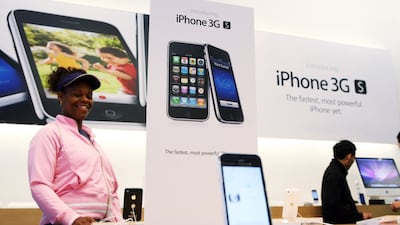
The iPhone 3GS was released on June 19, 2009. It was twice as fast as its previous version. AFP -

The iPhone 4 was released on June 24, 2010. It featured FaceTime for the first occasion as well as a retina screen. Reuters -

A later release, this time on October 14, 2011, the iPhone 4S had a new dual-core processor. Reuters -

Apple CEO Tim Cook takes to the stage following the reveal of the iPhone 5 in San Francisco, California, on September 12, 2012. This was the first 4-inch screen and the phone was faster and slimmer. Reuters -
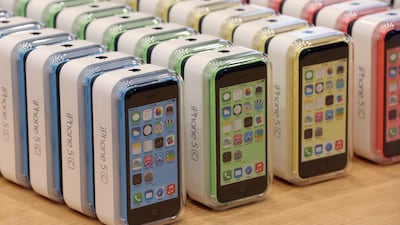
The iPhone 5C arrived on September 20, 2013 and was less expensive and very similar to the iPhone 5 except it came with colourful casing. Getty Images -
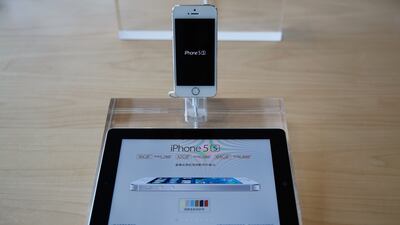
The iPhone 5s came at the same time as the 5C and introduced touch ID and a motion data processor as health and fitness apps started to come to the fore. Getty Images -
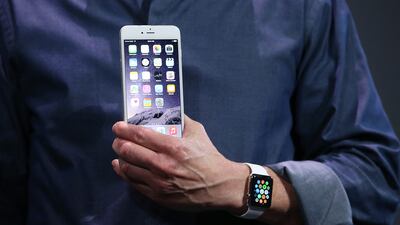
The iPhone 6 marked another double launch when unveiled on September 9, 2014. The 6 had a 4.7-inch screen, faster processor and improved camera. AFP -

The iPhone 6 Plus had a 5.5-inch screen and was $100 more expensive. Reuters -
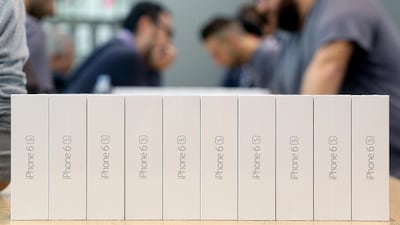
The iPhone 6s came on September 25, 2015 with 3D touch and a camera that could shoot 4K video. EPA -

The iPhone 6s Plus is displayed at Tokyo's flagship store on September 25, 2015. Both new phones came in a new colour - rose gold. AFP -
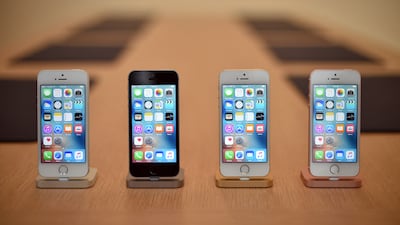
Unveiled on March 21, 2016, the iPhone SE had the same design as the iPhone 5 and saw a return to the 4-inch screen which was preferred by some users. It was more affordable and hence lacked features such as Touch ID. AFP -

The iPhone 7 announced on September 7, 2016, said somewhat controversially goodbye to the audio jack. Reuters -
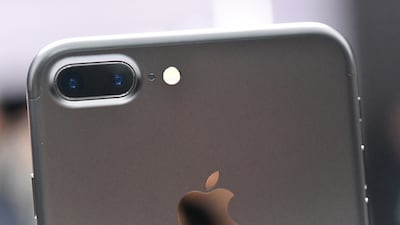
The iPhone 7 Plus had a dual camera added. AFP -

The iPhone 8 was released on September 22, 2017 and had a new glass and aluminium design, retina HD screen. Reuters -
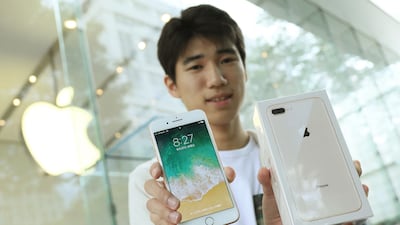
A customer gets his hands on an iPhone 8 Plus on launch day in Tokyo on September 22, 2017. The launches also saw speakers that were 25% louder and the most powerful and smartest chip in a smartphone (according to Apple). AFP -

The iPhone X marked a decade of iPhones on September 12, 2017. It's main changes were an edge-to-edge super retina screen. Touch ID was removed with Face ID introduced. Reuters -

The iPhone XS was released on September 21, 2018 and had a Super Retina OLED screen with improved scratch and water resistance. Face ID was faster. Reuters -

The iPhone XS Max had the largest iPhone screen to date at 6.5 inches. It could handle 3 million pixels. Reuters -
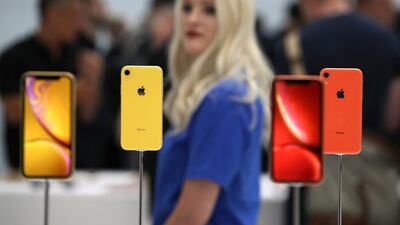
The iPhone XR was slightly cheaper than the XS and came with a 6.1-inch screen. AFP -
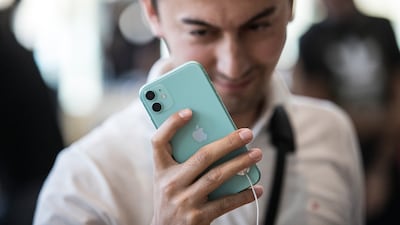
A customer looks at the iPhone 11 at an Apple store in Dubai Mall on September 20, 2019. EPA -
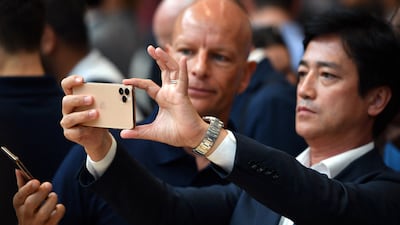
A man tries out the iPhone 11 Pro in Cupertino, California, on September 10, 2019. AFP -

Midnight Green was introduced for the iPhone 11 Pro Max, while there was also a new three-camera system. Reuters -
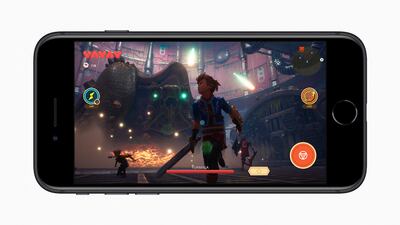
Arriving on April 15, 2020, the iPhone SE was for budget-minded customers and was pretty much a replica of the iPhone 8. Its 4.7-inch screen felt rather on the small side compared to the big screens of its big brothers. Apple Inc. / AFP -
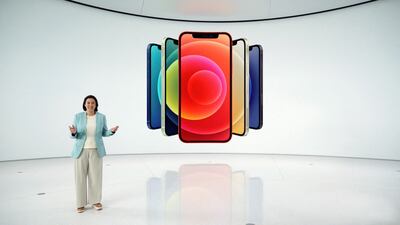
The iPhone 12 on October 13, 2020 introduced a new processor and a screen that offered four times better protection if dropped. Apple / AFP -

The iPhone 12 mini offered a 5.4-inch screen. Getty Images -
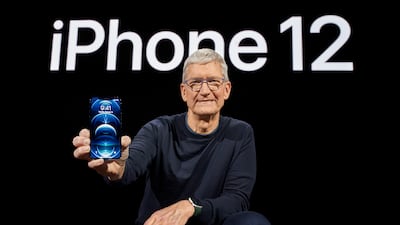
Mr Cook showcases the iPhone 12 Pro during an event at Apple Park in Cupertino, California, on October 13, 2020. This upgrade saw a faster chip, 5G speed, a "camera system that’s killer in low light. A LiDAR Scanner for more realistic AR. And two great sizes to choose from — including our largest display ever". Apple / EPA -

The iPhone 12 Pro Max was categorised as a 'legacy phone'. Reuters -
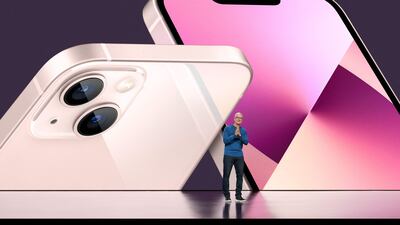
The new iPhone 13 was unveiled on September 14, 2021. It has a smart data mode which helps battery life, more 5G bands and antenna lines that use material made from recycled plastic water bottles. AFP -
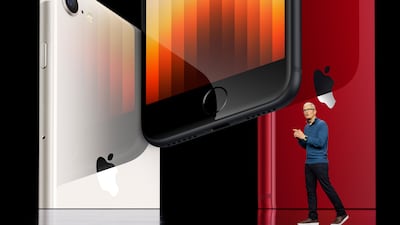
Apple CEO Tim Cook showcasing the third generation iPhone SE featuring 5G and the A15 Bionic chip on March 8, 2022. EPA -
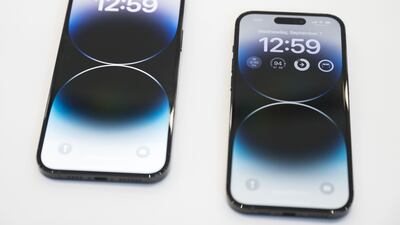
The Apple iPhone 14, 14 Plus, Pro Max and the Apple iPhone 14 Pro were unveiled during an event on September 7, 2022. It didn’t raise its US prices during one of the worst years for inflation in decades. The biggest addition was emergency calling after a car crash. Bloomberg



