


More than a decade ago, most people visited doctors in person when they were unwell.
Telehealth was not a big buzzword in the region, or globally, and was certainly not part of Jordanian entrepreneur Jalil Allabadi’s plan when he set up Altibbi in 2011.
But the UAE-based start-up, which now claims to be the largest artificial intelligence-based digital health platform in the Middle East, has changed and expanded significantly since it was created as an online Arabic medical dictionary.
“Our story is different from the normal tech start-ups you see in this region," says Mr Allabadi, founder and chief executive of Altibbi.
"The original idea actually came from my father, who is a doctor [trained in Germany].
"He came back to work in refugee camps and realised there was a big gap in communication between the patient and doctor because medicine in the Arab world is taught in English or French."
To meet that gap and educate patients, his father started writing an Arabic-language medical dictionary. While the book made its way into universities and clinics, it did not “achieve what he wanted”.
Mr Allabadi, who at the time was pursuing his MBA abroad, decided to work on a project to promote the dictionary and widen its reach by turning it into digital platform, similar to an Arabic version of US-based health publisher WebMD.
The MBA project sparked the idea for a full-fledged business, and Mr Allabadi returned to Jordan and put together a plan.
His first hirings were a pharmacist and a tech expert, both of whom were family friends. Two years after the project, Altibbi was launched and very soon traffic began to build.
Having bootstrapped to launch the start-up, the team invested heavily in its content and began monetising the platform through advertising.
“The vision was to create a WebMD of the Arab world and we did that,” Mr Allabadi says.
"It was 15,000 pages that we put online at first, which was fantastic. We started getting thousands of visitors to the website every day."
The plan went well and covered costs, but it was “not growing wildly, because we came to the realisation that advertising in this part of the world ... back then was extremely low and digital [advertising] in health was a small fraction of the whole pie”.
“So we had to switch [the plan] and that was one of the first painful decisions that we had to make.”
One of the biggest traffic generators on the site was launched in mid-2013 – a free question and answer feature in which patients could interact with doctors.
The Altibbi team pitched to investors that they would focus on building this model and shut down advertising.
By 2016-2017, the start-up had launched a primary care general practitioner telehealth product, which remains its main product today.
-

Health experts have long warned of the dangers of using the internet to find medical advice instead of seeing a GP - a trend referred to as "Doctor Google". -

Researchers researchers from Boston's Brigham and Women's Hospital suggest searching the web for a diagnosis.may be less harmful than medical professionals believe. Photo: Scott Eisen/Bloomberg via Getty Images -
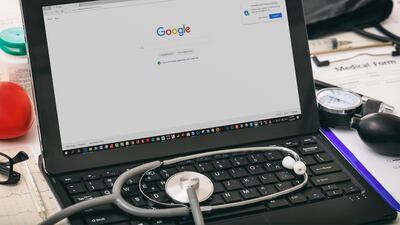
Participants in the study of 5,000 people demonstrated modest improvements in reaching an accurate diagnosis after looking up symptoms online. -
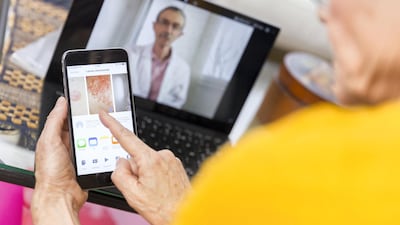
For the next phase, David Levine, managing director of general internal medicine and primary care at the Brigham, intends to investigate further the ability of AI to help people diagnose their own condition correctly. (Photo by: BSIP/Universal Images Group via Getty Images)


Demand for digital health care has grown in recent years, with the coronavirus pandemic providing a significant boost as lockdowns forced people to depend on remote medical services.
The remote healthcare market in the Middle East and North Africa is projected to reach $1.8 billion in 2024, growing at a compound annual rate of 12.8 per cent from $989 million in 2019, according to the 2020 Global Ventures Digital Health report.
The overall healthcare technology start-up ecosystem in the Mena region is also booming and attracted investments of more than $80m in 2021, marking an annual increase of 29 per cent in funding, according to data platform Magnitt.
The market is worth more than $1.5bn, an increase of 22 times since 2016, Magnitt said.
Altibbi raised $500,000 from investors in 2014 and another $500,000 in 2015.
In 2017, it raised $6.5m in a Series B funding led by Middle East Venture Partners and Dash Ventures, both investors in the seed round of the company.
founder and chief executive of Altibbi
When Mr Allabadi made his pitch to investors in 2017, Altibbi was receiving 200,000 unique visitors each day and conducting 100 daily consultations. Today, the site gets a million unique visitors a day and conducts 5,000 to 6,000 consultations.
To date, Altibbi has conducted more than 4.5 million consultations. It has 1,500-plus certified doctors on the platform and offers 24-7 telehealth in seven countries in the Mena region. It also hosts more than two million pages of content.
To support the next stage of its expansion and growth, the start-up raised a further $44m in a Series B funding round led by Foundation Holdings, Hikma Ventures and existing investors Global Ventures and Dash Ventures, in March.
The new funds will be used to expand Altibbi’s offering into online pharmacy and diagnostics collection.
The company also aims to increase its investments in machine learning to support doctors in providing precise diagnoses, referrals and prescriptions.
The amount raised by Altibbi in the round accounted for 50 per cent of last year’s capital investment in the sector across Mena, and supported HealthTech to emerge as the fourth-most funded industry in the region during the first quarter, according to Magnitt’s Mena Q1 2022 Venture Investment Report.
The HealthTech sector has attracted both limited funding and a smaller number of start-ups, because it is a “very difficult" industry with “huge” liabilities, says Mr Allabadi.
The company operates on a direct business to consumer model, with most patients paying for the telehealth services.
“It varies between countries but on average, it’s about $5 a month to get unlimited telehealth consultations. It’s primary care telehealth, we're not talking about specialists,” he says.
“And we are working a lot now with insurance companies and with governments as well. This is a new thing, especially after Covid-19, since governments became more interested.
"So we’ve started working with the government in Jordan, the government in Egypt and now we're having some conversations in Saudi Arabia.”
Altibbi maintains a stringent quality-control process when bringing in doctors, with monitoring maintained constantly to ensure the quality of care is not compromised, Mr Allabadi says.
The start-up is also able to streamline costs by using technology to ensure “quality of operations, efficiency and scale”.
“This is where a lot of machine learning and AI data science [comes in]," he says. "It’s happening in the back end to make sure that we’re [ensuring quality] ... since there is a lot of liability.
"The medical advice has to be correct ... it's not like delivering food.
"In our case, if you give the wrong advice, the patient will face other complications."
Using technological solutions also supports the platform to start predicting patterns and improving the quality of care, although Mr Allabadi stresses that data for research remains anonymous, with privacy protected.
Looking ahead, the start-up is focusing on Saudi Arabia and Egypt and on growing vertically in those regions.
It is also considering a possible initial public offering in the next two to three years, with one of its investors at the recent fund-raising stating that Altibbi aims to be “the first publicly listed digital health unicorn [valuation of more than $1 billion] IPO in the GCC”.
“We don’t have any plans for [a listing] right now. But all we know is that it is on our plate for the next two to three years to become a unicorn ... [and] then going for an IPO would be an option.”
Company Profile
Name: Altibbi
Launched in: 2011
Based in: UAE
Sector: HealthTech
Size: 85 employees, 1,500 certified doctors (freelance)
Total funding raised so far: $52.5m
Q&A with Altibbi’s founder Jalil Allabadi
If not Altibbi, what would you have rather started?
I would have started something in education, not necessarily in technology.
Have you done anything on your entrepreneurial journey you regret?
No.
What memory do you treasure the most?
Until now, I think that a moment that amazed me is when I realised that this is what I want to do [start Altibbi]. I think the next one would be realising a dream, which is an IPO.
What is your advice to entrepreneurs?
Remain hungry. That is the most important advice I ever got. Just remain hungry for success, for achieving something and accomplishing something.
What is your personal motto?
Just be optimistic all the time. I’m a serial optimist.
What is your vision for Altibbi?
We want [Altibbi] to be at the heart of health care in emerging markets. We started with the infrastructure and we want to do the drug delivery and the diagnostics.
"We want to make it [health care] more seamless, more efficient, cheaper and [of] higher quality at the same time. This is our vision and our motto is better health for all.
"So we’re all about delivering a better, higher quality health care and more accessibility."

