


The Middle East will be able to hasten the growth of its electric vehicle market if infrastructure is more widespread and consumers are willing to pay to shift to more sustainable means of transport, according to industry experts.
While government subsidies do play a role in encouraging consumers to shift from traditional vehicles, investments in infrastructure have been more effective and are responsible for about 40 per cent of EV sales globally, Nasser Saidi, chairman of the Clean Energy Business Council, said during a panel discussion at the inaugural Electric Vehicle Innovation Summit (EVIS) in Abu Dhabi on Monday.
Aside from the core infrastructure, “we also look at charging points, the speeds and quality of EVs and if they are able to compete with internal combustion vehicles”, he said.
Consumers also require options that are cheaper.
“We need cars that are attractive, desirable and affordable. And you need consumers who are keen [to shift] and willing to pay,” said Rana Nawas, a partner at New York-based consultancy Oliver Wyman, referring to the current high prices of EVs.
The global EV market continues to grow amid a governmental and societal shift towards energy conservation.
Global sales of EVs more than doubled to 6.6 million in 2021, according to the International Energy Agency.
The sales value of the market surged 77 per cent annually to about $273 billion in 2021, doubling to $110bn in China alone, BloombergNEF data showed.
Although not completely carbon-free, EVs have a significantly lower emission footprint, compared with their gas counterparts. Transport is one of the sectors that greatly contributes to carbon emissions, accounting for about one fourth of the global total.
Global carbon dioxide emissions reached their highest annual level yet in 2021, rising 6 per cent to 36.3 gigatonnes, IEA figures show.
-
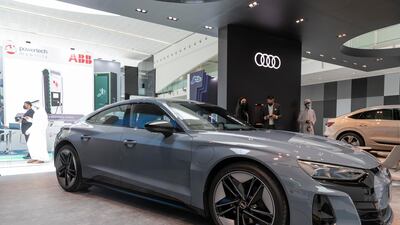
An Audi e-tron at the Electric Vehicle Innovation Summit (EVIS) being held at the Abu Dhabi National Exhibition Centre. All photos by Antonie Robertson / The National -
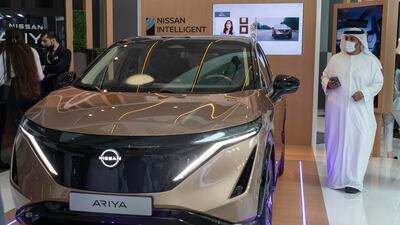
A Nissan Ariya electric model at EVIS. -

Visitors check out an electric vehicle at the show. -
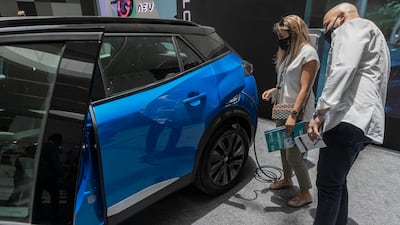
An electric Peugeot model at EVIS. -
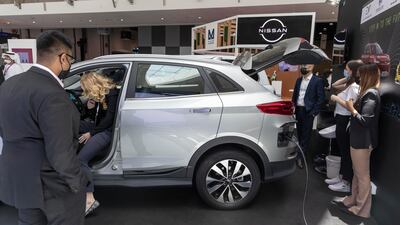
Visitors watch as an electric car is charged at EVIS. -

Visitors check out the UAE's first locally produced electric car, Al Damani. The vehicle is manufactured by the M Glory Group. -
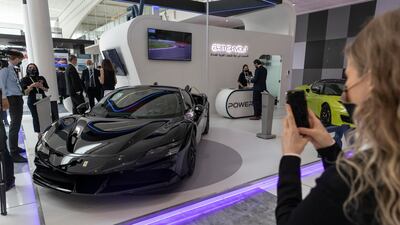
The Ferrari stand at the electric vehicle car show. -
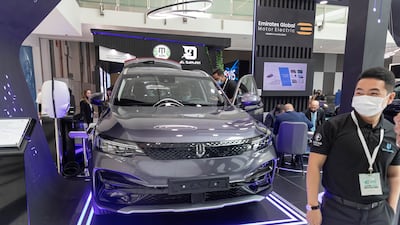
The Emirates Global Motor Electric stand. The UAE is seeking to position itself as a leader in the next generation of transport. -
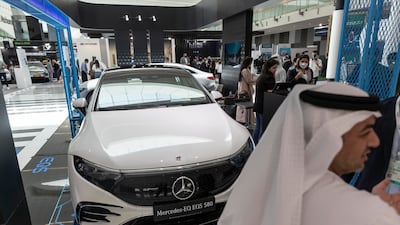
A Mercedes Benz electric car on display at the show. -
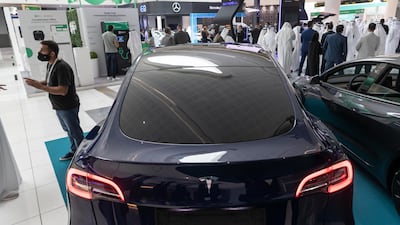
Tesla is also exhibiting its cars at the show, the Mena region's first exhibition focused on electric vehicles. -
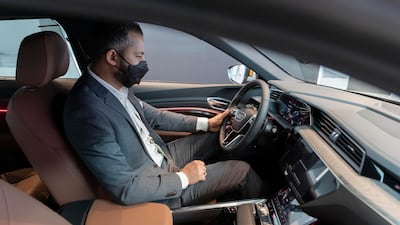
The interior of an Audi e-tron.


In the UAE, the willingness of consumers to use EVs has continued to attract investment.
Tesla Motors, the world's biggest EV maker, opened its showroom in Dubai in July 2017, its first in the Middle East.
In March, Dubai-based M Glory Holding Group said it will open an EV manufacturing plant, marking its foray into the highly competitive market as the UAE pushes to expand its manufacturing sector.
The Dh1.5bn ($408 million) factory in Dubai Industrial City will be one of the largest in the Middle East and is expected to make 55,000 EVs a year as demand for green mobility increases.
Oil prices can also be an influencing factor in consumer decisions. Prices have surged in the past several weeks, mainly because of supply concerns linked to the Russia-Ukraine conflict.
“If we look at the tremendous increase in oil prices, that would encourage more [buyers of EVs],” Mr Saidi said.
communications manager at the European Association for Electromobility
The growth of the EV market will remain steady and only pick up pace if the right investments and awareness programmes are in place, helping governments to achieve their sustainable goals sooner rather than later, said Ms Nawas.
“By 2040, about a third of all vehicles in the world will be EVs, and by 2026, about 45,000 EVs will be sold in region,” she said.
While most countries still lack the infrastructure to support a green mobility economy and many consumers don't have the disposable income to invest in an EV, collaboration and knowledge-sharing can play a role in supporting adoption.
“The growth of the EV market is exponential. It is very, very fast and never been as high this year,” said Philippe Vangeel, communications manager at the European Association for Electromobility.
“The technology is there and it is mature; we just have to do it. The industry knows what direction it should take.”

