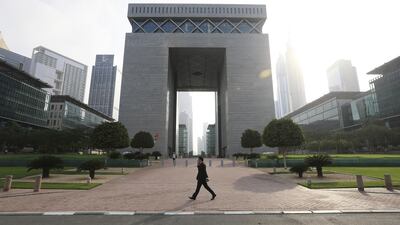
The Dubai International Financial Centre’s workplace savings programme has signed up 19,182 employees from 1,187 companies since it was launched a year ago.
The DIFC Employee Workplace Savings plan built up more than $127 million worth of assets under management as of February 1, 2021, the free zone said on Tuesday.
Launched in February last year for employees based in the DIFC, the Dews plan restructured the gratuity benefit system and requires employers in the free zone to make monthly contributions to a managed investment programme.
A substantial number of employees also chose to make additional voluntary contributions to the Dews plan.
The free zone is the first body in the UAE to overhaul the gratuity system – a defined end-of-service benefit that all expatriate employees are entitled to after completing at least one year of service.
“DIFC is proud to have created the region’s first employee savings scheme and delighted with the high levels of uptake by our clients and workforce,” said Arif Amiri, chief executive of DIFC Authority.
The Dews programme ensures the liability moves from an unfunded to a funded benefit, which is taken off a company’s balance sheet and placed in a trust-based structure.
Equiom is the master trustee of the Dews programme while Zurich Workplace Solutions is the plan administrator and global consultancy Mercer is the investment adviser.
Dews requires employers to contribute an amount equal to 5.83 per cent or 8.33 per cent of an employee’s wage, depending on their length of service, on a monthly basis to a fund administered by a trust.
“The Dews scheme has successfully turned an unfunded liability into a recognisable and secure benefit,” said Reena Vivek, senior executive officer at Zurich Workplace Solutions.
“The growing number of employees making voluntary contributions into the plan is a sign of the positive impact Dews has had in encouraging regular savings.”
Employees can choose from five risk-profiled funds: low, low to moderate, moderate, moderate to high and high. There is also a Sharia-compliant option available.
At the end of January, 75 per cent of the plan’s assets were invested in the low-to-moderate growth fund while about a fifth of assets were split across other funds.
“Dews aims to address a key issue with the end-of-service benefit system in the Middle East where employers are not obliged to fund their end-of-service liability externally,” said Chris Cain, Middle East client services director at Equiom.
Most companies tend to make EoS payments from their cashflow, meaning that employees are not protected against employer insolvency
“Most companies, therefore, tend to make end-of-service payments from their cash flow, meaning that employees are not protected against employer insolvency.
“Dews has addressed this issue and as part of the scheme, once funds are paid on behalf of employees, the sum is ring-fenced and is no longer a liability of the employer, making it safer for employees,” he said.
About 75 per cent of companies in the UAE do not set aside specific assets for end-of-service benefits, according to a 2019 survey by Zurich.
About 80 per cent of those polled, which included chief financial officers and finance managers, said a mandatory funding requirement would be a good decision.

Red flags
- Promises of high, fixed or 'guaranteed' returns.
- Unregulated structured products or complex investments often used to bypass traditional safeguards.
- Lack of clear information, vague language, no access to audited financials.
- Overseas companies targeting investors in other jurisdictions - this can make legal recovery difficult.
- Hard-selling tactics - creating urgency, offering 'exclusive' deals.
Courtesy: Carol Glynn, founder of Conscious Finance Coaching
COMPANY%20PROFILE%20
%3Cp%3E%3Cstrong%3ECompany%3A%20%3C%2Fstrong%3EOlive%20Gaea%3Cbr%3E%3Cstrong%3EStarted%3A%3C%2Fstrong%3E%202021%3Cbr%3E%3Cstrong%3ECo-founders%3A%3C%2Fstrong%3E%20Vivek%20Tripathi%2C%20Jessica%20Scopacasa%3Cbr%3E%3Cstrong%3EBased%3A%3C%2Fstrong%3E%20Dubai%3Cbr%3E%3Cstrong%3ELicensed%20by%3A%20%3C%2Fstrong%3EDubai%20World%20Trade%20Centre%3Cbr%3E%3Cstrong%3EIndustry%3A%3C%2Fstrong%3E%20Climate-Tech%2C%20Sustainability%3Cbr%3E%3Cstrong%3EFunding%3A%20%3C%2Fstrong%3E%241.1%20million%3Cbr%3E%3Cstrong%3EInvestors%3A%20%3C%2Fstrong%3ECornerstone%20Venture%20Partners%20and%20angel%20investors%3Cbr%3E%3Cstrong%3ENumber%20of%20employees%3A%3C%2Fstrong%3E%208%3Cbr%3E%3C%2Fp%3E%0A
MATCH INFO
Quarter-finals
Saturday (all times UAE)
England v Australia, 11.15am
New Zealand v Ireland, 2.15pm
Sunday
Wales v France, 11.15am
Japan v South Africa, 2.15pm
GRAN%20TURISMO
%3Cp%3E%3Cstrong%3EDirector%3A%3C%2Fstrong%3E%20Neill%20Blomkamp%3C%2Fp%3E%0A%3Cp%3E%3Cstrong%3EStars%3A%3C%2Fstrong%3E%20David%20Harbour%2C%20Orlando%20Bloom%2C%20Archie%20Madekwe%2C%20Darren%20Barnet%3C%2Fp%3E%0A%3Cp%3E%3Cstrong%3ERating%3A%3C%2Fstrong%3E%203%2F5%3C%2Fp%3E%0A
What the law says
Micro-retirement is not a recognised concept or employment status under Federal Decree Law No. 33 of 2021 on the Regulation of Labour Relations (as amended) (UAE Labour Law). As such, it reflects a voluntary work-life balance practice, rather than a recognised legal employment category, according to Dilini Loku, senior associate for law firm Gateley Middle East.
“Some companies may offer formal sabbatical policies or career break programmes; however, beyond such arrangements, there is no automatic right or statutory entitlement to extended breaks,” she explains.
“Any leave taken beyond statutory entitlements, such as annual leave, is typically regarded as unpaid leave in accordance with Article 33 of the UAE Labour Law. While employees may legally take unpaid leave, such requests are subject to the employer’s discretion and require approval.”
If an employee resigns to pursue micro-retirement, the employment contract is terminated, and the employer is under no legal obligation to rehire the employee in the future unless specific contractual agreements are in place (such as return-to-work arrangements), which are generally uncommon, Ms Loku adds.
The Voice of Hind Rajab
Starring: Saja Kilani, Clara Khoury, Motaz Malhees
Director: Kaouther Ben Hania
Rating: 4/5
The Settlers
Director: Louis Theroux
Starring: Daniella Weiss, Ari Abramowitz
Rating: 5/5
Dark Souls: Remastered
Developer: From Software (remaster by QLOC)
Publisher: Namco Bandai
Price: Dh199
The bio
Job: Coder, website designer and chief executive, Trinet solutions
School: Year 8 pupil at Elite English School in Abu Hail, Deira
Role Models: Mark Zuckerberg and Elon Musk
Dream City: San Francisco
Hometown: Dubai
City of birth: Thiruvilla, Kerala
