When you imagine the future of work, what do you see?
Many might be influenced by movies and TV shows depicting a dystopian future of the workplace, a world in which robots do everything and humans are left by the wayside, struggling to survive financially without jobs or a purpose in life.
For others, it could be akin to work-life purgatory in a job at Lumon Industries, the fictitious company at the centre of Apple TV’s Severance, where workers have undergone surgery to insert a microchip in their brains to separate home from work.
Known as “innies” at the office, Lumon’s employees have no memory of their home life and spend their days searching for “scary” numbers in the Macrodata Refinement division, where they are occasionally rewarded with waffles and music dance experiences.
Once they leave for the day, they become “outties” and have no recollection of work (perhaps thankfully after those waffle and dance employee bonding sessions).
Watch: Hungry for risotto? Just ask this robot chef
But back to the real world. The Covid-19 pandemic is often credited as the turning point for disruption in the workplace, as millions of employees switched to working from home during lockdowns and started understanding the importance of a better work-life balance – though, hopefully, not to the same degree as Severance.
While work-life balance may have been the main priority for workers from 2020 to 2023, many have shifted their concerns to job security and the role artificial intelligence will play in the future thanks to a surge in popularity of natural language processing tools such as ChatGPT, Google’s Bard (now known as Gemini) and others.
A survey by analytics advisory company Gallup last September found 22 per cent of Americans now fear that technology will make their jobs obsolete.
“Fear of becoming obsolete, or Fobo, remains uncommon among US workers, but it has grown more in the past two years than at any time in Gallup's trend since 2017,” Gallup said at the time.
“Twenty-two per cent now say they worry that technology will make their job obsolete, up seven percentage points from the prior reading in 2021.”
In the UAE, 72 per cent of employees believe that AI will significantly affect their work in the next five years, research conducted by professional network LinkedIn revealed last September.
Meanwhile, in a study published in December on the future of work, Virgin Media O2 Business found that 52 per cent of UK workers under the age of 50 are unsure what job they will be doing in 20 years’ time based on how quickly their industry is changing.
However, UK-based futurist Tracey Follows, who worked with Virgin Media Business O2 on its study, believes that large-scale job displacement should not be feared, as emerging technology is set to create new sectors and roles.
This includes new policies and initiatives in the safety sector that take into account changing workplaces, such as automation in factories, Ms Follows says.
“I think when any new technologies come along – we saw it with the car when it replaced horses – over time, you develop lots of new health and safety regulations, policies and initiatives,” Ms Follows said during The National’s Pocketful of Dirhams podcast on the future of work.
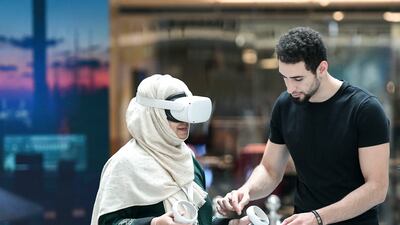
“With all of the robotics and automation that's coming into factories and services and products … I think there's going to be a whole new sector around training for safety, which happens in virtual reality and in very immersive simulated environments.”
Here, we look at four trends set to shape the world of work in the 2040s and beyond.
1. The end of the monthly salary transfer
It wasn’t so long ago that salaries were paid weekly in cash – although that’s more of a memory for older Generation X and baby boomer employees, when they’d line up at their company’s cashier office to sign for their pay packets.
These days, of course, the majority of workers worldwide receive their salaries through electronic transfers, either once a fortnight or (more likely) once a month, as the world moves towards a cashless society.
Fast forward to 2040 and that monthly salary transfer may no longer exist thanks to the widespread adoption of blockchain and cryptocurrencies, Ms Follows says in the Virgin Media O2 Business Future of Work study.
“Employees will be able to choose how they are paid, driven by their own politics and ethics, their purposeful life plan, their social and environmental values and their desires around work-life balance,” she says.
“Widespread adoption of cryptocurrencies and blockchain payroll will enable less centralised payment methods allowing for faster, secure payments. This will enable payments to be made on a daily or even hourly basis.”
Workers could also receive real-time bonuses rather than waiting an entire year, as they do today, Ms Follows says.
While instant payments exist on some platforms today, it will become more mainstream in about 20 years, she adds.
“Why shouldn't you receive a bonus payment in that moment, a kind of commission for doing your job particularly well?” she says.
“It might be that that's how we see some of the productivity come back into the economy and into the idea of work that actually people can be more productive when they're paid in the instant moment.”
2. Employees will have their own AI coaches
Within 10 years, the majority of employees will have an AI coach, Ms Follows says. But by 2040, more than half of workers in developed regions will be using AI agents in some capacity, she adds.
AI coaches will keep employees on their “path to purpose” as they integrate the technology into learning and the goals they want to achieve, she says in the report.
“In this way, the AI [coach] will continuously monitor and assess their performance against their life-work purpose and suggest any blind spots or areas that might need attention.”
“[This will] help improve any weaknesses in their skill sets and build on their inherent talents and traits, so they can fulfil their purpose in a way that is personalised to them.”
The AI [coach] will continuously monitor and assess their performance against their life-work purpose and suggest any blind spots or areas that might need attention
Tracey Follows,
futurist
3. Emerging sectors in the 2040s
As already mentioned, safety will emerge as a key sector of the future, as many of the current warehousing and logistics roles that exist today will be replaced by AI, Ms Follows says.
Before you start worrying about your job, Ms Follows adds that many employees currently working in these roles are expected to transition to safety maintenance roles.
Meanwhile, five to 10 per cent of jobs in industries such as manufacturing, health care, retail and transport are likely to be transitioned to bespoke professional safety, mental health safety and regulatory training roles.
“Much of this will be done in immersive virtual and augmented reality training environments – purpose-built 3D spaces where digital technologies alter the environment and create any simulated environment possible,” she says.
“This could be a nightclub, a factory warehouse, medical centre or a hotel kitchen.”
4. New jobs of the future
The world of work is constantly evolving as technology continues to disrupt many sectors, say the authors of the 100 Jobs of the Future report, published by Australia’s Deakin University.
However, some jobs will not change much in the future, particularly for employees working in skilled manual roles that machines will be unable to duplicate or jobs that make economic sense to continue as they are, the report authors say.
“Some of the 100 jobs of the future are variations of those that already exist, possibly with more technology enablement that delivers instantaneous outcomes where currently processes are protracted, or more personalisation that modifies the role to become mainstream in a different form,” they add.
UAE jobs in the metaverse – in pictures
However, future job roles include a future nostalgist – a person who recreates remembered experiences for the elderly – and a 100-year counsellor, who helps “centurions enjoy a third age” as medical advances extend the lifespan of humans, the Deakin University study found.
Then there is a health shaper (basically tech-savvy wellness consultants or nutritionists), a biomimicry innovator (apparently a person who will “seek sustainable solutions to human challenges by emulating nature's engineering processes”) and the cool sounding child assistant bot programmer, whose job it will be to design humanoid robots, known as “kiddobots”, that will support children to play safely.
Perhaps becoming a robot ethicist is more in line with your interests, or if you are interested in protecting the environment and helping to solve crimes, you could aim to become a smart dust wrangler.
Unsurprisingly, the space sector features in the list, including a role as an offworld habitat designer, otherwise known as somebody who can design liveable buildings for colonies on other planets.
However, it is worth noting that the authors of the report say the aim of their research was to “interrogate these work futures … that go beyond generalities of trends and skills and offer a grounded, but complex and imaginative projection of future work”.

UAE currency: the story behind the money in your pockets
Why are asylum seekers being housed in hotels?
The number of asylum applications in the UK has reached a new record high, driven by those illegally entering the country in small boats crossing the English Channel.
A total of 111,084 people applied for asylum in the UK in the year to June 2025, the highest number for any 12-month period since current records began in 2001.
Asylum seekers and their families can be housed in temporary accommodation while their claim is assessed.
The Home Office provides the accommodation, meaning asylum seekers cannot choose where they live.
When there is not enough housing, the Home Office can move people to hotels or large sites like former military bases.
THE BIO
Born: Mukalla, Yemen, 1979
Education: UAE University, Al Ain
Family: Married with two daughters: Asayel, 7, and Sara, 6
Favourite piece of music: Horse Dance by Naseer Shamma
Favourite book: Science and geology
Favourite place to travel to: Washington DC
Best advice you’ve ever been given: If you have a dream, you have to believe it, then you will see it.
Mercer, the investment consulting arm of US services company Marsh & McLennan, expects its wealth division to at least double its assets under management (AUM) in the Middle East as wealth in the region continues to grow despite economic headwinds, a company official said.
Mercer Wealth, which globally has $160 billion in AUM, plans to boost its AUM in the region to $2-$3bn in the next 2-3 years from the present $1bn, said Yasir AbuShaban, a Dubai-based principal with Mercer Wealth.
“Within the next two to three years, we are looking at reaching $2 to $3 billion as a conservative estimate and we do see an opportunity to do so,” said Mr AbuShaban.
Mercer does not directly make investments, but allocates clients’ money they have discretion to, to professional asset managers. They also provide advice to clients.
“We have buying power. We can negotiate on their (client’s) behalf with asset managers to provide them lower fees than they otherwise would have to get on their own,” he added.
Mercer Wealth’s clients include sovereign wealth funds, family offices, and insurance companies among others.
From its office in Dubai, Mercer also looks after Africa, India and Turkey, where they also see opportunity for growth.
Wealth creation in Middle East and Africa (MEA) grew 8.5 per cent to $8.1 trillion last year from $7.5tn in 2015, higher than last year’s global average of 6 per cent and the second-highest growth in a region after Asia-Pacific which grew 9.9 per cent, according to consultancy Boston Consulting Group (BCG). In the region, where wealth grew just 1.9 per cent in 2015 compared with 2014, a pickup in oil prices has helped in wealth generation.
BCG is forecasting MEA wealth will rise to $12tn by 2021, growing at an annual average of 8 per cent.
Drivers of wealth generation in the region will be split evenly between new wealth creation and growth of performance of existing assets, according to BCG.
Another general trend in the region is clients’ looking for a comprehensive approach to investing, according to Mr AbuShaban.
“Institutional investors or some of the families are seeing a slowdown in the available capital they have to invest and in that sense they are looking at optimizing the way they manage their portfolios and making sure they are not investing haphazardly and different parts of their investment are working together,” said Mr AbuShaban.
Some clients also have a higher appetite for risk, given the low interest-rate environment that does not provide enough yield for some institutional investors. These clients are keen to invest in illiquid assets, such as private equity and infrastructure.
“What we have seen is a desire for higher returns in what has been a low-return environment specifically in various fixed income or bonds,” he said.
“In this environment, we have seen a de facto increase in the risk that clients are taking in things like illiquid investments, private equity investments, infrastructure and private debt, those kind of investments were higher illiquidity results in incrementally higher returns.”
The Abu Dhabi Investment Authority, one of the largest sovereign wealth funds, said in its 2016 report that has gradually increased its exposure in direct private equity and private credit transactions, mainly in Asian markets and especially in China and India. The authority’s private equity department focused on structured equities owing to “their defensive characteristics.”
Ways to control drones
Countries have been coming up with ways to restrict and monitor the use of non-commercial drones to keep them from trespassing on controlled areas such as airports.
"Drones vary in size and some can be as big as a small city car - so imagine the impact of one hitting an airplane. It's a huge risk, especially when commercial airliners are not designed to make or take sudden evasive manoeuvres like drones can" says Saj Ahmed, chief analyst at London-based StrategicAero Research.
New measures have now been taken to monitor drone activity, Geo-fencing technology is one.
It's a method designed to prevent drones from drifting into banned areas. The technology uses GPS location signals to stop its machines flying close to airports and other restricted zones.
The European commission has recently announced a blueprint to make drone use in low-level airspace safe, secure and environmentally friendly. This process is called “U-Space” – it covers altitudes of up to 150 metres. It is also noteworthy that that UK Civil Aviation Authority recommends drones to be flown at no higher than 400ft. “U-Space” technology will be governed by a system similar to air traffic control management, which will be automated using tools like geo-fencing.
The UAE has drawn serious measures to ensure users register their devices under strict new laws. Authorities have urged that users must obtain approval in advance before flying the drones, non registered drone use in Dubai will result in a fine of up to twenty thousand dirhams under a new resolution approved by Sheikh Hamdan bin Mohammed, Crown Prince of Dubai.
Mr Ahmad suggest that "Hefty fines running into hundreds of thousands of dollars need to compensate for the cost of airport disruption and flight diversions to lengthy jail spells, confiscation of travel rights and use of drones for a lengthy period" must be enforced in order to reduce airport intrusion.
The Cockroach
(Vintage)
Ian McEwan
Key figures in the life of the fort
Sheikh Dhiyab bin Isa (ruled 1761-1793) Built Qasr Al Hosn as a watchtower to guard over the only freshwater well on Abu Dhabi island.
Sheikh Shakhbut bin Dhiyab (ruled 1793-1816) Expanded the tower into a small fort and transferred his ruling place of residence from Liwa Oasis to the fort on the island.
Sheikh Tahnoon bin Shakhbut (ruled 1818-1833) Expanded Qasr Al Hosn further as Abu Dhabi grew from a small village of palm huts to a town of more than 5,000 inhabitants.
Sheikh Khalifa bin Shakhbut (ruled 1833-1845) Repaired and fortified the fort.
Sheikh Saeed bin Tahnoon (ruled 1845-1855) Turned Qasr Al Hosn into a strong two-storied structure.
Sheikh Zayed bin Khalifa (ruled 1855-1909) Expanded Qasr Al Hosn further to reflect the emirate's increasing prominence.
Sheikh Shakhbut bin Sultan (ruled 1928-1966) Renovated and enlarged Qasr Al Hosn, adding a decorative arch and two new villas.
Sheikh Zayed bin Sultan (ruled 1966-2004) Moved the royal residence to Al Manhal palace and kept his diwan at Qasr Al Hosn.
Sources: Jayanti Maitra, www.adach.ae
Who's who in Yemen conflict
Houthis: Iran-backed rebels who occupy Sanaa and run unrecognised government
Yemeni government: Exiled government in Aden led by eight-member Presidential Leadership Council
Southern Transitional Council: Faction in Yemeni government that seeks autonomy for the south
Habrish 'rebels': Tribal-backed forces feuding with STC over control of oil in government territory
Women’s World T20, Asia Qualifier, in Bangkok
UAE fixtures Mon Nov 20, v China; Tue Nov 21, v Thailand; Thu Nov 23, v Nepal; Fri Nov 24, v Hong Kong; Sun Nov 26, v Malaysia; Mon Nov 27, Final
(The winners will progress to the Global Qualifier)
What the law says
Micro-retirement is not a recognised concept or employment status under Federal Decree Law No. 33 of 2021 on the Regulation of Labour Relations (as amended) (UAE Labour Law). As such, it reflects a voluntary work-life balance practice, rather than a recognised legal employment category, according to Dilini Loku, senior associate for law firm Gateley Middle East.
“Some companies may offer formal sabbatical policies or career break programmes; however, beyond such arrangements, there is no automatic right or statutory entitlement to extended breaks,” she explains.
“Any leave taken beyond statutory entitlements, such as annual leave, is typically regarded as unpaid leave in accordance with Article 33 of the UAE Labour Law. While employees may legally take unpaid leave, such requests are subject to the employer’s discretion and require approval.”
If an employee resigns to pursue micro-retirement, the employment contract is terminated, and the employer is under no legal obligation to rehire the employee in the future unless specific contractual agreements are in place (such as return-to-work arrangements), which are generally uncommon, Ms Loku adds.
More on animal trafficking
Harry%20%26%20Meghan
%3Cp%3E%3Cstrong%3EDirector%3A%20%3C%2Fstrong%3ELiz%20Garbus%26nbsp%3B%3C%2Fp%3E%0A%3Cp%3E%3Cstrong%3EStars%3A%3C%2Fstrong%3E%20Duke%20and%20Duchess%20of%20Sussex%0D%3Cbr%3E%0D%3Cbr%3E%3Cstrong%3ERating%3A%20%3C%2Fstrong%3E3%2F5%3C%2Fp%3E%0A
Votes
Total votes: 1.8 million
Ashraf Ghani: 923,592 votes
Abdullah Abdullah: 720,841 votes
Killing of Qassem Suleimani
The biog
Age: 23
Occupation: Founder of the Studio, formerly an analyst at Cleveland Clinic Abu Dhabi
Education: Bachelor of science in industrial engineering
Favourite hobby: playing the piano
Favourite quote: "There is a key to every door and a dawn to every dark night"
Family: Married and with a daughter
Gulf Under 19s final
Dubai College A 50-12 Dubai College B
Results
Female 49kg: Mayssa Bastos (BRA) bt Thamires Aquino (BRA); points 0-0 (advantage points points 1-0).
Female 55kg: Bianca Basilio (BRA) bt Amal Amjahid (BEL); points 4-2.
Female 62kg: Beatriz Mesquita (BRA) v Ffion Davies (GBR); 10-2.
Female 70kg: Thamara Silva (BRA) bt Alessandra Moss (AUS); submission.
Female 90kg: Gabreili Passanha (BRA) bt Claire-France Thevenon (FRA); submission.
Male 56kg: Hiago George (BRA) bt Carlos Alberto da Silva (BRA); 2-2 (2-0)
Male 62kg: Gabriel de Sousa (BRA) bt Joao Miyao (BRA); 2-2 (2-1)
Male 69kg: Paulo Miyao (BRA) bt Isaac Doederlein (USA); 2-2 (2-2) Ref decision.
Male 77kg: Tommy Langarkar (NOR) by Oliver Lovell (GBR); submission.
Male 85kg: Rudson Mateus Teles (BRA) bt Faisal Al Ketbi (UAE); 2-2 (1-1) Ref decision.
Male 94kg: Kaynan Duarte (BRA) bt Adam Wardzinski (POL); submission.
Male 110kg: Joao Rocha (BRA) bt Yahia Mansoor Al Hammadi (UAE); submission.
Kandahar%20
%3Cp%3E%3Cstrong%3EDirector%3A%3C%2Fstrong%3E%20Ric%20Roman%20Waugh%3C%2Fp%3E%0A%3Cp%3E%3Cstrong%3EStars%3A%C2%A0%3C%2Fstrong%3EGerard%20Butler%2C%20Navid%20Negahban%2C%20Ali%20Fazal%3C%2Fp%3E%0A%3Cp%3E%3Cstrong%3ERating%3A%3C%2Fstrong%3E%202.5%2F5%3C%2Fp%3E%0A
The specs
Engine: 6.2-litre supercharged V8
Power: 712hp at 6,100rpm
Torque: 881Nm at 4,800rpm
Transmission: 8-speed auto
Fuel consumption: 19.6 l/100km
Price: Dh380,000
On sale: now
The biog
Favourite pet: cats. She has two: Eva and Bito
Favourite city: Cape Town, South Africa
Hobby: Running. "I like to think I’m artsy but I’m not".
Favourite move: Romantic comedies, specifically Return to me. "I cry every time".
Favourite spot in Abu Dhabi: Saadiyat beach