The Charging Bull on Wall Street. Both the Nasdaq and S&P 500 indexes have started the year in positive territory. Reuters

Is this the beginning of a new bull market?


  • English
  • Arabic

Investors love playing the old hits. They bought US technology stocks and cryptocurrencies on repeat during the stock market bull run of 2021, and can't bear to let them go now.

Former tech heroes Tesla, Meta Platforms (formerly known as Facebook), Amazon and Netflix went into meltdown last year, as did Bitcoin, Ether and the rest, in what many analysts saw as a long-term shift in sentiment and fortunes.

Both asset classes belonged to the pop-tastic era of endless fiscal and monetary stimulus, which died in last year's inflationary reality check.

Watch: US Federal Reserve chief warns of 'pain' in reducing inflation

Yet, shockingly, they are now topping the investment charts again.

Electric car maker Tesla is off like a rocket this year and is up 75 per cent.

Meta has rebounded more than 50 per cent, Amazon is up 30 per cent and Netflix has gained 25 per cent.

Meanwhile, the Nasdaq has jumped 18 per cent and the S&P 500 is up 10 per cent.

Bitcoin also started 2023 with a bullet, climbing more than 40 per cent in 2023 to top $23,500 early this month. Ether and Dogecoin are close behind, as cryptocurrencies make an even more unlikely comeback.

Even meme stocks are on the mend. Remember AMC Entertainment? It is up 55 per cent this year. GameStop? Up roughly a third.

There were indications this could happen last summer, when technology stocks and cryptocurrency prices started to sing during the short-lived bear market rally.

So, are investors taking one final trip on the nostalgia circuit or does this year’s risk-on recovery have staying power?

2023 is shaping up to be the opposite of last year, for better and for worse, says Ben Laidler, global market strategist at trading platform eToro.

Technology stocks and cryptocurrencies were hit hardest by last year’s inflationary storm, with Bitcoin down 65 per cent and the Nasdaq crashing 33 per cent.

They are now leading the relief rally and this is not simply based on wishful thinking, Mr Laidler says.

“US inflation has been falling for six months and the US Federal Reserve is within a whisker of stopping its dramatic rate hiking cycle, which is coming as a huge relief to stressed investors.”

Investors should not get too carried away because we have not reached the sunlit uplands yet.

“The US economy is set to grow just 1.4 per cent this year, with zero profit growth on the S&P 500,” Mr Laidler says.

Private investors saw the rebound coming, with eToro surveys showing twice as many buying than selling in the final quarter of 2022.

Their favoured asset classes? Cryptocurrencies and technology stocks.

Cryptocurrencies — in pictures

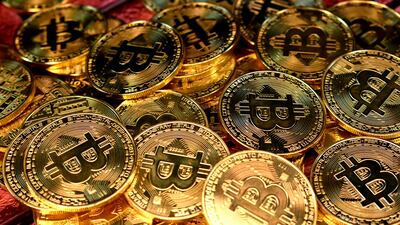
  • The crypto market, which includes currencies such as Bitcoin, pictured, has lost $2 trillion of its value in six months. Unsplash
    The crypto market, which includes currencies such as Bitcoin, pictured, has lost $2 trillion of its value in six months. Unsplash
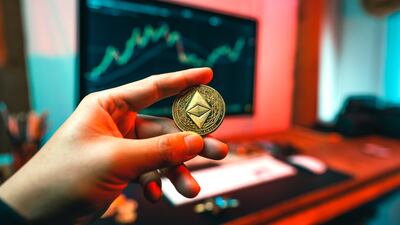
  • The price of Ethereum, the second largest cryptocurrency by market size, has fallen by 70 per cent this year. Investors and analysts are watching to see if it will dip below $1,000. Unsplash
    The price of Ethereum, the second largest cryptocurrency by market size, has fallen by 70 per cent this year. Investors and analysts are watching to see if it will dip below $1,000. Unsplash
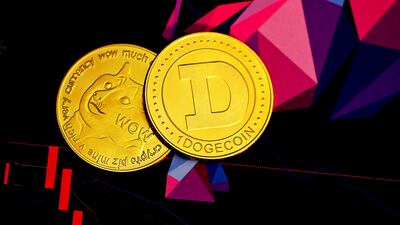
  • Dogecoin, supported by Elon Musk, is about 90 per cent down from May last year, yet it is outperforming Bitcoin and Ethereum in the current crash. Unsplash
    Dogecoin, supported by Elon Musk, is about 90 per cent down from May last year, yet it is outperforming Bitcoin and Ethereum in the current crash. Unsplash
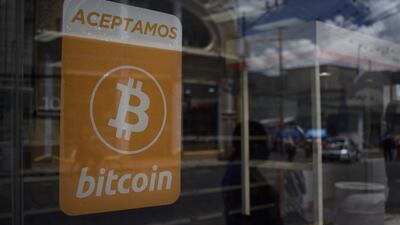
  • The government of El Salvador has invested $105 million in Bitcoin. President Nayib Bukele's embrace of the cryptocurrency as legal tender is being questioned as the market crashes. Getty
    The government of El Salvador has invested $105 million in Bitcoin. President Nayib Bukele's embrace of the cryptocurrency as legal tender is being questioned as the market crashes. Getty
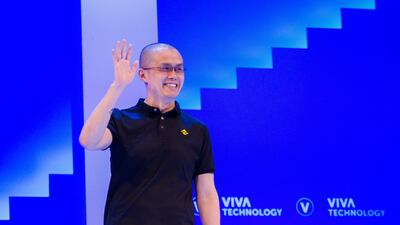
  • Changpeng Zhao, founder of crypto exchange giant Binance, has compared the current market turmoil to the dotcom bubble of the early 2000s. Still, the company is aggressively pursuing licensing in international jurisdictions and introducing new products. Getty
    Changpeng Zhao, founder of crypto exchange giant Binance, has compared the current market turmoil to the dotcom bubble of the early 2000s. Still, the company is aggressively pursuing licensing in international jurisdictions and introducing new products. Getty
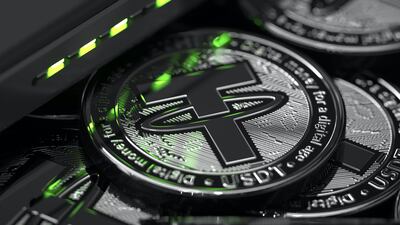
  • Tether is the biggest issuer of stablecoins, a type of cryptocurrency pegged to a traditionally stable asset like the US dollar. Most stablecoins are meant to maintain a constant price of $1 and are backed by real reserve funds, making it easy to convert crypto investments into cash. But Tether's financial statements show that may not be true, leaving the issuer and its investors vulnerable. Unsplash
    Tether is the biggest issuer of stablecoins, a type of cryptocurrency pegged to a traditionally stable asset like the US dollar. Most stablecoins are meant to maintain a constant price of $1 and are backed by real reserve funds, making it easy to convert crypto investments into cash. But Tether's financial statements show that may not be true, leaving the issuer and its investors vulnerable. Unsplash
  • The recent crypto crash can in part be attributed to the collapse of TerraUSD, a stablecoin pegged to the US dollar through algorithms and linked to a "sister" cryptocurrency named Luna. When the price of Luna plummeted, TerraUSD also fell, creating a “death spiral” to practically zero for both coins. Unsplash
    The recent crypto crash can in part be attributed to the collapse of TerraUSD, a stablecoin pegged to the US dollar through algorithms and linked to a "sister" cryptocurrency named Luna. When the price of Luna plummeted, TerraUSD also fell, creating a “death spiral” to practically zero for both coins. Unsplash
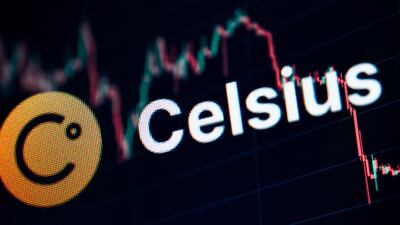
  • On June 12 crypto lender Celsius Network said it had paused customer withdrawals, saying it needed “to stabilise liquidity and operations”. Investors are still waiting, with no signs that the current meltdown will let up. Getty
    On June 12 crypto lender Celsius Network said it had paused customer withdrawals, saying it needed “to stabilise liquidity and operations”. Investors are still waiting, with no signs that the current meltdown will let up. Getty

Investors are embracing risk again as inflation and interest expectations peak, but they are at risk of becoming complacent, says Vijay Valecha, chief investment officer at Century Financial.

“They are understandably enjoying the joyride after a rough year but should err on the side of caution.”

We now live in a very different world, as the Fed funds rate has climbed from a range of 0.25 per cent to 0.5 per cent last March to 4.5 per cent to 4.75 per cent today.

Markets expect two more rate increases and this means that early stage growth companies can no longer borrow money at rock-bottom rates based on the promise of profits tomorrow.

“Investors now assign more value to good-quality companies with a sound rationale and strong income prospects today,” Mr Valecha says.

Cryptocurrencies remain a “high-risk and speculative asset class”, while some US tech hopefuls are now classified as penny stocks after last year’s falls, he says.

“Investors should stick to good-quality names and not try to catch falling knives or make outsize bets on futuristic or niche technologies.”

Some risk is good but do not overdo it as a hawkish word from the Fed could dampen sentiment overnight, Mr Valecha adds.

Tech giants Apple, Amazon and Google-owner Alphabet delivered a check to bullish sentiment last week, as their earnings “disappointed in their own separate ways”, says Chris Beauchamp, chief market analyst at trading platform IG Group.

“Despite this, risk appetite seems to be solid and US equities have started to join in on the global rally amid hopes for a more upbeat performance next time.”

Others are even more optimistic, including Yves Bonzon, group chief investment officer at Julius Baer, who boldly states that we are now witnessing “a new bull cycle, not a bear rally”.

From a technical point of view, the rally is healthy, with broad participation across the index components, Mr Bonzon says.

“We have been saying for several months now that the bottom of the 2022 bear market was in October. We are not in a counter-trend rally but a new bull cycle.”

We have been saying for several months now that the bottom of the 2022 bear market was in October
Yves Bonzon,
group chief investment officer at Julius Baer

Naturally, there are still threats, such as a Covid-19 resurgence and war in Ukraine, but as inflation falls, markets should rise.

Everything now rests on the speed of what Mr Bonzon calls “disinflation” and how central banks respond.

In the US, the Fed has almost finished its work but does not want to signal a premature pause, while the European Central Bank is at risk of overdoing it and should resist “embarking on a path of excessive tightening that can only lead to another embarrassing reversal”, Mr Bonzon says.

Samuel Fuller, director of Financial Markets Online, says investors are now anxiously trying to second guess the Fed’s next move.

“Some market watchers are predicting interest rates could soon peak at 4.95 per cent. Ordinarily, all this would give a fillip to US equities but so far, markets have been whipsawing because of the ambivalent signals accompanying the Fed’s decision,” he says.

“This has left both the US dollar and stock markets in limbo as traders scramble to decode which of the contradictory signals to believe.”

Markets are likely to pause after their recent strong run, but investors who are too cautious risk making a classic mistake. History shows that the biggest returns are made in the early stages of a bull market.

As recent events have shown, when investors get their mojo back, we are likely to find them singing the same tunes as before.


Abramovich London

A Kensington Palace Gardens house with 15 bedrooms is valued at more than £150 million.

A three-storey penthouse at Chelsea Waterfront bought for £22 million.

Steel company Evraz drops more than 10 per cent in trading after UK officials said it was potentially supplying the Russian military.

Sale of Chelsea Football Club is now impossible.

Ten tax points to be aware of in 2026

1. Domestic VAT refund amendments: request your refund within five years

If a business does not apply for the refund on time, they lose their credit.

2. E-invoicing in the UAE

Businesses should continue preparing for the implementation of e-invoicing in the UAE, with 2026 a preparation and transition period ahead of phased mandatory adoption. 

3. More tax audits

Tax authorities are increasingly using data already available across multiple filings to identify audit risks. 

4. More beneficial VAT and excise tax penalty regime

Tax disputes are expected to become more frequent and more structured, with clearer administrative objection and appeal processes. The UAE has adopted a new penalty regime for VAT and excise disputes, which now mirrors the penalty regime for corporate tax.

5. Greater emphasis on statutory audit

There is a greater need for the accuracy of financial statements. The International Financial Reporting Standards standards need to be strictly adhered to and, as a result, the quality of the audits will need to increase.

6. Further transfer pricing enforcement

Transfer pricing enforcement, which refers to the practice of establishing prices for internal transactions between related entities, is expected to broaden in scope. The UAE will shortly open the possibility to negotiate advance pricing agreements, or essentially rulings for transfer pricing purposes. 

7. Limited time periods for audits

Recent amendments also introduce a default five-year limitation period for tax audits and assessments, subject to specific statutory exceptions. While the standard audit and assessment period is five years, this may be extended to up to 15 years in cases involving fraud or tax evasion. 

8. Pillar 2 implementation 

Many multinational groups will begin to feel the practical effect of the Domestic Minimum Top-Up Tax (DMTT), the UAE's implementation of the OECD’s global minimum tax under Pillar 2. While the rules apply for financial years starting on or after January 1, 2025, it is 2026 that marks the transition to an operational phase.

9. Reduced compliance obligations for imported goods and services

Businesses that apply the reverse-charge mechanism for VAT purposes in the UAE may benefit from reduced compliance obligations. 

10. Substance and CbC reporting focus

Tax authorities are expected to continue strengthening the enforcement of economic substance and Country-by-Country (CbC) reporting frameworks. In the UAE, these regimes are increasingly being used as risk-assessment tools, providing tax authorities with a comprehensive view of multinational groups’ global footprints and enabling them to assess whether profits are aligned with real economic activity. 

Contributed by Thomas Vanhee and Hend Rashwan, Aurifer

The biog

Born: Kuwait in 1986
Family: She is the youngest of seven siblings
Time in the UAE: 10 years
Hobbies: audiobooks and fitness: she works out every day, enjoying kickboxing and basketball

Company%20profile
%3Cp%3E%3Cstrong%3ECompany%3A%20%3C%2Fstrong%3ESplintr%3C%2Fp%3E%0A%3Cp%3E%3Cstrong%3EStarted%3A%20%3C%2Fstrong%3EMay%202019%3C%2Fp%3E%0A%3Cp%3E%3Cstrong%3EFounders%3A%20%3C%2Fstrong%3EMohammad%20AlMheiri%20and%20Badr%20AlBadr%3C%2Fp%3E%0A%3Cp%3E%3Cstrong%3EBased%3A%20%3C%2Fstrong%3EDubai%20and%20Riyadh%3C%2Fp%3E%0A%3Cp%3E%3Cstrong%3ESector%3A%20%3C%2Fstrong%3Epayments%20%2F%20FinTech%3C%2Fp%3E%0A%3Cp%3E%3Cstrong%3ESize%3A%20%3C%2Fstrong%3E10%20employees%3C%2Fp%3E%0A%3Cp%3E%3Cstrong%3EInitial%20investment%3A%20%3C%2Fstrong%3Eundisclosed%20seven-figure%20sum%20%2F%20pre-seed%3C%2Fp%3E%0A%3Cp%3E%3Cstrong%3EStage%3A%20%3C%2Fstrong%3Eseed%3C%2Fp%3E%0A%3Cp%3E%3Cstrong%3EInvestors%3A%20%3C%2Fstrong%3Eangel%20investors%3C%2Fp%3E%0A
Why are asylum seekers being housed in hotels?

The number of asylum applications in the UK has reached a new record high, driven by those illegally entering the country in small boats crossing the English Channel.

A total of 111,084 people applied for asylum in the UK in the year to June 2025, the highest number for any 12-month period since current records began in 2001.

Asylum seekers and their families can be housed in temporary accommodation while their claim is assessed.

The Home Office provides the accommodation, meaning asylum seekers cannot choose where they live.

When there is not enough housing, the Home Office can move people to hotels or large sites like former military bases.

Name: Peter Dicce

Title: Assistant dean of students and director of athletics

Favourite sport: soccer

Favourite team: Bayern Munich

Favourite player: Franz Beckenbauer

Favourite activity in Abu Dhabi: scuba diving in the Northern Emirates 


Electric scooters: some rules to remember
  • Riders must be 14-years-old or over
  • Wear a protective helmet
  • Park the electric scooter in designated parking lots (if any)
  • Do not leave electric scooter in locations that obstruct traffic or pedestrians
  • Solo riders only, no passengers allowed
  • Do not drive outside designated lanes
THREE POSSIBLE REPLACEMENTS

Khalfan Mubarak
The Al Jazira playmaker has for some time been tipped for stardom within UAE football, with Quique Sanchez Flores, his former manager at Al Ahli, once labelling him a “genius”. He was only 17. Now 23, Mubarak has developed into a crafty supplier of chances, evidenced by his seven assists in six league matches this season. Still to display his class at international level, though.

Rayan Yaslam
The Al Ain attacking midfielder has become a regular starter for his club in the past 15 months. Yaslam, 23, is a tidy and intelligent player, technically proficient with an eye for opening up defences. Developed while alongside Abdulrahman in the Al Ain first-team and has progressed well since manager Zoran Mamic’s arrival. However, made his UAE debut only last December.

Ismail Matar
The Al Wahda forward is revered by teammates and a key contributor to the squad. At 35, his best days are behind him, but Matar is incredibly experienced and an example to his colleagues. His ability to cope with tournament football is a concern, though, despite Matar beginning the season well. Not a like-for-like replacement, although the system could be adjusted to suit.

Updated: March 13, 2024, 10:00 AM