

“Never let a good crisis go to waste,” Winston Churchill once said — and many international investors may be wondering if they should heed the late wartime prime minister's words and take advantage of the financial crisis that threatens to engulf the UK.
The country is in an economic mess. Worse, it is largely self-inflicted, as new Prime Minister Liz Truss makes a misguided start to her tenure.
On September 23, Chancellor Kwasi Kwarteng stood up to deliver a mini-budget aimed at driving the country's economy back to its long-term trend growth rate of 2.5 per cent a year.
Instead, he plunged it into chaos, destroying investor confidence, crushing the pound and almost triggering a pensions meltdown.
While Mr Kwarteng on Monday bowed to widespread pressure and scrapped the plan to abolish the 45 pence income tax rate for high earners, the mini-budget remains a nightmare for Britons and could end 12 years of Conservative rule. But is it also a buying opportunity for overseas investors?
____________________
Watch: UK Prime Minister Liz Truss defends economic plan
Suddenly, UK assets are going cheap. Stock markets are down, bond prices are tumbling and Credit Suisse reckons property prices could fall by 10 per cent to 15 per cent. For those with US dollars, UK assets are already more than 20 per cent cheaper, in currency terms as the greenback soars.
So what’s gone wrong and how bad — or good, depending on your perspective — can things get?
Mr Kwarteng's “fiscal event”, as he labelled it, was a masterpiece of bad timing.
Ms Truss had just announced an energy bills support package that could cost a staggering £150 billion ($168.1bn), which will be added to the nation's debt rather than funded by a windfall tax on oil and gas companies.
The last thing international investors needed to hear was that the UK was going to borrow another £72bn to fund tax cuts for the super-rich.
Allowing bankers to pay themselves bigger bonuses and initially scrapping 45 per cent income tax band was never going to be popular. But to launch it at a time when millions are facing the choice between eating and heating their homes was a fiasco.
The Tories are plunging in the polls, but the real threat comes as international investors vote with their feet.
The UK is unusual as it relies on overseas buyers to finance almost half of its government debt, to the tune of about £70bn a year. Former Bank of England governor Mark Carney once called it “relying on the kindness of strangers”.
Ms Truss and Mr Kwarteng have abused that kindness, with foreigners reluctant to buy government debt from a country whose leaders appeared to have lost all fiscal sense.
Last Wednesday, yields on 30-year UK government bonds, known as gilts, soared from 3.6 per cent to almost 5.2 per cent as investors demanded a higher return. One year ago, 30-year gilts yielded just 1.33 per cent.
When bond yields rise, bond prices fall. This almost smashed the nation’s £1.5 trillion workplace pensions system, as trustees found their bond holdings no longer matched their liabilities and had to sell them in a panic to raise cash.
____________________
Cost of living crisis in the UK — in pictures
-
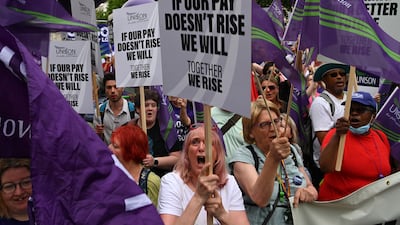
People demonstrate in central London against the rising cost of living. EPA -
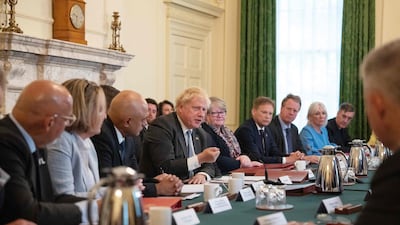
Former British prime minister Boris Johnson said workers should accept a pay cut to avoid spiralling inflation. AFP -
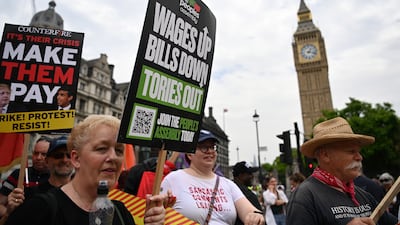
Inflation in the UK hit an annual rate of 9.1 per cent in May. EPA -

The British government told workers they cannot expect pay rises to keep up with the increasing cost of living. EPA -
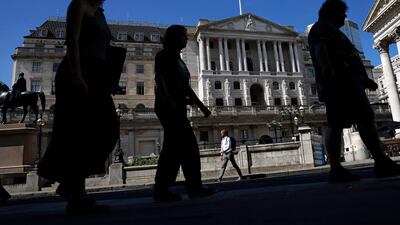
The Bank of England, which says it can do nothing to stop the sharp increase in prices, is raising rates at an unprecedented rate. AFP -
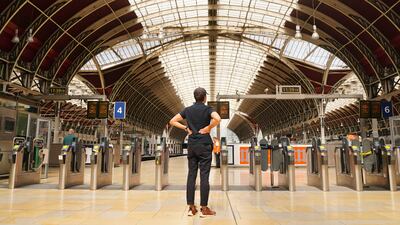
The UK was also brought to standstill by the biggest rail strike in 30 years this week, with 40,000 RMT union members walking out in a row over a below-inflation pay offer. PA -

The RMT picket line outside Bristol Temple Meads station. PA -
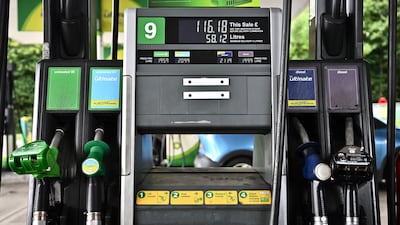
The cost of petrol continues to rise. AFP -
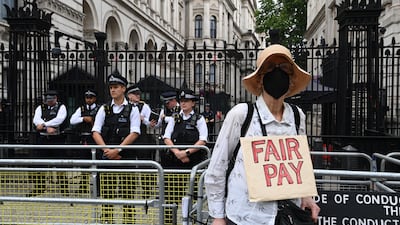
A protester demonstrates outside Downing Street. EPA -

Volunteers in Bradford, northern England, prepare food parcels at the Bradford Central Foodbank. More and more people are visiting the centre. AFP


BoE governor Andrew Bailey stepped into prevent ruinous financial contagion with a pledge to buy £65bn of his own gilts.
The central bank's intervention has given embattled buyers a reason to step back into the market, says Chris Beauchamp, chief market analyst at online trading platform IG. “This might mark the low for now in risk assets.”
The pound has recovered slightly. After threatening to fall to parity with the US dollar, it has crept above $1.11. Gilt yields are below 4 per cent.
An uneasy peace holds but after the recent wave of selling, there’s hope for a bounce in the short-term, Mr Beauchamp says.
However, “this doesn’t change the bleaker medium-term view”, he adds.
Perhaps surprisingly, London’s benchmark FTSE 100 index has not done that badly this year, falling “just” 7.56 per cent. That is dwarfed by the 24.1 per cent drop on the US S&P 500.
The FTSE 100 is packed with banking, energy, consumer staples and healthcare stocks that hold up well in times of weak growth and high inflation, says Jason Hollands, managing director of Bestinvest.
“It has low exposure to growth sectors like technology, communications and consumer discretionary businesses, which have sold off this year,” Mr Hollands says.
Companies listed on the index generate three quarters of their earnings overseas, so actually benefit from a weaker pound, as this boosts the value of those revenues once converted back into a weaker sterling.
The FTSE 100 also offers attractive dividends, currently yielding 4.1 per cent a year against 1.69 per cent on the S&P 500. It is much cheaper than the US, trading at 14 times earnings against around 27 times.
Nobody expects the FTSE 100 to take off like a rocket but it does have its attractions, says Victoria Scholar, head of investment at Interactive Investor. “It offers steady growth and income prospects for long-term investors.”
As with all UK assets, it is also cheaper for dollar buyers, as the pound has fallen an incredible 21.11 per cent against the greenback.
Sterling is not the only currency on the rack. The euro is down 15.74 per cent against the dollar year-to-date, while the Japanese yen has fallen 25.43 per cent against the greenback.
If you earn dollars or dollar-pegged currencies such as the UAE dirham, everywhere is cheap at the moment.
A more exciting question is whether now is the time to buy UK property.
The UK property market has been astonishingly resilient, with prices rising another 11.5 per cent in the 12 months to August despite this year’s woes.
That may change as the mortgage market is in disarray. When gilt yields rocketed, lenders pulled more than 3,000 fixed-rate deals, which were suddenly impossible to price.
Markets expect the BoE to hike base lending rates from today’s 2.25 per cent to 6 per cent, to save the pound and curb inflation.
That would add £7,500 a year to the cost of servicing a £200,000 variable rate mortgage, at a time when millions are struggling to financially cover food and fuel costs. Many will be forced to sell their homes, but could find buyers in short supply.
As mortgage rates rocket and choice shrinks, the market is under pressure, says Tomer Aboody, director of property finance lender MT Finance. “We are seeing a shift in sentiment and the move to a buyers’ market. Sellers no longer call the shots.”
director of property finance lender MT Finance
Buying UK property is also slightly cheaper, as Mr Kwarteng cut stamp duty in his mini-budget, saving buyers up to £2,500.
But those expecting to bag a prime bargain may be disappointed, Mr Aboody says. “Prime properties, especially within the London area, should sustain values as foreign buyers take advantage of the weaker pound.”
Anybody buying UK assets today must brace themselves for further volatility, says Joshua Raymond of currency broker XTB. “The Bank of England is applying plasters on the financial wounds created by the Truss government.”
The central bank’s £64bn intervention only lasts until October 14. If Ms Truss and Mr Kwarteng have not relented by then, the crisis could intensify.
Global investors will not want to let today's crisis go to waste but nor should they rush in either.
This could have a lot further to run and if it does, buyers could find even bigger bargains in the months ahead, especially in the nation’s property market.

