

Gautam Adani, the Indian tycoon who has climbed the wealth rankings at breakneck speed this year, surpassed Jeff Bezos to become the world’s second-richest person.
Mr Adani, who started the year as No 14 on the Bloomberg Billionaires Index, now has a $146.9 billion fortune that trails only Elon Musk’s $260bn.
Shares of his flagship Adani Enterprises surged to a record this week, and some of his group companies have climbed more than 1,000 per cent since 2020.
________________
Watch: who is billionaire Elon Musk?
Mr Bezos’s net worth dropped to $145.8bn as of 10.38am New York time on Friday, as a renewed tech sell-off again hammered the fortunes of the richest Americans.
The shift in the wealth rankings could be fleeting and depends largely on shares of Amazon, which are down more than 26 per cent this year.
Mr Adani first overtook India’s Mukesh Ambani as the richest Asian person in February, became a centibillionaire in April and surpassed Bill Gates and France’s Bernard Arnault in the past two months.
It’s the first time someone from Asia has featured this high in the top echelons of the wealth index, which has been dominated by US tech entrepreneurs.
Mr Adani, 60, dropped out of college to try his luck in Mumbai’s diamond industry in the early 1980s before turning to coal and ports.
His conglomerate has since expanded into everything from airports to data centres, cement, media and green energy, focusing on areas that Prime Minister Narendra Modi deems crucial to meeting India’s long-term economic goals.
The nation’s largest private-sector port and airport operators, city-gas distributor and coal miner are all part of Mr Adani’s empire, which also aims to become the world’s largest renewable-energy producer.
Last year, it pledged to invest $70bn in green power, a pivot that has been criticised by some as greenwashing given that so much of the group’s revenue still comes from fossil fuels.
The push into renewables and infrastructure has earned Mr Adani investments from companies including Warburg Pincus and TotalEnergies, helping to boost his companies’ shares and his personal fortune.
This year, he added about $70bn to his wealth — more than anyone else — while many have seen losses.
The rapid expansion of Mr Adani’s conglomerate prompted Fitch Group unit CreditSights to describe some of the companies’ leverage as “elevated” in a September report. The group has said its companies have reduced debt levels in recent years.
The scrutiny is adding to already existing worries over opaque shareholder structures and a lack of analyst coverage. Some Adani Group companies have traded at 700 times earnings, far surpassing companies such as Tesla. and Amazon, whose valuations have been closer to 100 times.
Mr Adani’s rise coincides with a tech sell-off that has shaved more than $45bn from Mr Bezos’s fortune since January.
The net worth of the Amazon founder — for years the world’s richest person — also significantly dropped after his 2019 divorce from ex-wife MacKenzie Scott, who received 4 per cent of the e-commerce giant.
__________
Expensive divorces — in pictures
-
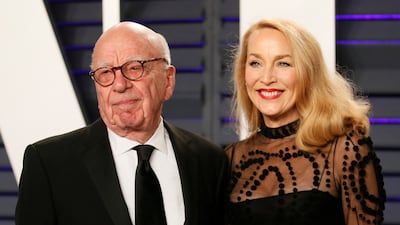
Jerry Hall cited irreconcilable differences as the reason for her split from billionaire Rupert Murdoch. Reuters -
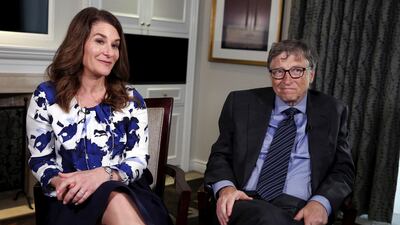
After 27 years of marriage, Microsoft co-founder Bill Gates and his wife Melinda filed divorce documents on May 3, 2021, citing a broken relationship as the reason for the split. Reuters -
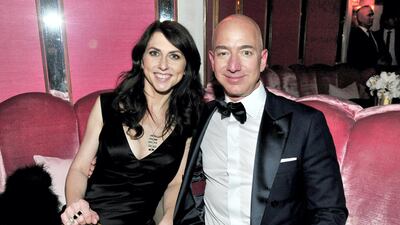
Jeff Bezos and his wife MacKenzie split in 2019. Mr Bezos paid $38bn to settle the divorce. Getty -
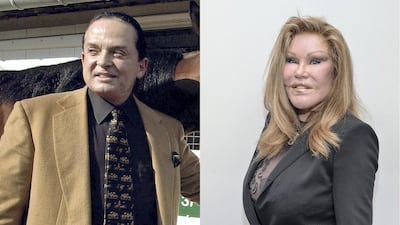
French-American businessman and art dealer Alec Wildenstein divorced his wife of 21 years, Jocelyn Wildenstein in 1999. AFP -
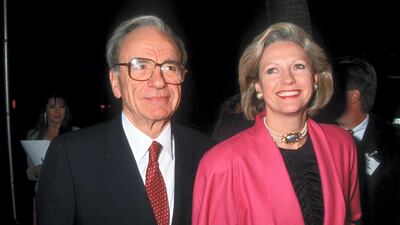
Mr Murdoch and journalist Maria Torv were married for 31 years, but the couple agreed to separate in 1998. Getty -

Former Formula One boss Bernie Ecclestone divorced international model Slavica Radic in 2009 after 25 years of marriage. Photo: Alamy -
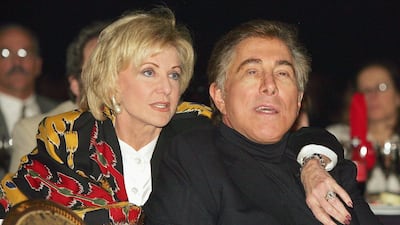
Steve Wynn and his wife Elaine were married to each other twice, from 1963 to 1986 and from 1991 to 2010. Getty -

Oil magnate Harold Hamm wrote his wife Sue Ann Arnall a $974.8 million cheque as part of divorce proceedings. Getty -

Saudi billionaire Adnan Khashoggi paid his wife Soraya a divorce settlement of $874m in 1982. Getty -
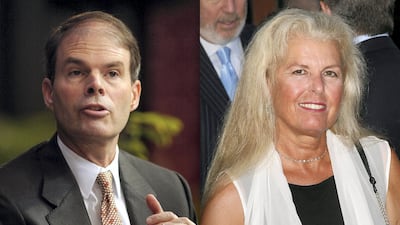
Cellular and Clearwire founder Craig McCaw separated with Wendy McCaw in 1998, earning her a $460m payout. Getty


The Indian tycoon, who has vowed to donate $7.7bn for social causes, has also been able to climb the wealth ranking because many of the tech entrepreneurs at the top have boosted their charitable giving.
Mr Bezos has committed $10bn to fight climate change and has donated money to the Smithsonian National Air and Space Museum.
Mr Gates and Warren Buffett, some of the top philanthropists, started the Giving Pledge initiative in 2010 to help ease a growing inequality gap.
The Microsoft co-founder said in July he was transferring $20bn to the Bill & Melinda Gates Foundation, which has also received more than $35bn from Mr Buffett.

