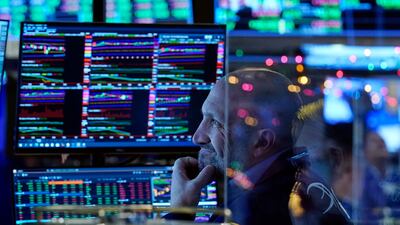
A trader on the floor of the New York Stock Exchange. Global shares rose by 17.3 per cent in 2021, as measured by the MSCI World index. AP

What are the best ways to invest your money in 2022?


  • English
  • Arabic

2021 was another great year for investors as the stock market shrugged off concerns about Covid-19 variants and resurgent inflation to fly higher for the third year in a row.

But not every asset class did well. The gold price fell, bonds struggled and cash remains a no-go zone.

So what can we expect in 2022? Unsurprisingly, there is plenty out there to make investors nervous.

The Omicron variant is spreading like wildfire, although so far it seems milder than Delta, while inflation hit a dizzying 6.8 per cent in the US in November. There are geopolitical worries, too.

There is another concern. Shares, property and cryptocurrency are floating on a sea of fiscal and monetary stimulus, but 2022 looks like the year in which central bankers and politicians will cut back. Are we finally facing the end of the great bull run?

Shares

In 2019, global shares rose by a thumping 28.4 per cent, as measured by the MSCI World index.

Last year, they shrugged off Covid-19 lockdowns to rise an impressive 16.5 per cent. They did it again in 2021, with MSCI World up another 17.3 per cent so far. In the US, the S&P 500 is up 30 per cent at the time of writing.

Clearly, this cannot go on for ever. So, is 2022 the year it all stops?

In the US, every single major sector rose last year, including technology, industrial, materials, energy, health care, utilities, financials and real estate, according to Matt Weller, global head of research at City Index.

Historically, this suggests that we are in a mid-to-late bull market cycle. “If defensive sectors like utilities, consumer staples and health care start to outperform, that could finally signal that the bear market may be around the corner,” he says.

If defensive sectors like utilities, consumer staples and health care start to outperform, that could finally signal that the bear market may be around the corner
Matt Weller,
global head of research, City Index

Megacap US tech firms were the stand-out performers once again, with Google-owner Alphabet rising 67 per cent and Microsoft (up 55 per cent), Apple (36 per cent) and Tesla (27 per cent) all putting in impressive performances.

Markets expect the US Federal Reserve to increase interest rates three or four times in 2022, and this could hit “overvalued technology stocks”, says Fawad Razaqzada, market analyst at Think Markets.

“Fed policy tightening will reduce the appeal of lower-yielding growth stocks, especially those with overstretched valuations. Sentiment hasn’t been helped by insider selling of late.”

Rising interest rates will increase debt servicing costs and squeeze company profit margins, says Laith Khalaf, head of investment analysis at AJ Bell.

“The US now accounts for two thirds of global stock market capitalisation, much of this concentrated in a small number of technology stocks. If big tech sneezes, the rest of the world is going to catch a very nasty cold,” Mr Khalaf says.

The travel, retail and hospitality sectors have been hit hard by Omicron lockdowns but do not write off equities yet, Mr Khalaf says.

“The stock market looks like the best game in town when it comes to delivering long-term returns in excess of inflation.

“As ever, investors need to tune out the short-term noise and keep an eye firmly on the long term, investing regularly to smooth out volatility,” he says.

Two markets could outperform, says Richard Whitehall, head of portfolio management at Aegon. “The UK and Japan offer relatively less demanding valuations and are well positioned to participate in the economic recovery.”

Outlook: The bull market has to end at some point and 2022 could be the year. Yet, there is still no better place to invest your money and any dip could be a buying opportunity for long-term investors.

Bonds

Many investors have abandoned bonds, amid negative real yields and fears of a bond market crash.

Bonds were traditionally supposed to offer a low-risk income and capital but some argue they have turned into a “high risk, no return” investment instead.

They pay a fixed rate of interest and this will look less and less attractive if inflation climbs, Mr Khalaf says.

Tighter monetary policy is on the way, barring a significant resurgence of the pandemic, and that could come as a shock to the bond market
Laith Khalaf,
head of investment analysis, AJ Bell

“Tighter monetary policy is on the way, barring a significant resurgence of the pandemic, and that could come as a shock to the bond market, which has become accustomed to ultra-loose monetary policy.”

As well as raising interest rates, central banks could start running down their huge bond purchasing programmes, affecting demand.

“Unless we believe monetary policy will never normalise and that quantitative easing is here for ever, there must come a day of reckoning for the bond market. It might be a gradual deflation rather than an explosive rupture, but it does look like a question of when, not if,” Mr Khalaf says.

Outlook: Analysts have been warning of a bond market crash for years but it has yet to happen. The higher inflation goes, the bigger the danger.

Cash

The average cash account has fallen in real terms by 2.37 per cent a year after inflation over the past decade, eroding the value of a £10,000 ($13,514) investment to £8,711, according to Brewin Dolphin.

Most people persist in thinking that cash in the bank is risk free, but inflation is a “silent killer”, investment manager Rob Burgeman says.

Many people do not realise this and banks are not obliged to issue warnings as they are with shares.

Most people think that cash in the bank is risk free, but inflation is a silent killer, financial advisers say. Ryan Carter / The National

“A more accurate bank statement would show the impact of inflation on your money and include warnings that cash savings may lose value over time,” Mr Burgeman says.

Interest rates will rise in 2022 but inflation will rise faster, according to Mr Khalaf. “Cash therefore still looks like an uncomfortable place to be for the foreseeable future.”

Outlook: Everybody needs a bit of money on instant access for emergencies, but you should never leave money in cash for the long term. The outlook has gone from bad to worse.

Cryptocurrencies

There was no Santa rally for Bitcoin, ended 2021 trading around $46,000. That is still a rise of more than 50 per cent, but it has been sliding lately and this year could be tougher, Vijay Valecha, chief investment officer at Century Financial, says. “Investors have retreated from the most speculative asset classes, worried that an ebbing tide of central bank stimulus and new variant of Covid-19 could spell trouble.”

Bitcoin will need to creep above the $50,000 mark for the bulls to take over again, he says. As ever, anything could happen.

For those happy to take a punt, cryptocurrency trader Nick Ranga at AskTraders.com tips Ethereum, which he calls “the only other digital asset besides Bitcoin worthy of being labelled as a blue-chip cryptocurrency”.

“It is the most used blockchain in the world and the default network for emerging non-fungible tokens, or NFTs,” he adds.

Ethereum can currently run 30 transactions per second but this year’s upgrade could increase that to 100,000 per second, giving it a further boost.

BinanceCoin, Polkadot, Solana, Cardano and XRP from Ripple are also worth watching in 2022, Mr Ranga says.

Outlook: Cryptocurrencies will remain as volatile as ever in 2022, but it is hard to shake the feeling that the big money has already been made.

Gold

Gold was possibly the only major asset class to fall in value last year, down about 5 per cent to $1,800 an ounce at the time of writing.

The precious metal does not pay interest, which means it could struggle if rates rise this year and make alternative safe havens such as cash and bonds look relatively more attractive.

“Money markets are now pricing in a 50 per cent possibility of an interest rate hike at the US Federal Reserve’s March meeting, which is capping the metal’s upside,” Mr Valecha says.

Although gold underperformed in 2021, it hit an all-time high of $2,084 as recently as August 2020, David Jones, chief market strategist at Capital.com, says. “Yet those glory days do feel well behind it at the moment.”

Some die-hard gold bugs believe that gold is due a good year after recent struggles, Mr Jones says. “It could do well if the economic bubble does finally pop.”

Outlook: Every investor should have some exposure to gold but now is not the time to rush into the precious metal as inflation climbs. Many also argue that Bitcoin is replacing it as a store of value. Time will tell.

Every investor should have some exposure to gold but now is not the time to rush into the precious metal as inflation climbs. Reuters

Surprise package?

Many analysts expect China to have a challenging year as growth slows, the government tightens scrutiny on the technology sector and the Evergrande collapse threatens its property market, but Aegon’s head of portfolio management, Richard Whitehall, is more optimistic.

“Equity prices may have reacted too strongly to China’s economic and policy difficulties, and the government may act to stabilise the economy and counteract any growth pressure. The current fall in valuations may well present opportunities over the next 12 months,” he says.

Outlook: China faces a bumpy year but may be worth buying on the dips.

MORE FROM CON COUGHLIN

Springtime in a Broken Mirror,
Mario Benedetti, Penguin Modern Classics


Stage result

1. Jasper Philipsen (Bel) Alpecin-Fenix 4:42:34

2. Sam Bennett (Irl) Bora-Hansgrohe

3. Elia Viviani (Ita) Ineos Grenadiers

4. Dylan Groenewegen (Ned) BikeExchange-Jayco

5. Emils Liepins (Lat) Trek-Segafredo

6. Arnaud Demare (Fra) Groupama-FDJ

7. Max Kanter (Ger) Movistar Team

8. Olav Kooij (Ned) Jumbo-Visma

9. Tom Devriendt (Bel) Intermarché-Wanty-Gobert Matériaux

10. Pascal Ackermann (Ger) UAE Team Emirate

Mobile phone packages comparison

Mercer, the investment consulting arm of US services company Marsh & McLennan, expects its wealth division to at least double its assets under management (AUM) in the Middle East as wealth in the region continues to grow despite economic headwinds, a company official said.

Mercer Wealth, which globally has $160 billion in AUM, plans to boost its AUM in the region to $2-$3bn in the next 2-3 years from the present $1bn, said Yasir AbuShaban, a Dubai-based principal with Mercer Wealth.

Within the next two to three years, we are looking at reaching $2 to $3 billion as a conservative estimate and we do see an opportunity to do so,” said Mr AbuShaban.

Mercer does not directly make investments, but allocates clients’ money they have discretion to, to professional asset managers. They also provide advice to clients.

“We have buying power. We can negotiate on their (client’s) behalf with asset managers to provide them lower fees than they otherwise would have to get on their own,” he added.

Mercer Wealth’s clients include sovereign wealth funds, family offices, and insurance companies among others.

From its office in Dubai, Mercer also looks after Africa, India and Turkey, where they also see opportunity for growth.

Wealth creation in Middle East and Africa (MEA) grew 8.5 per cent to $8.1 trillion last year from $7.5tn in 2015, higher than last year’s global average of 6 per cent and the second-highest growth in a region after Asia-Pacific which grew 9.9 per cent, according to consultancy Boston Consulting Group (BCG). In the region, where wealth grew just 1.9 per cent in 2015 compared with 2014, a pickup in oil prices has helped in wealth generation.

BCG is forecasting MEA wealth will rise to $12tn by 2021, growing at an annual average of 8 per cent.

Drivers of wealth generation in the region will be split evenly between new wealth creation and growth of performance of existing assets, according to BCG.

Another general trend in the region is clients’ looking for a comprehensive approach to investing, according to Mr AbuShaban.

“Institutional investors or some of the families are seeing a slowdown in the available capital they have to invest and in that sense they are looking at optimizing the way they manage their portfolios and making sure they are not investing haphazardly and different parts of their investment are working together,” said Mr AbuShaban.

Some clients also have a higher appetite for risk, given the low interest-rate environment that does not provide enough yield for some institutional investors. These clients are keen to invest in illiquid assets, such as private equity and infrastructure.

“What we have seen is a desire for higher returns in what has been a low-return environment specifically in various fixed income or bonds,” he said.

“In this environment, we have seen a de facto increase in the risk that clients are taking in things like illiquid investments, private equity investments, infrastructure and private debt, those kind of investments were higher illiquidity results in incrementally higher returns.”

The Abu Dhabi Investment Authority, one of the largest sovereign wealth funds, said in its 2016 report that has gradually increased its exposure in direct private equity and private credit transactions, mainly in Asian markets and especially in China and India. The authority’s private equity department focused on structured equities owing to “their defensive characteristics.”

The biog

Hometown: Cairo

Age: 37

Favourite TV series: The Handmaid’s Tale, Black Mirror

Favourite anime series: Death Note, One Piece and Hellsing

Favourite book: Designing Brand Identity, Fifth Edition

What vitamins do we know are beneficial for living in the UAE

Vitamin D: Highly relevant in the UAE due to limited sun exposure; supports bone health, immunity and mood.Vitamin B12: Important for nerve health and energy production, especially for vegetarians, vegans and individuals with absorption issues.Iron: Useful only when deficiency or anaemia is confirmed; helps reduce fatigue and support immunity.Omega-3 (EPA/DHA): Supports heart health and reduces inflammation, especially for those who consume little fish.

Seven tips from Emirates NBD

1. Never respond to e-mails, calls or messages asking for account, card or internet banking details

2. Never store a card PIN (personal identification number) in your mobile or in your wallet

3. Ensure online shopping websites are secure and verified before providing card details

4. Change passwords periodically as a precautionary measure

5. Never share authentication data such as passwords, card PINs and OTPs  (one-time passwords) with third parties

6. Track bank notifications regarding transaction discrepancies

7. Report lost or stolen debit and credit cards immediately

The Penguin

Starring: Colin Farrell, Cristin Milioti, Rhenzy Feliz

Creator: Lauren LeFranc

Rating: 4/5

EMILY%20IN%20PARIS%3A%20SEASON%203
%3Cp%3ECreated%20by%3A%20Darren%20Star%3C%2Fp%3E%0A%3Cp%3EStarring%3A%20Lily%20Collins%2C%20Philippine%20Leroy-Beaulieu%2C%20Ashley%20Park%3C%2Fp%3E%0A%3Cp%3ERating%3A%202.75%2F5%3C%2Fp%3E%0A
Gothia Cup 2025

4,872 matches 

1,942 teams

116 pitches

76 nations

26 UAE teams

15 Lebanese teams

2 Kuwaiti teams

COMPANY PROFILE
Name: Kumulus Water
 
Started: 2021
 
Founders: Iheb Triki and Mohamed Ali Abid
 
Based: Tunisia 
 
Sector: Water technology 
 
Number of staff: 22 
 
Investment raised: $4 million 
Know your Camel lingo

The bairaq is a competition for the best herd of 50 camels, named for the banner its winner takes home

Namoos - a word of congratulations reserved for falconry competitions, camel races and camel pageants. It best translates as 'the pride of victory' - and for competitors, it is priceless

Asayel camels - sleek, short-haired hound-like racers

Majahim - chocolate-brown camels that can grow to weigh two tonnes. They were only valued for milk until camel pageantry took off in the 1990s

Millions Street - the thoroughfare where camels are led and where white 4x4s throng throughout the festival

How the bonus system works

The two riders are among several riders in the UAE to receive the top payment of £10,000 under the Thank You Fund of £16 million (Dh80m), which was announced in conjunction with Deliveroo's £8 billion (Dh40bn) stock market listing earlier this year.

The £10,000 (Dh50,000) payment is made to those riders who have completed the highest number of orders in each market.

There are also riders who will receive payments of £1,000 (Dh5,000) and £500 (Dh2,500).

All riders who have worked with Deliveroo for at least one year and completed 2,000 orders will receive £200 (Dh1,000), the company said when it announced the scheme.

Tips for taking the metro

- set out well ahead of time

- make sure you have at least Dh15 on you Nol card, as there could be big queues for top-up machines

- enter the right cabin. The train may be too busy to move between carriages once you're on

- don't carry too much luggage and tuck it under a seat to make room for fellow passengers

TOURNAMENT INFO

Women’s World Twenty20 Qualifier

Jul 3- 14, in the Netherlands
The top two teams will qualify to play at the World T20 in the West Indies in November

UAE squad
Humaira Tasneem (captain), Chamani Seneviratne, Subha Srinivasan, Neha Sharma, Kavisha Kumari, Judit Cleetus, Chaya Mughal, Roopa Nagraj, Heena Hotchandani, Namita D’Souza, Ishani Senevirathne, Esha Oza, Nisha Ali, Udeni Kuruppuarachchi

While you're here
Updated: March 13, 2024, 12:25 PM