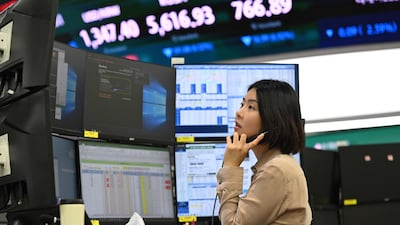

Asian markets fell on Thursday, as artificial intelligence-related stocks plunged after a drop on Wall Street, fuelled by concerns about rising competition and profit growth in the chips sector.
South Korea's Kospi slumped more than 7 per cent, while Tokyo’s Nikkei 225 index was down 5.12 per cent at midday local time on Thursday. Hong Kong's Hang Seng index dropped by 1 per cent, while China's Shanghai Composite Index fell 1.75 per cent.
Asian markets are dealing with "not just the deeper sell-off in AI-related stocks but also the tightening of financial conditions that comes from higher yields and a higher US dollar", said Kyle Rodda, senior financial market analyst at Capital.com.
In its report on Thursday, the International Monetary Fund also warned of the Asia region's heavy reliance on the AI boom.
Strong global demand for semiconductors, AI infrastructure and related technology products has boosted exports and investment, particularly in economies integrated into technology supply chains.
"The AI-driven technology boom has provided an important offset for economies in East and South-East Asia, although the evolution of AI investment and its long-term economic effects are uncertain," the fund said in a report on the outlook for the Asia-Pacific region.
"A correction in AI-related investment or asset valuations could weigh disproportionately on Asia given its central role in global technology supply chains," it added.
The IMF also said uncertainty over US monetary policy could keep Asian financial markets volatile.
Overnight, stocks on Wall Street dropped as consumer price inflation rose more than expected in September.
"Wall Street tumbled on further evidence that inflation in the United States is sticky, while a pullback in chip stocks on fears about rising competition and peak profit growth added to the woes," Mr Rodda said.
The inflation figures were the "critical driver of markets in US trade", he added.
US inflation rose to 3.7 per cent annually in September, above both the 3.6 per cent forecast for the month and August’s 3.4 per cent. Core inflation also was higher than expected, at 2.6 per cent year-on-year.
"US stocks sold off as higher-rate expectations returned to the fore, with the S&P 500 recording its weakest session since late July and the Nasdaq hit harder by pressure on chip names," said Daniel Richards, senior economist at Emirates NBD.
"The risk-off move extended into Asia, where falls in Japan and Korea this morning were much sharper."
The US inflation data now points to a higher chance of a rate hike by the US Federal Reserve, Mr Rodda said.

