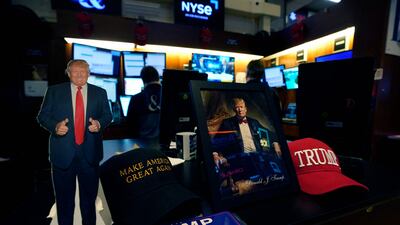

Global stock markets rallied to finish higher on Friday, with Wall Street posting its best week since Donald Trump was assured of his return to the White House and London hitting a high, as investors prepared for the new US government and a significant shift in economic policies.
When he assumes office on January 20, Mr Trump will be inheriting an economy that continues to outperform expectations.
The US economy, the world's largest, grew by 3.1 per cent last quarter, driven by consumer spending despite higher borrowing costs. Retail sales continued to grow in December, albeit at a slower pace, government data showed this week.
Inflation, meanwhile, has fallen on an uneven path, but the labour market remains on solid footing.
Still, Mr Trump has threatened to impose universal tariffs on 10 to 20 per cent of all imports, as well as an additional 60 per cent levy on goods from China.
“Mr Trump’s concerns about trade deficits and industrial competitiveness are understandable, but tariffs are not the answer,” said Nigel Green, chief executive of Dubai-based financial services firm deVere Group.
“They’re a blunt instrument that punishes consumers and disrupts global markets … Mr Trump’s tariff strategy might resonate with domestic audiences, but the global economy doesn’t operate in a vacuum.”
Still, there is optimism for a second Trump term, especially with technology companies, who have rallied and have continued to perform well since he was re-elected in November.
The gains in US stocks also come as there is more optimism about the ability of companies and the US economy to adapt to a higher interest rate environment. This optimism comes as the quarterly earnings season got off to a strong start, led by major banks.
JPMorgan Chase, Wells Fargo, Goldman Sachs and Citigroup all reported better-than-expected earnings per share. Revenues for all three, except for Wells Fargo, were also better than expected.
“The results … were enough to prove to investors that the upwards outlook for inflation and the higher-for-linger interest rates and the subsequent rise in bond yields will not prevent the stock market from continuing its bullish trend, even with high valuations,” said Samer Hasn, a senior market analyst at XS.com.
“Also, healthy results from banks help to reinforce the healthy image of the economy, and favourable earnings results from tech companies will justify high valuations, which we will wait to see during this season.”
On Wall Street, the S&P 500 added 1 per cent for its best week since the elections, propelled by gains from the so-called Magnificent Seven stocks – Alphabet, Amazon, Apple, Meta Platforms, Microsoft, Nvidia and Tesla, who individually and collectively comprise a significant weight on the S&P 500.
The Dow Jones Industrial Average rose 0.8 per cent, while the Nasdaq composite, also tech-heavy, jumped 1.5 per cent.
That has brought the gains of the S&P 500, Dow and Nasdaq in 2025 to 2 per cent, 2.2 per cent and 1.7 per cent, respectively.
In Europe, London's FTSE 100 leapt 1.4 per cent to a record on Friday, taking cues from corporate results and the anticipation of Mr Trump's return to the White House.
The UK economy growth is expected to grow 1.6 per cent in 2025, up from an initial 1.4 per cent projection and after missing forecasts last year, the International Monetary Fund said this week.
Frankfurt's DAX also rose 1.2 per cent to settle at a new high, while Paris' CAC-40 added 1 per cent.
Earlier in Asia, major indices were mixed as Tokyo's Nikkei 225 bucked the trend, edging down 0.3 per cent at the close. Gaming giant Nintendo led the decline, shedding by as much as 7 per cent on Friday after a disappointing preview of its upcoming Switch 2 hand-held console.
Hong Kong's Hang Seng index added 0.3 per cent, while the Shanghai Composite rose 0.2 per cent, as China, the world's second-largest economy, awaits Mr Trump's tariff moves while its battles a tepid economy.
In commodities, oil prices settled lower on Friday on supply concerns, but still managed to post a fourth consecutive weekly gain as the US imposed more sanctions on Russia’s energy industry.
Brent closed 0.62 per cent lower at $80.79 a barrel, while West Texas Intermediate shed 1.02 per cent to settle at $77.88.
Gold, meanwhile, notched a third weekly gain in a row despite closing lower on Friday, weighed by a strong dollar but supported by uncertainties on the next Trump administration.
The precious metal declined 0.6 per cent to $2,703.20 an ounce. Silver retreated 1.38 per cent to $30.40 an ounce.

