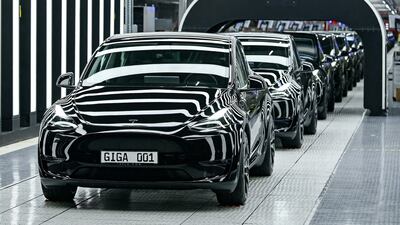
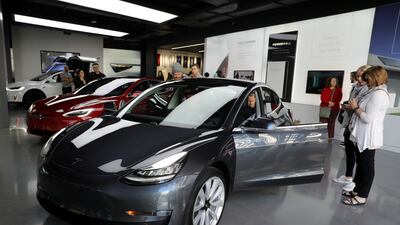
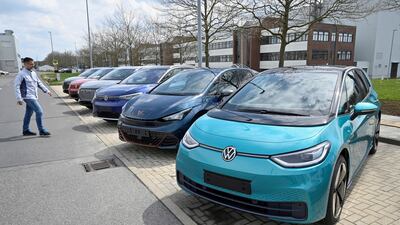
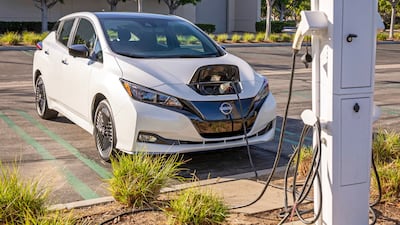
The merry-go-round of private meetings at an annual mining industry conference at Florida’s Hollywood Beach had a cast of new faces this year: carmaker executives who are anxious about surging prices and tighter supply of metals used in electric vehicle batteries.
Tesla, Ford Motor and Mercedes-Benz Group were among the companies to send senior staff to the BMO Global Metals & Mining Conference, an event typically attended by iron ore and aluminium producers.
Their presence underscores the growing popularity of battery-powered cars, helped by a push towards clean energy, which is estimated to require $10 trillion worth of metals until 2050, according to Bloomberg.
Car producers “had room-to-room meetings with a lot of companies, like ourselves, trying to understand how to address their own supply chain”, said Trent Mell, chief executive of Electra Battery Materials, a Toronto-based developer of mining and refining projects.
Car companies are now filling rooms with specialists in metals like lithium — the metal that is ubiquitous in electric car batteries — and manganese, or in battery recycling, he said.
“Once you might have had one or two people dealing with raw materials procurement.”
Availability and costs of crucial battery materials like lithium, cobalt and nickel have been key concerns for years among EV makers trying to build out their electric line-ups.
The issue has gained more urgency in recent months because of rising competition to strike supply deals with mining companies and project developers and by wild swings in raw material costs. The spot value of lithium consumption alone surged to about $35 billion in 2022, from $3 billion in 2020, according to Bloomberg calculations.
Lithium “was a meaningful source of cost increase”, for Tesla in the final quarter of 2022, chief financial officer Zachary Kirkhorn said in January. While a lithium benchmark has tumbled almost a third this year, prices remain 590 per cent higher than at the start of 2021.
Volvo Car, Nio and Jeep-maker Stellantis have also said they are being affected by higher raw materials costs, and some are looking for deals with suppliers to tie-up potential sources of metals.
Like others, EV maker Rivian Automotive is spending a lot of time examining deal structures with suppliers, and this “could involve ownership positions” in mining assets, chief executive RJ Scaringe said on a February 28 earnings call.
General Motors last year struck a prepayment deal for lithium, while Ford Motor offered a loan to help fund a mine project.
“Investing in these raw materials provides a way for car makers to control margins along the supply chain and ensure they remain competitive,” said Andrew Miller, chief operating officer of Benchmark Mineral Intelligence, an industry data provider. “Raw materials are now the largest cost driver for a battery.”
Car makers are also getting involved in the development of new mining projects.
GM added a $650 million stake in Lithium Americas to help bring in a mine in Nevada, and has considered buying an interest in Brazilian giant Vale’s base metals unit. Tesla, which is constructing a metal refinery in Corpus Christi, Texas, has studied a takeover of miner Sigma Lithium.
The world’s second-largest miner, Rio Tinto Group, is hunting for lithium deals, but expects to be outbid by car producers, chief executive Jakob Stausholm said last month.
Car manufacturers are also putting more senior managers, rather than junior procurement executives, in charge of discussions over metals, according to Kent Masters, chief executive of Charlotte, North Carolina-based Albemarle, one of the world’s leading lithium suppliers.
“It’s obviously become a more critical issue for OEMs [original equipment manufacturers],” Mr Masters told the Florida conference, organised by Bank of Montreal.
“We’ve been able to change the level at which we interact with those customers, and they’re investing significant amounts of money in electric vehicles.”
Investing in these raw materials provides a way for automakers to control margins along the supply chain and ensure they remain competitive. Raw materials are now the largest cost driver for a battery
Andrew Miller,
chief operating officer of Benchmark Mineral Intelligence
Volkswagen has pledged to boost co-operation with Canada’s mining sector, formed a joint venture with Belgium-based materials supplier Umicore and has a deal with would-be lithium supplier Vulcan Energy Resources which aims to develop an operation in Germany.
Volkswagen is “sounding out the market” and is in talks with “many potential partners” on raw materials, a representative said.
“Various instruments are possible, from long-term agreements to streaming deals and equity investments,” the representative said. Hedging of commodities prices is likely to be an important way of coping with rising raw material costs, according to the group’s chief financial officer Arno Antlitz.
About $265.5 billion has been invested in developing EVs since 2018 but only $40 billion on raw materials, according to Battery Materials Review, which tracks investment in the sector.
Even so, some said moves by car manufacturers to buy directly into metals could be doomed by their lack of expertise in mining and dismal record on acquisitions, according to Jeff Currie, Goldman Sachs Group’s head of commodities.
“It always ends in tears,” he told Bloomberg. “It requires an expertise that is very different than producing cars.”

COMPANY%20PROFILE
%3Cp%3E%3Cstrong%3ECompany%20name%3A%3C%2Fstrong%3E%203S%20Money%3Cbr%3E%3Cstrong%3EStarted%3A%3C%2Fstrong%3E%202018%3Cbr%3E%3Cstrong%3EBased%3A%3C%2Fstrong%3E%20London%3Cbr%3E%3Cstrong%3EFounders%3A%3C%2Fstrong%3E%20Ivan%20Zhiznevsky%2C%20Eugene%20Dugaev%20and%20Andrei%20Dikouchine%3Cbr%3E%3Cstrong%3ESector%3A%3C%2Fstrong%3E%20FinTech%3Cbr%3E%3Cstrong%3EInvestment%20stage%3A%3C%2Fstrong%3E%20%245.6%20million%20raised%20in%20total%3C%2Fp%3E%0A
Tank warfare
Lt Gen Erik Petersen, deputy chief of programs, US Army, has argued it took a “three decade holiday” on modernising tanks.
“There clearly remains a significant armoured heavy ground manoeuvre threat in this world and maintaining a world class armoured force is absolutely vital,” the general said in London last week.
“We are developing next generation capabilities to compete with and deter adversaries to prevent opportunism or miscalculation, and, if necessary, defeat any foe decisively.”
MATCH INFO
Liverpool 2 (Van Dijk 18', 24')
Brighton 1 (Dunk 79')
Red card: Alisson (Liverpool)
Gifts exchanged
- King Charles - replica of President Eisenhower Sword
- Queen Camilla - Tiffany & Co vintage 18-carat gold, diamond and ruby flower brooch
- Donald Trump - hand-bound leather book with Declaration of Independence
- Melania Trump - personalised Anya Hindmarch handbag
Mercer, the investment consulting arm of US services company Marsh & McLennan, expects its wealth division to at least double its assets under management (AUM) in the Middle East as wealth in the region continues to grow despite economic headwinds, a company official said.
Mercer Wealth, which globally has $160 billion in AUM, plans to boost its AUM in the region to $2-$3bn in the next 2-3 years from the present $1bn, said Yasir AbuShaban, a Dubai-based principal with Mercer Wealth.
“Within the next two to three years, we are looking at reaching $2 to $3 billion as a conservative estimate and we do see an opportunity to do so,” said Mr AbuShaban.
Mercer does not directly make investments, but allocates clients’ money they have discretion to, to professional asset managers. They also provide advice to clients.
“We have buying power. We can negotiate on their (client’s) behalf with asset managers to provide them lower fees than they otherwise would have to get on their own,” he added.
Mercer Wealth’s clients include sovereign wealth funds, family offices, and insurance companies among others.
From its office in Dubai, Mercer also looks after Africa, India and Turkey, where they also see opportunity for growth.
Wealth creation in Middle East and Africa (MEA) grew 8.5 per cent to $8.1 trillion last year from $7.5tn in 2015, higher than last year’s global average of 6 per cent and the second-highest growth in a region after Asia-Pacific which grew 9.9 per cent, according to consultancy Boston Consulting Group (BCG). In the region, where wealth grew just 1.9 per cent in 2015 compared with 2014, a pickup in oil prices has helped in wealth generation.
BCG is forecasting MEA wealth will rise to $12tn by 2021, growing at an annual average of 8 per cent.
Drivers of wealth generation in the region will be split evenly between new wealth creation and growth of performance of existing assets, according to BCG.
Another general trend in the region is clients’ looking for a comprehensive approach to investing, according to Mr AbuShaban.
“Institutional investors or some of the families are seeing a slowdown in the available capital they have to invest and in that sense they are looking at optimizing the way they manage their portfolios and making sure they are not investing haphazardly and different parts of their investment are working together,” said Mr AbuShaban.
Some clients also have a higher appetite for risk, given the low interest-rate environment that does not provide enough yield for some institutional investors. These clients are keen to invest in illiquid assets, such as private equity and infrastructure.
“What we have seen is a desire for higher returns in what has been a low-return environment specifically in various fixed income or bonds,” he said.
“In this environment, we have seen a de facto increase in the risk that clients are taking in things like illiquid investments, private equity investments, infrastructure and private debt, those kind of investments were higher illiquidity results in incrementally higher returns.”
The Abu Dhabi Investment Authority, one of the largest sovereign wealth funds, said in its 2016 report that has gradually increased its exposure in direct private equity and private credit transactions, mainly in Asian markets and especially in China and India. The authority’s private equity department focused on structured equities owing to “their defensive characteristics.”
Results
%3Cp%3E%3Cstrong%3EStage%203%3A%3C%2Fstrong%3E%3Cbr%3E1.%20Einer%20Rubio%20(COL)%20Movistar%20Team%20-%204h51%E2%80%9924%E2%80%9D%3Cbr%3E2.%20Remco%20Evenepoel%20(BEL)%20Soudal%20Quick-Step%20-%2014%22%3Cbr%3E3.%20Adam%20Yates%20(GBR)%20UAE%20Team%20Emirates%20-%2015%22%3Cbr%3E%3Cstrong%3EGeneral%20classifications%3A%3C%2Fstrong%3E%3Cbr%3E1.%20Remco%20Evenepoel%20(BEL)%20Soudal%20Quick-Step%3Cbr%3E2.%20Lucas%20Plapp%20(AUS)%20Ineos%20Grenaders)%20-%207%22%3Cbr%3E3.%20Pello%20Bilbao%20(ESP)%20Bahrain%20Victorious%20-%2011%22%3C%2Fp%3E%0A
INDIA'S%20TOP%20INFLUENCERS
%3Cp%3E%3Cstrong%3EBhuvan%20Bam%3C%2Fstrong%3E%3Cbr%3E%3Ca%20href%3D%22https%3A%2F%2Fwww.instagram.com%2Fbhuvan.bam22%2F%3Fhl%3Den%22%20target%3D%22_self%22%3EInstagram%3C%2Fa%3E%20followers%3A%2016.1%20million%3Cbr%3EBhuvan%20Bam%20is%20a%2029-year-old%20comedian%20and%20actor%20from%20Delhi%2C%20who%20started%20out%20with%20YouTube%20channel%2C%20%E2%80%9CBB%20Ki%20Vines%E2%80%9D%20in%202015%2C%20which%20propelled%20the%20social%20media%20star%20into%20the%20limelight%20and%20made%20him%20sought-after%20among%20brands.%3Cbr%3E%3Cstrong%3EKusha%20Kapila%3C%2Fstrong%3E%3Cbr%3E%3Ca%20href%3D%22https%3A%2F%2Fwww.instagram.com%2Fkushakapila%2F%3Fhl%3Den%22%20target%3D%22_self%22%3EInstagram%3C%2Fa%3E%20followers%3A%203.1%20million%3Cbr%3EKusha%20Kapila%20is%20a%20fashion%20editor%20and%20actress%2C%20who%20has%20collaborated%20with%20brands%20including%20Google.%20She%20focuses%20on%20sharing%20light-hearted%20content%20and%20insights%20into%20her%20life%20as%20a%20rising%20celebrity.%3Cbr%3E%3Cstrong%3EDiipa%20Khosla%3C%2Fstrong%3E%3Cbr%3E%3Ca%20href%3D%22https%3A%2F%2Fwww.instagram.com%2Fdiipakhosla%2F%3Fhl%3Den%22%20target%3D%22_self%22%3EInstagram%3C%2Fa%3E%20followers%3A%201.8%20million%3Cbr%3EDiipa%20Khosla%20started%20out%20as%20a%20social%20media%20manager%20before%20branching%20out%20to%20become%20one%20of%20India's%20biggest%20fashion%20influencers%2C%20with%20collaborations%20including%20MAC%20Cosmetics.%3Cbr%3E%3Cstrong%3EKomal%20Pandey%3Cbr%3E%3C%2Fstrong%3E%3Ca%20href%3D%22https%3A%2F%2Fwww.instagram.com%2Fkomalpandeyofficial%2F%3Fhl%3Den%22%20target%3D%22_self%22%3EInstagram%3C%2Fa%3E%20followers%3A%201.8%20million%3Cbr%3EKomal%20Pandey%20is%20a%20fashion%20influencer%20who%20has%20partnered%20with%20more%20than%20100%20brands%2C%20including%20Olay%20and%20smartphone%20brand%20Vivo%20India.%3Cbr%3E%3Cstrong%3ENikhil%20Sharma%3C%2Fstrong%3E%3Cbr%3E%3Ca%20href%3D%22https%3A%2F%2Fwww.instagram.com%2Fnikkkhil%2F%3Fhl%3Den%22%20target%3D%22_self%22%3EInstagram%3C%2Fa%3E%20followers%3A%201.4%20million%3Cbr%3ENikhil%20Sharma%20from%20Mumbai%20began%20his%20online%20career%20through%20vlogs%20about%20his%20motorcycle%20trips.%20He%20has%20become%20a%20lifestyle%20influencer%20and%20has%20created%20his%20own%20clothing%20line.%3Cbr%3E%3Cem%3ESource%3A%20Hireinfluence%2C%20various%3C%2Fem%3E%3Cbr%3E%3C%2Fp%3E%0A
UAE%20SQUAD
%3Cp%3E%0D%3Cstrong%3EMen%3A%3C%2Fstrong%3E%20Saif%20Al%20Zaabi%2C%20Salem%20Al%20Marzooqi%2C%20Zayed%20Al%20Ansaari%2C%20Saud%20Abdulaziz%20Rahmatalla%2C%20Adel%20Shanbih%2C%20Ahmed%20Khamis%20Al%20Blooshi%2C%20Abdalla%20Al%20Naqbi%2C%20Khaled%20Al%20Hammadi%2C%20Mohammed%20Khamis%20Khalaf%2C%20Mohammad%20Fahad%2C%20Abdulla%20Al%20Arimi.%0D%3Cbr%3E%3Cstrong%3EWomen%3A%3C%2Fstrong%3E%20Mozah%20Al%20Zeyoudi%2C%20Haifa%20Al%20Naqbi%2C%20Ayesha%20Al%20Mutaiwei.%3C%2Fp%3E%0A
The specs
Engine: 4.0-litre V8
Power: 503hp at 6,000rpm
Torque: 685Nm at 2,000rpm
Transmission: 8-speed auto
Price: from Dh850,000
On sale: now
UAE currency: the story behind the money in your pockets