

The 10.7 per cent rally in the S&P 500 from its June lows is stumbling as it runs into what has been the toughest month for the US stock market, sparking nerves among some fund managers of a broad sell-off in September.
The S&P has been in a bear market since plummeting early this year as investors priced in the expectation of Federal Reserve interest rate rises, but the index has rallied strongly since June, regaining half its losses for the year.
That rebound has been fuelled by a combination of strong earnings from bellwether companies and signs that inflation might have peaked, potentially allowing the Fed to slow rate rises.
Jackson Hole Economic Symposium - in pictures
-
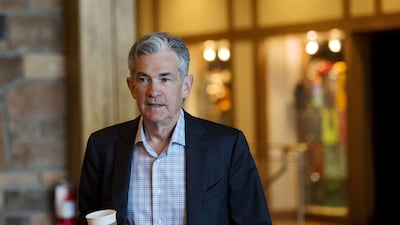
Federal Reserve chairman Jerome Powell's remarks are to be livestreamed from the annual Jackson Hole Economic Policy Symposium. Reuters -
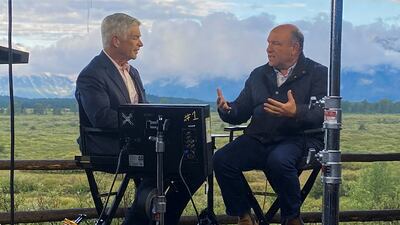
Philadelphia Federal Reserve Bank President Patrick Harker, left, speaks with CNBC's Steve Liesman in an interview ahead of the annual Federal Reserve Bank of Kansas City's Economic Policy Symposium, at Jackson Hole, Wyoming. Reuters -

Ash Hermanowski, food access and operations manager of the Jackson Cupboard in Jackson Hole, hands out meals from a garage after the nonprofit's location flooded. AP -
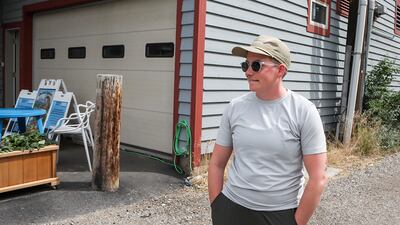
High inflation, soaring home prices and financial inequality are all too visible in the idyllic mountain setting where the economic conference takes place. AP -

Esther George, president and chief executive officer of the Federal Reserve Bank of Kansas City, gives an interview at the Jackson Hole Economic Symposium Bloomberg -
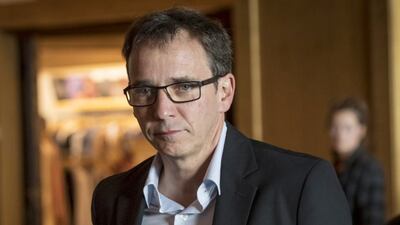
Pierre-Olivier Gourinchas, professor of economics at the University of California-Berkeley, at the 2019 summit. Reuters -
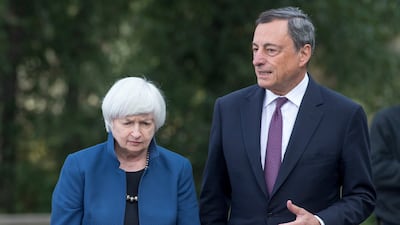
Janet Yellen, at the time chairwoman of board of governors of the Federal Reserve System and Mario Draghi, at the time president of the European Central Bank, at Jackson Hole in 2017. Bloomberg -
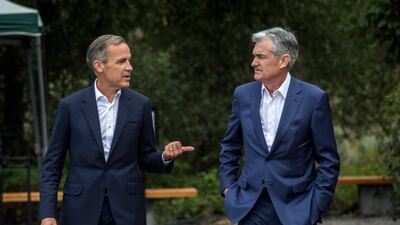
Mark Carney, left, at the time governor of the Bank of England, and Federal Reserve chairman Jerome Powell, at the 2019 Jackson Hole gathering. AP -
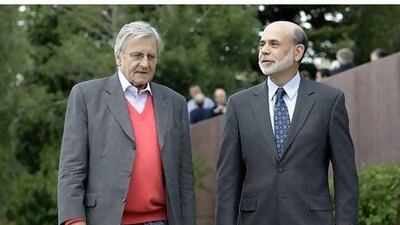
Former US Federal Reserve chairman Ben Bernanke, right, and Jean-Claude Trichet, former president of the European Central Bank, at a previous summit. AP -
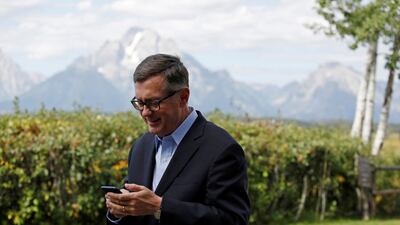
Former Federal Reserve vice chairman Richard Clarida at the 2019 Jackson Hole symposium. Reuters -
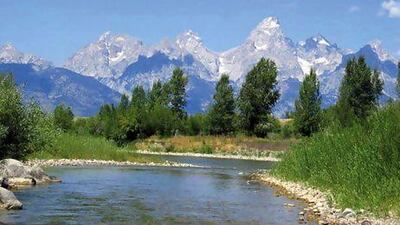
With upscale ski resorts, campsites and ranches Jackson Hole is popular with outdoor enthusiasts. Bloomberg


But as investors and traders return from summer holidays, some are nervous about a bumpier ride in September, due to seasonal concerns and nervousness about the Fed's pace of rises and their economic effect.
The S&P 500 fell nearly 3.4 per cent on Friday after Fed chairman Jerome Powell reiterated the central bank's commitment to taming inflation despite a possible recession.
"These are the unfortunate costs of reducing inflation. But a failure to restore price stability would mean far greater pain," Mr Powell said in a speech in Jackson Hole, Wyoming.
September typically is a down month for the stock market because fund managers tend to sell underperforming positions as the end of the third quarter approaches, according to the Stock Trader's Almanac.
"We've had a breathtaking run and I wouldn't be shocked if the market takes a hit here," said Jack Janasiewicz, lead portfolio strategist at Natixis Investment Management Solutions.
The S&P 500 could fall as much as 10 per cent in September as investors price in the likelihood that the Fed will not start to cut rates as early as some had hoped, Mr Janasiewicz said.
September has been the worst month for the S&P 500 since 1945, with the index advancing only 44 per cent of the time, the least of any month, according to CFRA data.
The S&P 500 has posted an average loss of 0.6 per cent in September, the worst for any month.
The index is down 14.8 per cent year to date and has been in a bear market, hitting its lowest level in June since December 2020 after the Fed announced its largest rate rises since 1994.
Chief among the reasons for the gloomy outlook is a belief that the Fed will continue increasing rates and keep them above neutral longer than markets had anticipated as recently as a week ago, weighing on consumer demand and the housing market.
Nearly half of market participants now expect the Fed funds rate to end the year above 3.7 per cent, up from 4 per cent a week ago, according to the CME FedWatch tool. The Fed funds rate is currently between 2.25 per cent and 2.5 per cent.
The September 20-21 Federal Open Market Committee meeting will also be likely to drive volatility during the month, prompting the S&P 500 to fall near its June lows, said Sam Stovall, chief investment strategist at CFRA.
Before that will be critical economic data, such as a reading on consumer prices that will offer investors more insight into whether inflation has peaked.
The strong rally since June, however, suggests the index will continue to rebound through December, Mr Stovall said.
"While we might end up retesting the June low, history says that we will not set a new low," he said.
While fund managers as a whole remain bearish, the ratio of bulls to bears has improved since July, reducing the likelihood of outsized gains in the months ahead, according to Bank of America survey released on August 16.
The bank's clients were net sellers of US equities last week for the first time in eight weeks, suggesting that investors are growing more defensive, the bank said.
At the same time, the use of leverage by hedge funds — a proxy for their willingness to take risk — has stabilised since June and is near the lowest level since March 2020, according to Goldman Sachs.
Investors may rotate into technology and other growth stocks that can take market share despite an economic slowdown, said Tiffany Wade, senior portfolio manager at Columbia Threadneedle Investments, who is overweight mega-cap stocks such as Amazon and Microsoft.
"We expect the pullback will start with some of the riskier names that have run up a lot since June," she said.

