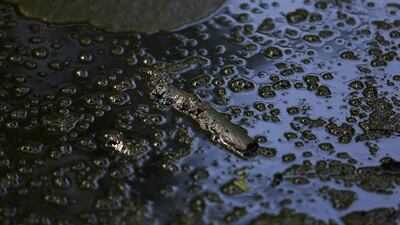
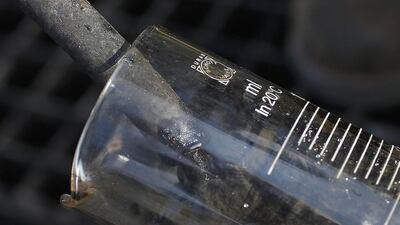
• Bottled samples of oil by-products from France's Alsace region are on display at the French Oil Museum in Merkwiller-Pechelbronn. Vincent Kessler / Reuters
    Bottled samples of oil by-products from France's Alsace region are on display at the French Oil Museum in Merkwiller-Pechelbronn. Vincent Kessler / Reuters
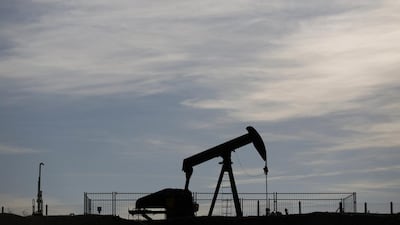
  • A working oil pump in Wintzenbach. Alsace, the cradle of the French oil exploration industry in the mid-18th century, is witnessing a tentative return of small oil explorers in the eastern region on the German border. Vincent Kessler / Reuters
    A working oil pump in Wintzenbach. Alsace, the cradle of the French oil exploration industry in the mid-18th century, is witnessing a tentative return of small oil explorers in the eastern region on the German border. Vincent Kessler / Reuters
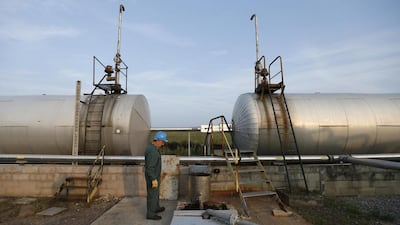
  • An employee at the Oelweg oil company, works near oil tanks at the site of an oil well in Oberlauterbach. Vincent Kessler / Reuters
    An employee at the Oelweg oil company, works near oil tanks at the site of an oil well in Oberlauterbach. Vincent Kessler / Reuters
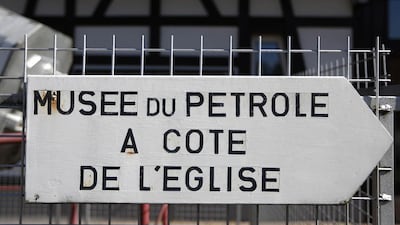
  • A sign on a fence, which reads Oil Museum next to the church", shows the direction for the French Oil Museum in Merkwiller-Pechelbronn. Vincent Kessler / Reuters
    A sign on a fence, which reads Oil Museum next to the church", shows the direction for the French Oil Museum in Merkwiller-Pechelbronn. Vincent Kessler / Reuters
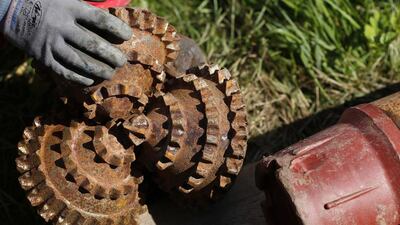
  • An employee holds a drill bit at the oil drilling site of the Millenium Geo-Venture company in Soufflenheim. Vincent Kessler / Reuters
    An employee holds a drill bit at the oil drilling site of the Millenium Geo-Venture company in Soufflenheim. Vincent Kessler / Reuters
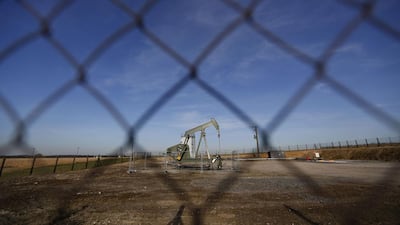
  • A working oil pump is seen through fencing in Niederlauterbach. Vincent Kessler / Reuters
    A working oil pump is seen through fencing in Niederlauterbach. Vincent Kessler / Reuters
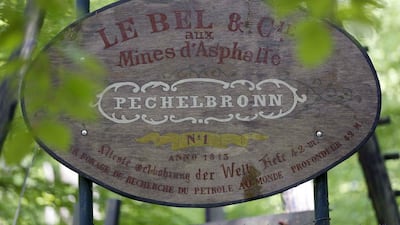
  • A commemorative sign is seen at the location of the world’s first ever prospective oil drilling site, built in 1813, in a forest near Merkwiller-Pechelbronn. Vincent Kessler / Reuters
    A commemorative sign is seen at the location of the world’s first ever prospective oil drilling site, built in 1813, in a forest near Merkwiller-Pechelbronn. Vincent Kessler / Reuters
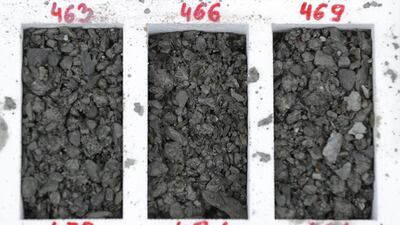
  • Cutting samples, ordered in the depth of their extraction and labelled in metres on display at the oil drilling site of the Millenium Geo-Venture company in Soufflenheim. Vincent Kessler / Reuters
    Cutting samples, ordered in the depth of their extraction and labelled in metres on display at the oil drilling site of the Millenium Geo-Venture company in Soufflenheim. Vincent Kessler / Reuters
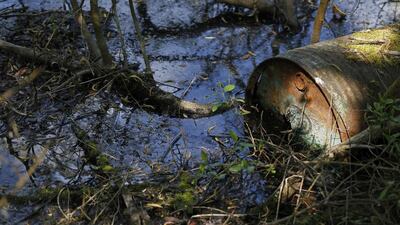
  • A rusted barrel is seen in a pond covered with leaked oil, near an abandoned paraffin wax factory, in a forest in Merkwiller-Pechelbronn. Vincent Kessler / Reuters
    A rusted barrel is seen in a pond covered with leaked oil, near an abandoned paraffin wax factory, in a forest in Merkwiller-Pechelbronn. Vincent Kessler / Reuters
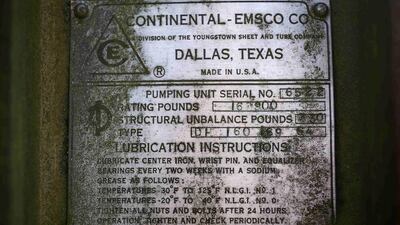
  • A label is seen on a rusted oil pump, part of the French Oil Museum collection, near the museum in Merkwiller-Pechelbronn. Vincent Kessler / Reuters
    A label is seen on a rusted oil pump, part of the French Oil Museum collection, near the museum in Merkwiller-Pechelbronn. Vincent Kessler / Reuters
  • An abandoned paraffin wax factory in a forest in Merkwiller-Pechelbronn. Vincent Kessler / Reuters
    An abandoned paraffin wax factory in a forest in Merkwiller-Pechelbronn. Vincent Kessler / Reuters
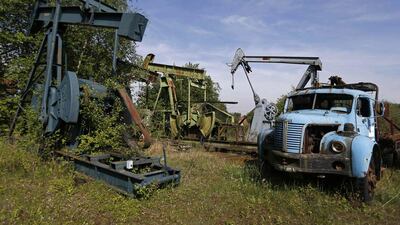
  • Abandoned oil pumps, part of the French Oil Museum collection, are seen near a rusted truck in a storage area of the museum in Merkwiller-Pechelbronn. Vincent Kessler / Reuters
    Abandoned oil pumps, part of the French Oil Museum collection, are seen near a rusted truck in a storage area of the museum in Merkwiller-Pechelbronn. Vincent Kessler / Reuters
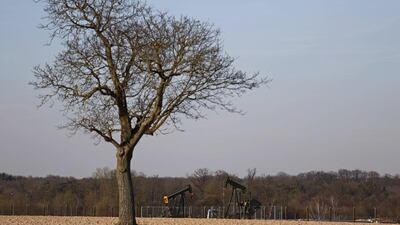
  • Oil pumps are seen in Niederlauterbach. Vincent Kessler / Reuters
    Oil pumps are seen in Niederlauterbach. Vincent Kessler / Reuters
  • An employee at the Oelweg oil company takes a sample of oil from an oil well in Oberlauterbach. Vincent Kessler / Reuters
    An employee at the Oelweg oil company takes a sample of oil from an oil well in Oberlauterbach. Vincent Kessler / Reuters

In pictures: Oil exploration returns to France’s Alsace region


  • English
  • Arabic

Sustainably high oil prices have lured small oil explorers back to Alsace, the cradle of the French oil exploration industry that gave birth to corporate giants such as Schlumberger.

The Baghdad Clock

Shahad Al Rawi, Oneworld

The specs: 2018 Maserati GranTurismo/GranCabrio

Price, base Dh485,000 (GranTurismo) and Dh575,000 (GranCabrio)

Engine 4.7L V8

Transmission Six-speed automatic

Power 460hp @ 7,000rpm

Torque 520Nm @ 4,750rpm

Fuel economy, combined 14.3L (GranTurismo) and 14.5L (GranCabrio) / 100km

Dubai Rugby Sevens, December 5 -7

World Sevens Series Pools

A – Fiji, France, Argentina, Japan

B – United States, Australia, Scotland, Ireland

C – New Zealand, Samoa, Canada, Wales

D – South Africa, England, Spain, Kenya

The Voice of Hind Rajab

Starring: Saja Kilani, Clara Khoury, Motaz Malhees

Director: Kaouther Ben Hania

Rating: 4/5

The British in India: Three Centuries of Ambition and Experience

by David Gilmour

Allen Lane

Ten tax points to be aware of in 2026

1. Domestic VAT refund amendments: request your refund within five years

If a business does not apply for the refund on time, they lose their credit.

2. E-invoicing in the UAE

Businesses should continue preparing for the implementation of e-invoicing in the UAE, with 2026 a preparation and transition period ahead of phased mandatory adoption. 

3. More tax audits

Tax authorities are increasingly using data already available across multiple filings to identify audit risks. 

4. More beneficial VAT and excise tax penalty regime

Tax disputes are expected to become more frequent and more structured, with clearer administrative objection and appeal processes. The UAE has adopted a new penalty regime for VAT and excise disputes, which now mirrors the penalty regime for corporate tax.

5. Greater emphasis on statutory audit

There is a greater need for the accuracy of financial statements. The International Financial Reporting Standards standards need to be strictly adhered to and, as a result, the quality of the audits will need to increase.

6. Further transfer pricing enforcement

Transfer pricing enforcement, which refers to the practice of establishing prices for internal transactions between related entities, is expected to broaden in scope. The UAE will shortly open the possibility to negotiate advance pricing agreements, or essentially rulings for transfer pricing purposes. 

7. Limited time periods for audits

Recent amendments also introduce a default five-year limitation period for tax audits and assessments, subject to specific statutory exceptions. While the standard audit and assessment period is five years, this may be extended to up to 15 years in cases involving fraud or tax evasion. 

8. Pillar 2 implementation 

Many multinational groups will begin to feel the practical effect of the Domestic Minimum Top-Up Tax (DMTT), the UAE's implementation of the OECD’s global minimum tax under Pillar 2. While the rules apply for financial years starting on or after January 1, 2025, it is 2026 that marks the transition to an operational phase.

9. Reduced compliance obligations for imported goods and services

Businesses that apply the reverse-charge mechanism for VAT purposes in the UAE may benefit from reduced compliance obligations. 

10. Substance and CbC reporting focus

Tax authorities are expected to continue strengthening the enforcement of economic substance and Country-by-Country (CbC) reporting frameworks. In the UAE, these regimes are increasingly being used as risk-assessment tools, providing tax authorities with a comprehensive view of multinational groups’ global footprints and enabling them to assess whether profits are aligned with real economic activity. 

Contributed by Thomas Vanhee and Hend Rashwan, Aurifer