


Elon Musk may be in the news for his interest in Twitter, but it is his tweet about lithium that may prove the most consequential, as the price for the rare metal surges.
"Price of lithium has gone to insane levels! Tesla might actually have to get into the mining & refining directly at scale, unless costs improve," the Tesla founder tweeted this month.
There are no further reported developments on Tesla's plans for lithium mining. But as Mr Musk pointed out, despite being called a rare metal lithium is not scarce. It is, however, used extensively in the batteries that underpin electrification and demand is far outpacing supply.
The cost of lithium – which rose nearly four-fold in the past year, according to an index of global prices compiled by Benchmark Mineral Intelligence – jeopardises the transition from fossil fuels to electric power and renewables. While lithium has been dragged into the turmoil surrounding commodities after Russia’s invasion of Ukraine, prices were already soaring before the war as demand surged amid a global race to net-zero emissions and the coronavirus pandemic disrupted supply chains.
investment director
With electric car sales continuing to grow around the world, some countries have begun to take urgent action to counter runaway price rises and a supply crunch.
In the US, President Joe Biden last month invoked the Defence Production Act, a Cold War-era law that gives him sweeping emergency powers to control domestic industries, in an effort to shore up domestic supplies of lithium and other critical minerals in the battery supply chain such as nickel, cobalt, manganese and graphite.
And in China – by far the world’s largest consumer of lithium – the government has reportedly begun telling companies involved in electric vehicle production that it wants cost of the metal to return to sustainable levels as soaring prices have increased inflation for manufacturers and threaten to eventually hurt consumer demand.
But will lithium production ever be able to meet demand as countries around the world aim for net zero emissions targets?
“Batteries are a key driver of lithium and other metals and currently there is a supply squeeze – partly driven by Russia invading Ukraine but also by a big pick-up in demand over the last few years,” said Ben Yearsley, a British investment director tracking global energy markets.
“I don’t think supply can keep up with demand, which means one of two things, either we slow the pace of decarbonisation – which seems to be politicians’ favoured route currently – or you pay more for it. Either way, that doesn’t get more metal out of the ground,” he told The National.
Hinting at a possible silver lining to the situation, Mr Yearsley said: “The Russia-Ukraine war shows how important energy security is – that’s actually fairly good for decarbonisation, with things like wind power abundant. However, lots of the ingredients needed are from conflicted areas.”
Demand for electric cars has held up even as the cost of producing the lithium-ion batteries that power them jumped by more than 50 per cent in the first quarter of 2022 over the previous year.
Environmental concerns and rising fuel costs since the war began in Ukraine are pushing more consumers towards buying electric vehicles despite their higher sticker prices.
Experts say the demand is only likely to grow from here.
-
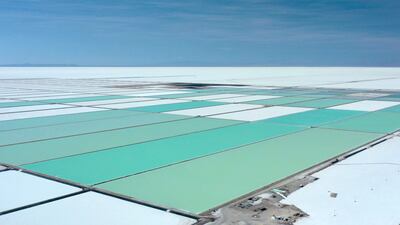
Evaporation pools at the new state-owned lithium extraction complex in the southern zone of Uyuni Salt Flat, Bolivia. AFP -
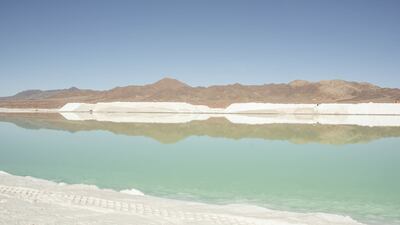
A brine pool at the Albemarle Corp lithium mine in Calama, northern Chile. Albemarle is the world's biggest producer of lithium. Bloomberg -
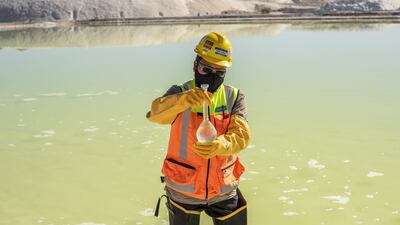
A mine worker takes water samples from a brine pool at the Albemarle lithium mine in Calama. Bloomberg -
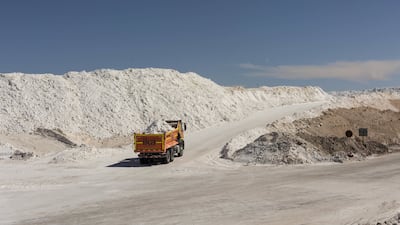
A lorry carries a load of potassium chloride at the Albemarle lithium mine in Calama. Bloomberg -
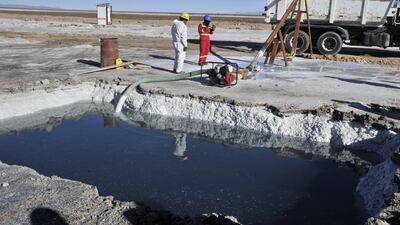
Workers at the Llipi pilot plant at Uyuni Salt Flat, south of Bolivia's capital La Paz. The country has more than 40 per cent of global lithium reserves. AFP -

Brine pools at SQM lithium mine on the Atacama Salt Flat in the Atacama Desert of northern Chile. Reuters -
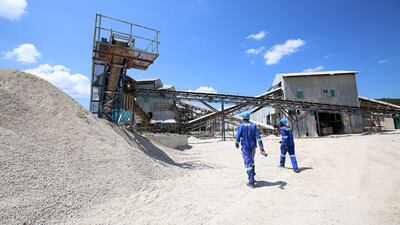
Bikita Minerals' mining plant in Bikita, 340 kilometres south of Zimbabwe's capital Harare. It is the only mine in Africa that produces world-class lithium pegmatite. Zimbabwe is the sixth-largest producer of lithium. EPA -
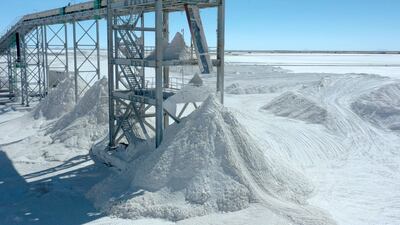
Piles of salt, a byproduct of lithium extraction, at the new state-owned lithium extraction complex at Uyuni Salt Flat, Bolivia. AFP -

Mountains provide a stunning backdrop to a lithium mine brine pool at the Atacama Salt Flat in Chile. Reuters


“The development and increase in sales of electric vehicles certainly affects the need for raw materials – the demand for critical minerals will increase,” said Akhmad Hanan, a researcher in energy security at the Purnomo Yusgiantoro Centre, a think tank in Indonesia.
“The most significant demand comes from China because it is the owner of the most electric vehicle manufacturers globally,” he told The National.
Beyond electric car production, lithium and other critical minerals have emerged as vital resources in the transition away from fossil fuels.
The rapid pace of electrification has created what some have called a “white gold rush” with the potential to create new global energy superpowers.
“We know that the need for critical minerals will increase as the energy transition continues in the future,” said Mr Hanan.
“Countries with abundant reserves and critical minerals production will dominate the world supply chain geographically,” he said.
With the projected value of the lithium-ion battery market projected to grow from $44.49 billion in 2021 to $193.13bn by 2028, according to research from Fortune Business Insights, establishing secure supplies of lithium is now a strategic aim for many states.
“Lithium supply security has become a top priority for Asia, Europe and the US technology companies,” said Mr Hanan.
“Strategic alliances and joint ventures among technology companies and exploration companies continue to be established to ensure a reliable, diversified supply of lithium for battery and vehicle manufacturers."
Where does lithium come from?
The world's supply of lithium comes mostly from hard rock mines and reservoirs of highly salty water, or brine, found beneath dried lakes.
"Four mineral operations in Australia, two brine operations each in Argentina and Chile, and two brine and one mineral operation in China accounted for most world lithium production," said Mr Hanan.
"Smaller operations in Brazil, China, Portugal, the United States and Zimbabwe also contributed to world lithium production."
In hard rock mining, lithium is extracted from the ground and then heated using fossil fuels, releasing large amounts of carbon dioxide and harming the environment. The process also requires large quantities of water.
Extracting lithium from brine is also energy intensive and requires water in ample quantities in places where it is often scarce.
But lithium can also be found in high concentrations in geothermal waters – underground reservoirs that are heated naturally from within the earth.
Hot salty water is pumped to the surface and can yield lithium and also generate electricity.
In Britain, Germany and the US, efforts to begin extracting lithium from these geothermal waters are well under way, giving hope to some that the environmental effects of lithium production could be drastically reduced.

