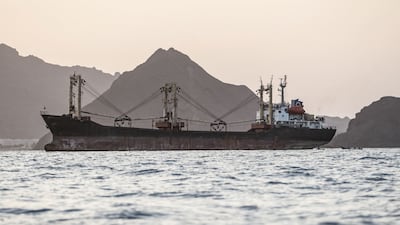

Oil prices shaved their losses on Friday, but remained on track to end remain $100 for a second straight week as tensions in the Middle East simmer.
Brent, the benchmark for two thirds of the world's oil, was down 1.35 per cent to $103.41 a barrel at 2.14pm UAE time. West Texas Intermediate, the gauge that tracks US crude, shed 0.39 per cent to $101.51 per barrel.
Both Brent and WTI were up by more than 2 per cent earlier in the day. From last week's close, Brent is on pace to post a 1.15 per cent drop, while WTI is poised to add 1.15 per cent.
Financial markets have largely ignored the volatility in energy prices because they have "already priced in quite a fair bit of that $100 per barrel of oil for now", said Hou Wey Fook, chief investment officer of Singapore-based DBS Bank.
For oil to make a material impact on financial markets, it needs to rise to $160 and "we don't think that is probable, [it is] not a high-probability scenario", he added.
Crude prices continued to fall as easing concerns over Saudi supply disruptions outweighed anxiety about a widening Middle East conflict, as fighting was renewed between Saudi Arabia and Yemen's Houthi rebels.
The decline comes after prices surged towards $110 a barrel on Monday after Saudi Arabia shut its East-West pipeline following attacks. That removed a crucial route for exporting crude and deepened fears of a global supply crunch.
On Thursday, Saudi Civil Defence officials said one person was killed and two were injured by debris from a Houthi drone that fell on Taif governorate, after it was intercepted and destroyed. It was the first death to be announced in the kingdom since the Iran-backed Houthis resumed attacks on Saudi Arabia this month.
But the Houthis have been communicating with US officials to assure Washington that the group's seizure of the Red Sea coast overlooking the Bab Al Mandeb strait will not lead to attacks on American ships, sources in Sanaa told The National.
Meanwhile, Tehran said it would not reopen the Strait of Hormuz until US President Donald Trump and Israeli Prime Minister Benjamin Netanyahu are removed from power, Mohammad Bagher Zolghadr, political adviser to supreme leader Ayatollah Mojtaba Khamenei, said in a statement on Thursday.
Oil has moved sharply in step to developments surrounding a potential resolution. But with no settlement in sight, prices have carried a significant geopolitical premium, said Nagham Hassan, a Middle East and North Africa market analyst at trading platform eToro.
“The outlook for oil over the next six months will depend heavily on the direction of the conflict,” she said. “Further escalation around the Strait of Hormuz or Bab Al Mandeb, as well as continued Ukrainian strikes on Russian refineries, could increase the risk of a genuine supply shortage and keep prices well above $100 per barrel, particularly while reserves remain low. A durable de-escalation remains the clearest scenario that could bring prices down.”
Gold, meanwhile, rose on Friday for a second straight day, to reach a one-week high. It came as investors continued to digest developments in the Middle East and oil kept moving down.
The precious metal, considered a safe-haven asset and a hedge against inflation, added 0.41 per cent to $4,378.48 an ounce. Silver jumped 2.16 per cent to $67.02 per ounce.

