

The takeover of major oilfields by the Syrian government from Kurdish forces is expected to help Damascus boost its oil revenue and reduce imports. The repair of damaged energy infrastructure and improvement in security is key to attracting investment, analysts say.
“For the Syrian government, regaining control of oil and gasfields is positive news,” Noam Raydan, a senior fellow at The Washington Institute, told The National.
“These assets were important for different players in the Syrian war over the past several years, including the Assad regime as well as ISIS … in providing revenue and electricity.”

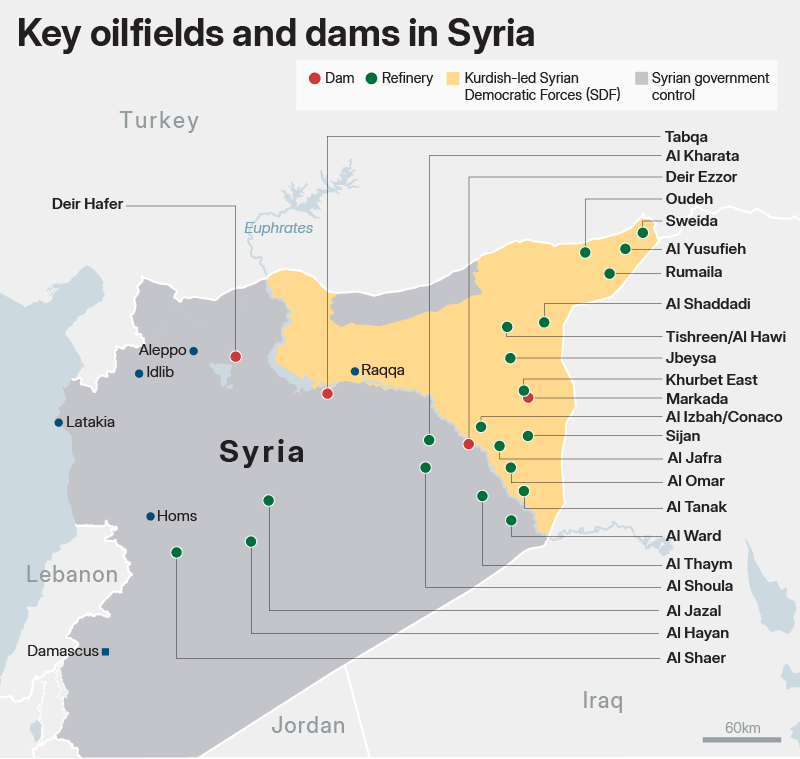
In a sweeping offensive last week, Syria’s military reclaimed the country’s main energy-producing region of Deir Ezzor and Raqqa in the north from Kurdish-led Syrian Democratic (SDF) to consolidate its grip on the country.
Deir Ezzor houses important sites such as Al Omar oilfield, Syria's biggest, and Conoco gasfield.
The oilfields have been under the control of different factions since the outbreak of civil war in Syria in 2011, including the Free Syrian Army as well as ISIS. At the end of 2017, SDF, with support from the international coalition managed to take control of it.
The takeover of the two fields by the Syrian government "marks the most significant consolidation of energy assets since the fall of the Assad regime in December 2024", said Benjamin Feve, senior research analyst at Karam Shaar advisory based in Istanbul.
“It restores formal state control over Syria’s most strategic hydrocarbon assets, which is a prerequisite for coherent energy policy, national revenue collection and sector-wide rehabilitation.”
Before the civil war started in 2011, oil was a central pillar of Syria's economy. It accounted for up to 25 per cent of its gross domestic product, the International Monetary Fund estimated, and about $3 billion in annual revenue.
Pre-civil war, Syria produced an estimated 380,00 to 400,000 barrels of oil per day and 900 million cubic feet (mmcfd) per day of gas before the outbreak of the civil war in 2011. Current production is estimated at about 110,000 bpd to 120,000 bpd, mainly from the north-eastern region of the country.
However, ownership alone does not translate into higher output and there is a need to boost investment to repair damaged pipelines and equipment at the two fields.
“With rehabilitation of wells, water-injection systems, power supply and pipelines, Al Omar could plausibly return to 25,000–40,000 bpd of production in two to four years time, from 14,200 bpd in late 2025,” Mr Fave said.
Syria is aiming to attract investment in energy and other sectors as it focuses on rebuilding its economy after more than 13 years of civil war.
Countries such as Saudi Arabia, the UAE, Turkey and Qatar have announced new investments in the past few months including a $7 billion deal in May to build solar and natural gas power plants by Qatar's UCC Holding, US company Power international and Cengiz Enerji of Turkey.
The UAE’s Dana Gas also signed an initial agreement with Syrian Petroleum Company to explore redevelopment and expansion of natural gasfields in Syria including Abu Rabah, one of the largest in the country.
The revival of oil sector will also help Syria reduce oil imports from countries such as Russia and Saudi Arabia, meet its domestic requirements and overcome power shortages.

Currently, Syria is processing crude at its two domestic refineries at Baniyas and Homs, and plans to build another site with 150,000 bpd capacity.
“With the integration of the Kurdish-controlled region, the Syrian government is likely to prioritise reducing import dependence for domestic refining," said Palash Jain, Middle East oil analyst at FGE NexantECA.
“Over the next two to three years, the authorities are expected to target further increases in crude production to a level sufficient to fully meet refinery feedstock requirements.”
However, enhanced security is expected to play a key role in attracting investment and revive the energy sector.
“While the government has successfully attracted interest from players like ConocoPhillips and re-engaged existing operators such as Gulfsands Petroleum, large-scale operational restarts are unlikely until the security situation stabilises further,” said Mrinal Bhardwaj, senior analyst of Rystad Energy,
In November, the Syrian Petroleum Company, US based ConocoPhillips and Novaterra Energy signed a preliminary agreement to expand co-operation in the natural gas sector including development of existing gasfields and exploration of new ones to boost domestic production.

