

Oversupply dynamics in the global crude market are expected to cushion any major shock to oil prices if US President Donald Trump chooses to take military action against Iran after anti-government protests in the country.
The global energy market will see a knee-jerk reaction in the short term, but it is expected to settle down and the overall impact on pricing will be subdued, said Manpreet Gill, chief investment officer, Africa, Middle East and Europe at Standard Chartered. This outcome was similar to what materialised after the outbreak of the 12-day Iran Israel war last June.
“We don't have to go back that far in history ... we had a spike in the regional tensions last year when oil prices did rise, but took a full circle,” Mr Gill told The National.
“That is a great example of separating what can be short-term sentiment-driven moves, versus where the demand supply fundamentals are.”
The intensity of the overall short-term oil prices shock will depend on how Washington’s threats to take military action against the Iranian regime will pan out.
But for the longer-term scenarios, the “main framework we use is to say, we know what demand, supply balances look like”, he said.
“The conclusion you reach by just looking at those numbers is that there's quite a lot of oversupply in energy markets, and you need a significant amount of global crude oil supplies taken off the market” to make a longer-term impact.
Even in case of the Russia-Ukraine war, when a lot of Moscow's energy supply got taken off the market, "it didn't have a lasting impact on oil prices, because the demand supply balance is so skewed in favour of excess supply", Mr Gill explained.
Oil prices fell more than 4 per cent on Thursday as fears over global crude supplies from the region eased after Mr Trump signalled he would hold off attacking Iran.
Brent, the benchmark for two thirds of the world's oil, was trading 4.15 per cent lower at $63.76 a barrel at 6.23pm UAE time on Thursday.
West Texas Intermediate, the gauge that tracks US crude, was down 4.29 per cent to $59.36 per barrel.
Over the past week, Mr Trump has repeatedly threatened Iran’s leadership over the killing of protesters who are gathering in large numbers across country to express their discontent with the country's deteriorating economy and its policies.
“We were told that the killing in Iran is stopping, and there’s no plan for executions,” Mr Trump said from the Oval Office on Wednesday, without disclosing the source for the information. “The killing has stopped. The executions have stopped."
He added: “I’m sure if it happens, I’ll be very upset."
Inflation impact
Mr Gill said regardless of what level of rhetoric remains in the public domain, the priority for the US remains to curtail broader impact on consumer prices.
“For example, on trade we heard a lot of noise, but ultimately the US avoided a big showdown … [as] avoiding the inflation surge ended up being a bigger priority. So that's almost like a constraint, regardless of what might be in the public domain,” he said.
Despite the public statements, how the situation in Iran unfolds and subsequent crude price moves is something investors should keep tabs on, Christian Nolting, chief investment officer at Deutsche Bank, told The National.
-

Anti-government demonstrators and supporters of exiled Iranian crown prince Reza Pahlavi outside the Houses of Parliament in London. EPA -

Iranians during a protest in Tehran on January 9. AFP -
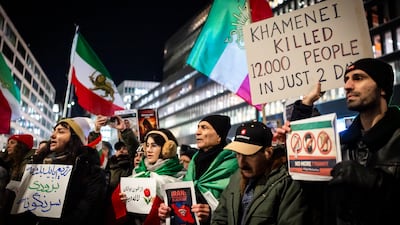
Protesters attend a rally in Zurich on January 13 in support of the nationwide mass demonstrations in Iran. EPA -

A screengrab shows body bags lying outside Kahrizak Forensic Medical Centre in Tehran, after deadly protests across Iran. Reuters -

Activists attend a rally in support of the protesters, in Los Angeles, California. AFP -

Protesters burn a picture of Iran's supreme leader Ayatollah Ali Khamenei outside Downing Street, in London. AFP -

Demonstrators gather in Paris to support the Iranian people amid the anti-government protests in Iran. AFP -
Smoke rises from a mosque as protesters gather amid evolving anti-government unrest in Tehran, Iran, on Friday. Reuters -
Protesters gather amid evolving anti-government unrest in Tehran, Tehran Province, Iran, on Friday. Reuters -
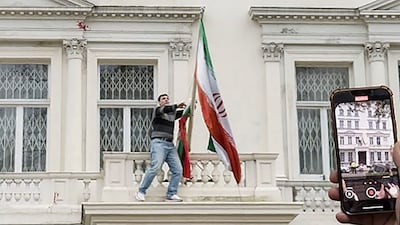
A protester pulls down the Iranian flag from the balcony of Iran's embassy in central London on Saturday. AFP -
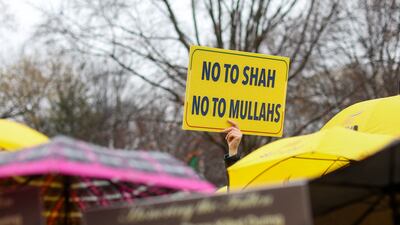
A person holds a placard, as demonstrators and activists rally in support of nationwide protests in Iran, outside the White House in Washington. Reuters -
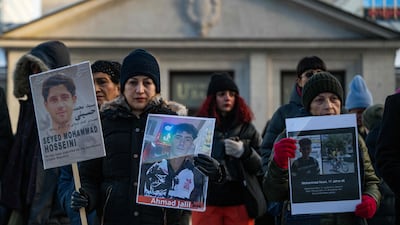
Protesters display placards featuring portraits of Iranians executed by the Iranian regime, during a rally in Berlin on Saturday. AFP -
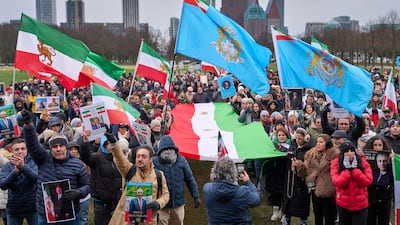
People protest in solidarity with demonstrations in Iran at Malieveld Square, Netherlands on Saturday. AFP


“For me, it's important to watch oil prices … what's the development there because that feeds into global inflation,” he said.
“If we were to get very much higher oil prices … that is probably then a game changer for central banks as they could not cut [interest rates] as much as they like.”
Mr Trump has also threatened Iran’s global trade partners with a 25 per cent tariff. China is Iran biggest global trade partner as it imports most of its energy needs from Tehran and if Washington slaps 25 per cent punitive duties on Beijing, it will likely upset the fragile tariff truce the world’s two largest economies currently hold.
However, Mr Nolting said that potential implications on the tariff front would not be unexpected.
“We always said that tariffs is a discussion that will not go away as there's not a 100 per cent agreement between US and China. There's just a pause at the moment, and so our forecast, anyhow, was that there's going [to be] further discussions,” he said.
“The good news, in a way, for me, is that there's a somehow balance between the US and China, because I think the US is clearly leading on AI investments, but China has a lot of rare earth, so they need each other a little bit. From that perspective, I think it will be tough discussions, but they will continue.”
Venezuela dynamic
Global energy prices have been volatile in the past few weeks since US captured Nicolas Maduro, the leader of Venezuela, the South American nation with the world's largest oil reserves.
The US wants rapidly develop the country’s ailing oil and gas infrastructure and boost supplies. But both Mr Nolting and Mr Gill said the plan does not change energy market dynamics in the short term.
“To be very honest, I think the movement we have seen in the global oil price [after US's move in Venezuela] was not much," Mr Nolting said.
Infrastructure investments in the country would boost production and from that perspective, “you could say, it is downside for the oil prices if there's much more production coming from Venezuela”, he said.
However, “I think that's not going to be done in a month, not in a year, and that's why I think the oil price reaction was not that much".
Mr Gill said any significant change to the country’s refining capacity or its hydrocarbons production is at least a few years away.
“I think that's why markets have treated it as a bit of a non-event. Obviously significant in three to five years, but 2026 outlook, it’s hard to see how anything changes,” he said.

