


Abu Dhabi National Energy Company, better known as Taqa, is closely monitoring the global tariff situation as it keeps the option of buying international assets on the table, its chief executive said on Wednesday.
Nearly half of the company's capacity is based in Abu Dhabi, and it is “not seeing any direct impact from the tariffs so far”, Jasim Thabet told The National on the sidelines of the World Utilities Congress in Abu Dhabi.
“But we are keeping a close eye on the flow of trades … if there are any tariffs happening [and] if there are opportunities for us to look at new markets to acquire new companies or to invest in other projects,” he said.
Mr Thabet said Taqa is focusing on boosting its renewables portfolio and is expected to increase investment to keep pace with the power needs of the booming data centre industry.
The company, which in April announced an artificial intelligence-focused initiative expected to drive Dh36 billion ($9.8 billion) of investments, will “continue to monitor the market for trends”, he said.
That programme – “a very big component” of which focuses on renewables – is being implemented in co-operation with Emirates Water and Electricity Company and clean energy firm Masdar, in which Taqa is the biggest shareholder.
“There's a combination of a lot of things – populations are growing, there's a need for additional and efficient power,” Mr Thabet said. “We're very well placed when it comes to investments.”
Taqa aims to deliver more renewable forms of energy, and is addressing one of its biggest challenges – ensuring an efficient transmission network for their distribution.
The company owns and operates transmission lines from its power and water plants to roads and homes, and requires operational efficiency to guarantee uninterrupted supply to users.
“There's a big deployment of renewables, so there are lots of opportunities for investment in renewables and also in networks,” he said. “One of the biggest bottlenecks is rolling out all the transmission networks that will require [those investments].”
-

Suhail Al Mazrouei, the UAE's Minister of Energy and Infrastructure, addresses delegates at the World Utilities Congress in Abu Dhabi. All photos: Ahmed Ramzan for The National -
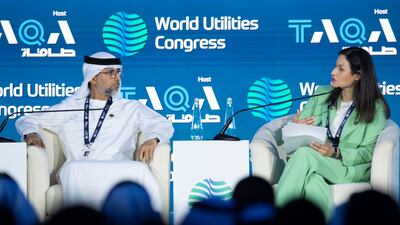
Mr Al Mazrouei and Maria Panayiotou, Cypriot Minister of Agriculture, Rural Development and Environment, at a session titled Looking ahead to Cop30: Strengthening the role of energy in updated national plans -

Visitors at the stand for Spanish technology company Minsait. The congress is being held at Adnec -
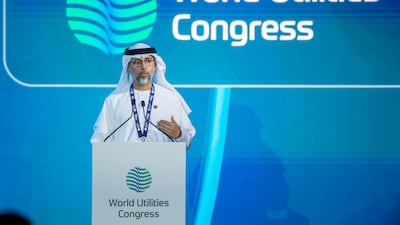
Mr Al Mazrouei delivers the opening speech at the event -

A display for Taqa Transmission at the event -

Dr Abdullah Humaid Al Jarwan, chairman of the Abu Dhabi Department of Energy, gives a speech during the World Utilities Congress -

Tabreed is among the companies with displays at Adnec -

Dr Al Jarwan addresses delegates as the congress gets under way -

Visitors at the Taqa Transmission stand


Data centres consume a significant amount of energy to handle massive amounts of data. Some are using sustainable sources such as solar and water to cut consumption and costs.
Power demand from data centres worldwide is predicted to more than double to about 945TWh by 2030. This is slightly more than Japan's entire electricity consumption, data from the International Energy Agency shows.
In general, the bigger the data centres, the bigger their energy need. On a monthly basis, small, medium and large-size data centres are estimated to consume as much as 36,000kWh, 2,000MW and 10MW, respectively, according to industry tracker Data Centre World.
The global data centre market is expected to pass $1 trillion by 2034, surging more than 160 per cent from a projected $386.7 billion in 2025, according to Precedence Research.
“Renewables play a very important component of having a balanced supply of energy in the grid,” Mr Thabet said.
Separately, Taqa and Mubadala, the Abu Dhabi sovereign investor, have completed the acquisition of a gas-fired power generation plant at the Talimarjan Power Complex in Uzbekistan, the two companies said on Thursday.
The companies will each hold a 40 per cent stake in the 875MW Talimarjan Power Plant 1 (TTP1) combined-cycle gas-fired plant and operation and maintenance company established to operate the plant, they said.

