

Shell’s successful appeal against a Dutch climate ruling highlights the challenge in tackling emissions produced from the use of petroleum products, also called Scope 3. The major climate ruling from 2021 ordered a 45 per cent reduction in Shell's absolute carbon emissions by 2030 compared to 2019 levels, including both direct and indirect emissions.
On Tuesday, a Dutch court overturned the ruling against Shell, but said that the company has a responsibility to lower greenhouse gas emissions to mitigate climate change. The court noted that Shell was already making progress on its direct emissions targets and sided with the company’s argument that a strict order to reduce Scope 3 emissions could potentially harm the environment by encouraging consumers to switch to more polluting alternatives like coal.
“The main outcome to be looked at is the fact that the Dutch court has revoked or thrown out the issue that a company like Shell should be looking at Scope 3 emissions, as this was part of the former ruling,” said Cyril Widdershoven, an analyst at the think tank Strategy International. Scope 3 emissions should be addressed, but the legal basis for holding a company accountable for emissions from the use of its products remains unclear, Mr Widdershoven told The National.
Emissions from the use of oil products account for 80 per cent to 95 per cent of total carbon emissions from oil and gas companies, but only a small number of firms have set targets to reduce Scope 3 emissions. Unlike Scope 1 and Scope 2 emissions, which can be directly addressed through operational changes and new technologies, Scope 3 emissions present a more complex challenge, as they rely on influencing the behaviour of consumers and other businesses, which is outside of a company's direct control.
“A court ruling would not reduce overall customer demand for products such as petrol and diesel for cars, or for gas to heat and power homes and businesses,” Shell said in a statement on Tuesday. It would “do little” to reduce emissions, as customers would take their business elsewhere, the company added.
Fossil fuels made up 84 per cent of the global energy mix in 2023, according to the latest Statistical Review of World Energy report. Disruptions to natural gas supply – seen as a transitional fuel – can prompt power plants to switch to burning coal, which has roughly double the carbon intensity of gas. Currently, Scope 3 is not directly addressed in any of the main climate charters or agreements.
-

Participants at the Cop29 venue in Baku, Azerbaijan. Reuters -
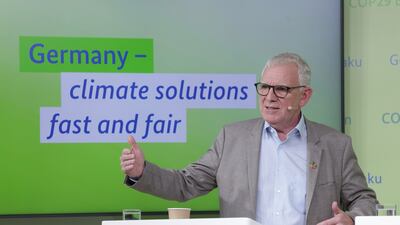
Jochen Flasbarth, State Secretary in the German Ministry for Economic Co-operation and Development, speaks in the Germany pavilion. Getty Images -

Nuclear power activists demonstrate. AP -

Activists hold a protest calling on developed nations to provide financing. Reuters -

An activist holds up a sign. Reuters -
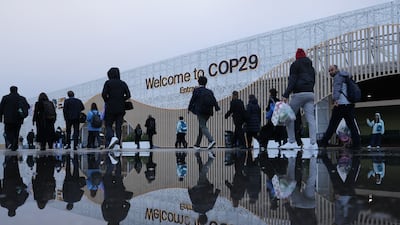
Conference participants arrive on day four. Getty Images -
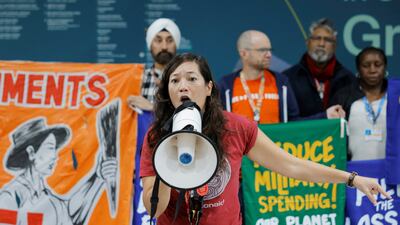
Another protest. Reuters -
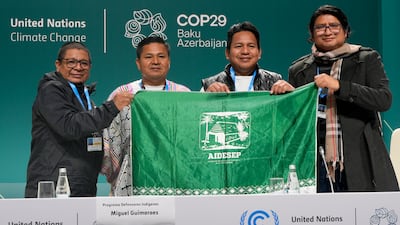
From left, Jorge Perez, Rolando Escobar, Miguel Vasquez and Esteban Cama at a session on Indigenous communities in the Peruvian Amazon. AP -
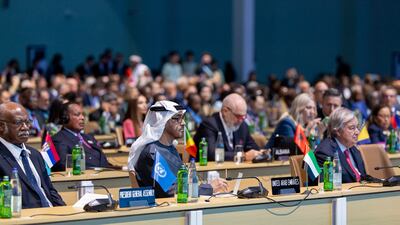
President Sheikh Mohamed attends the World Leaders Climate Action Summit at Cop29, in Azerbaijan's capital Baku. UAE Presidential Court -
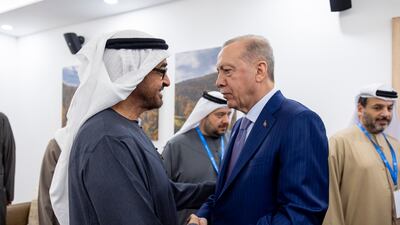
Sheikh Mohamed greets Recep Tayyip Erdogan, President of Turkey. WAM -
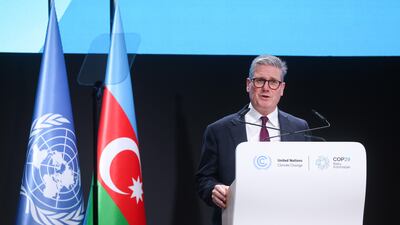
British Prime Minister Keir Starmer at Cop29. Bloomberg -

Ding Xuexiang, China's first Vice Premier, at Cop29. Bloomberg -
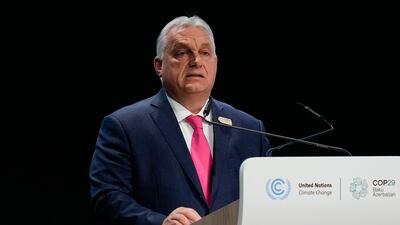
Hungary's Prime Minister Viktor Orban at a plenary session at Cop29. AP -
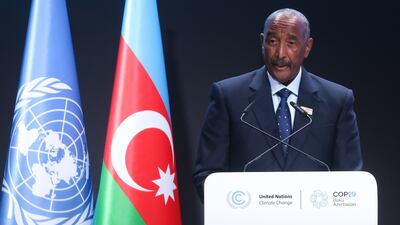
Sudan's military leader Abdel Fattah Al Burhan, at Cop29. Bloomberg -
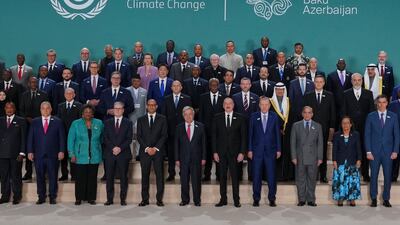
World leaders pose for a group photo at the Cop29 United Nations Climate Change Conference, in Baku, Azerbaijan. AP -

Hungarian Prime Minister Viktor Orban, left, stands next to Turkish President Recep Tayyip Erdogan. Reuters -
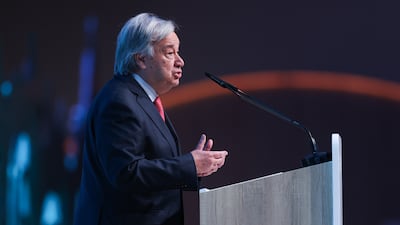
Antonio Guterres, UN secretary-general, addresses Cop29. Bloomberg -
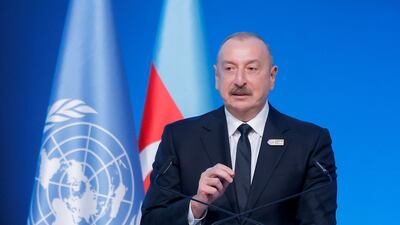
Azerbaijan's President Ilham Aliyev speaks during the Cop29 opening ceremony. Reuters -
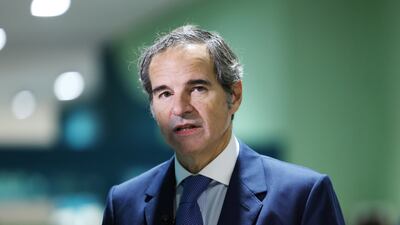
Rafael Grossi, director general of International Atomic Energy Agency (IAEA), at Cop29. Bloomberg -

Activists demonstrate for climate justice and a ceasefire in the Israel-Hamas war in Gaza, on day one of Cop29. AP -

Cop28 President Dr Sultan Al Jaber and Cop29 President Mukhtar Babayev at the official handover. AFP -
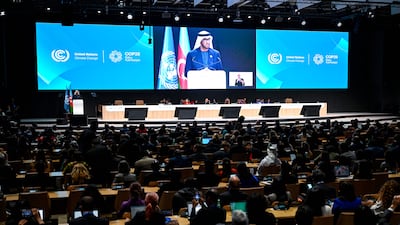
Dr Al Jaber, Minister of Industry and Advanced Technology, delivers a speech during the opening of Cop29 in Baku. AFP -

Mr Babayev speaks during the opening plenary session. AP -

An installation depicting a beached whale by the Belgian art collective Captain Boomer on an embankment in Baku. EPA -

The Turkey Solidarity Centre pavilion. Bloomberg -
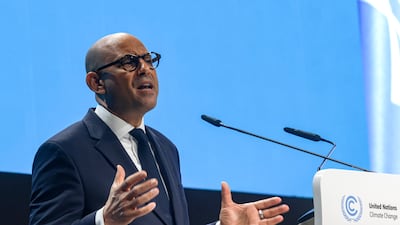
Simon Stiell, executive secretary of the UN Framework Convention on Climate Change, speaks during the opening ceremony. EPA -
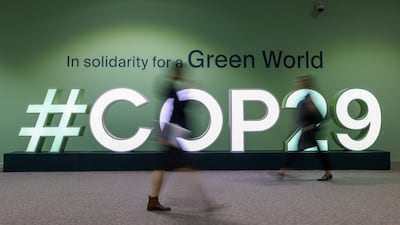
People begin arriving for the start of Cop29 in Baku. Bloomberg -

Dr Al Jaber at Cop29 with Moroccan climate researcher Cherif El Khalil. AP -

A mosaic adorns a wall at the Cop29 venue, Baku Stadium, in the capital of Azerbaijan. Bloomberg -

A woman tries out a VR headset at the tourism booth as the Cop29 UN climate summit gets under way in Baku, Azerbaijan. AP


Many oil and gas companies, including Shell, committed to the Oil and Gas Decarbonisation Charter (OGDC) last year. This charter aims to achieve net-zero emissions by 2050 or earlier, and to reduce methane emissions from exploration and production.
An OGDC spokesperson declined to comment on the case, saying the charter does not address individual member companies. Last week at Adipec, the charter’s head Bjorn Sverdrup said that oil companies tapping the brakes on some climate initiatives would not affect long-term net zero goals.
“There may be short-term adjustments … but I think the long-term direction is set, and it's all a question about pace. I think there is eagerness to speed things up rather than slow things down,” Mr Sverdrup told The National in an interview on the sidelines of the Abu Dhabi event. Oil and gas companies face the challenge of balancing environmental responsibility with profitability, driven by increasing pressure from investors, regulators and consumers.
BlackRock, Shell's largest shareholder, declined to comment on the climate ruling, and Vanguard Group, the second-largest shareholder, did not respond to a request for comment. Despite the growing adoption of electric vehicles and renewable energy, oil and gas are projected to remain essential to the energy landscape in the coming decade, especially as demand rises from developing economies like India.
Opec, the oil producer's group, has urged for increased investment in the oil industry, estimating that $17.4 trillion is necessary to meet growing energy demand through 2050. This figure is higher than the $14 trillion projected by the group last year for the period ending in 2045. Climate activists voiced disappointment with the development, but said the ruling also opened the door for future climate litigation targeting fossil fuel companies based on their investments.
“While we mourn today’s setback, the ruling establishes a responsibility for big oil and gas to act that future litigation can build on. The court ruled that protection against climate change is a human right, and corporations have a responsibility to reduce their emissions," said Laurie van der Burg of Oil Change International. "As far as we know, this is the first case where a court has acknowledged that new investments in oil and gas are incompatible with international climate goals."

