


When I first visited Venezuela in 1998, Hugo Chavez, a former paratrooper and failed coup leader, in his trademark red beret, was running for president for the first time.
One of his opponents was the former Miss Universe and mayor of a Caracas district, Irene Saenz. The recent election featured less colourful candidates, but could be equally important for the country, and the world oil market.
Current President Nicolas Maduro, who replaced Mr Chavez when he died in March 2013, declared victory in the latest election against his main opponent, Edmundo Gonzalez Urrutia, despite exit polls having Mr Gonzalez Urrutia at 65 per cent.
Suspicious announcements had television results that added up to 132 per cent and vote tallies of an improbably precise 51.95 per cent for Mr Maduro and 43.18 per cent for Mr Gonzalez Urrutia, as of the latest data on Friday.
Not surprisingly, the opposition has claimed fraud, there have been protests, the US, EU foreign policy chiefs, and various regional neighbours have expressed disapproval, while Mr Maduro’s amigos (friends) in Russia, China, Iran and Cuba have congratulated him.
-

Venezuelans confront police officers during a protest against President Nicolas Maduro's government in Caracas. AFP -
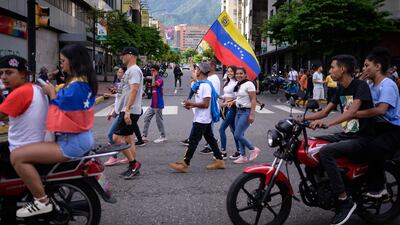
Demonstrators march in Caracas as they protest against the outcome of presidential elections. Bloomberg -
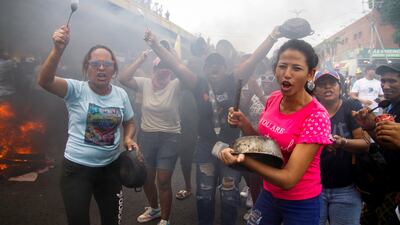
Thousands of people descended on central Caracas on Monday evening as they headed towards the presidential palace. Reuters -
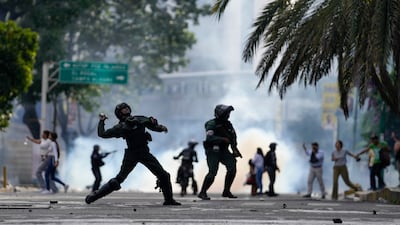
Police hurdle a tear gas canister at protesters demonstrating against the election results in Caracas. AP -
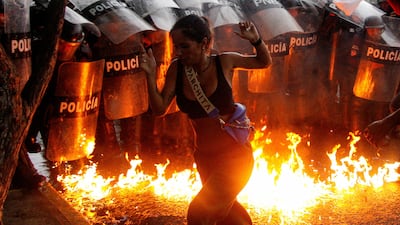
Molotov cocktails hit the ground in front of security forces during protests in Puerto La Cruz, Venezuela. Reuters -
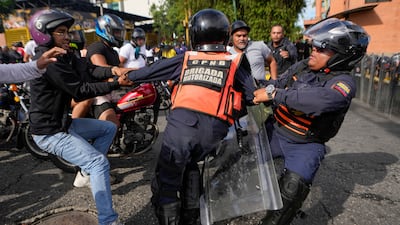
Police and protesters engage in scuffles in Caracas. AP -
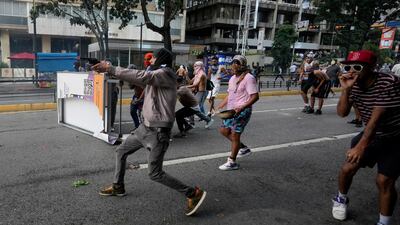
A protester aims a weapon during clashes with police in Caracas. AP -
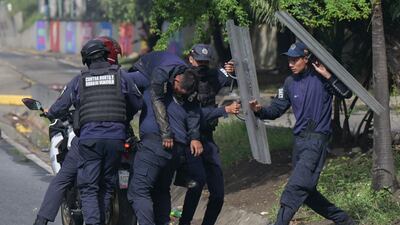
Police officers carry an injured colleague as they take cover during a protest in Caracas. AFP -
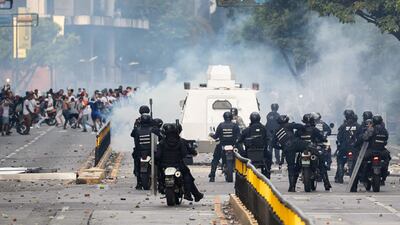
Police officers and the Bolivarian National Guard clash with opposition protesters in Caracas. EPA -
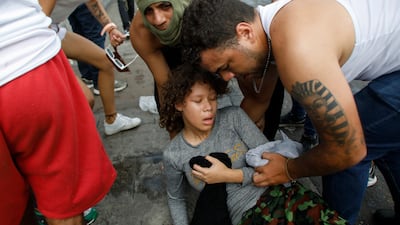
People take care of a protester affected by tear gas thrown by police during demonstrations in Caracas. AP -
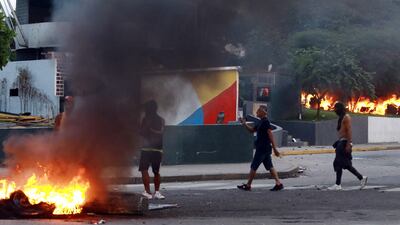
Venezuelans set a small police station on fire during a protest against the government in Valencia, Carabobo state. AFP -
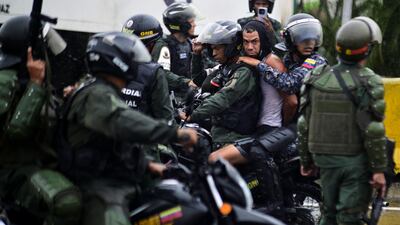
A demonstrator is detained by riot police in Caracas. Reuters -
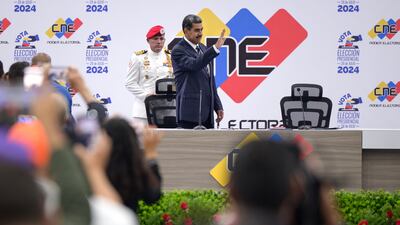
Mr Maduro arrives for a press conference to certify the election at the National Electoral Council in Caracas. Bloomberg -
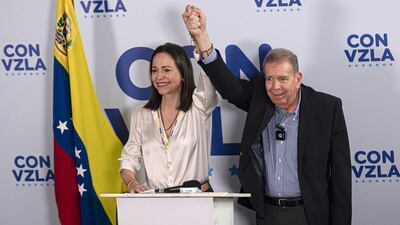
Opposition leader Maria Corina Machado raises the hand of her party's presidential candidate Edmundo Gonzalez a day after the presidential election. Getty Images -
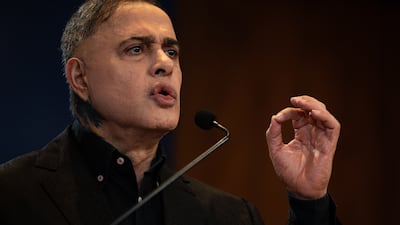
Public prosecutor Tarek Saab speaks during a press conference in Caracas. Venezuela named Ms Corina Machado as a key suspect in its investigation of alleged electoral sabotage in Sunday's presidential vote. Bloomberg -
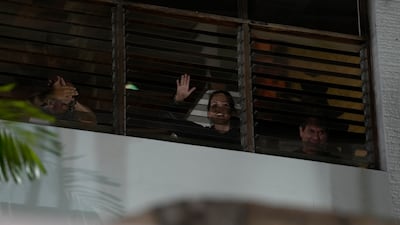
Opposition members who sought refuge in the Argentine embassy thank supporters protesting against the election outcome in Caracas. AP -
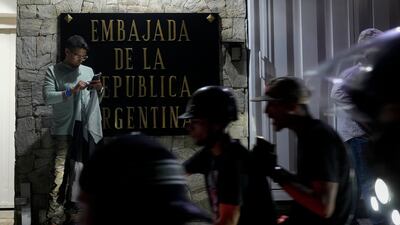
Opposition supporters protest against the official election results outside the Argentine embassy in Caracas. AP -
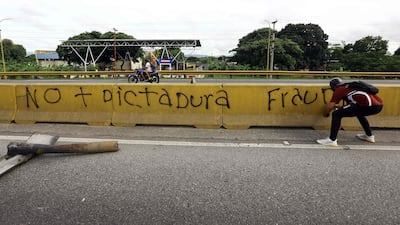
A man writes in Spanish 'no more dictatorship, fraud' on a wall during a protest in Valencia, Carabobo state. AFP


This is more than just a local squabble. It affects the direction of world oil markets, of politics and the balance of power in Latin America, and even the US’s presidential election.
And it may be prophetic of how some other petroleum-exporting countries deal with a future of declining oil revenue.
To understand the current situation, it’s worth revisiting how closely oil policy has determined the Venezuelan economy since Mr Chavez’s Bolivarian Revolution.
Venezuela’s democratic parties led the country to be a founder member of Opec in 1960, and nationalised its oil industry in 1976. In 1985, it was the richest country per capita in South America. But low oil prices from 1986 onwards and a legacy of badly-directed state spending and severe inequality discredited the establishment.
In the late 1990s, Venezuela made a determined effort to boost oil capacity and contest the leadership of Opec with Saudi Arabia. By the time of the 1998 election, this had led to very low oil prices. Given Venezuela’s much higher production costs, this was an unwinnable contest, as Mr Chavez quickly perceived.
He steadily pushed out foreign investors, cut back production, and tightened his grip on national oil company Petroleos de Venezuela (PDVSA).

After a general strike in 2002-2003, aimed at toppling him, he fired 19,000 employees. From one of the world’s best state oil corporations, it degenerated into a mess of disrepair, debt and corruption. Skilled workers instead went to boost output in neighbouring Colombia and in Canada’s heavy oil industry.
Although petroleum output steadily declined, higher prices let revenue soar, allowing Mr Chavez to spread money around lavishly on social programmes and aid to ideological allies such as Cuba.
Oil prices plunged in late 2014. From around 2.4 million barrels per day, production slumped to 500,000 bpd by 2020. Gross domestic product per capita in local purchasing power, which had peaked at $18,850 per person in 2013, collapsed to $5,730 by 2020, one of the steepest economic declines outside wartime yet recorded. From a population of just over 30 million, more than 7.7 million Venezuelans fled to escape poverty, hunger and rampant crime.
The economic free fall predated tight US sanctions. But the administration of Donald Trump put on pressure from 2019, banning transactions with PDVSA and US imports of Venezuelan oil, once a staple for Gulf of Mexico refineries. That helped push production to its minimum.
In contrast, President Joe Biden’s administration tried to open some space for negotiations, temporarily suspending some sanctions and permitting US company Chevron to operate under license, in return for commitment to democratic measures, including the latest elections. Oil output has slightly recovered from 2021 onwards.
Venezuela’s woes are often blamed, particularly by right-wing Americans, on its “socialist” policies. Hostility to foreign business, price controls, subsidies and attempts at funding social programmes for its supporters have certainly hurt the economy.
But other socialist or leftist South American governments have not caused such a catastrophe. Instead, the drying-up of investment, corruption, a kleptocratic and narcocratic ruling class, and the destruction of all competent and independent institutions, have been more damaging.
So what happens now? The Maduro government has clamped down hard after its win, with 20 people reported killed in protests. Opposition leader Maria Corina Machado, herself banned from running, has re-emerged from sanctuary in the Argentinian embassy to address crowds as thousands continue to take to the streets.

Perhaps, people power, the loss of loyal support in the poor neighbourhoods, a fracture in the Venezuelan military, and condemnation from countries such as Chile, Colombia, Peru and Argentina, might bring down Mr Maduro, or at least force the ruling party to enter some power-sharing arrangement.
The US would then ease sanctions, foreign investment and returning exiles with their skills and savings would flood in, and Venezuela could at last begin the job of rebuilding its ruined infrastructure.
Its oil industry will likely never regain the heights of the early 1970s. Facilities are decrepit, and its mostly heavy, high-carbon oil production is out of favour. Under ideal conditions, output might recover to 2.5 million barrels per day by 2030.
Or, more likely, the combination of repression, continuing backing from the military and remaining loyal “Chavistas”, some Russian assistance, a tepid response from leftist Latin American democracies, and distribution of dwindling petrodollars, keeps Mr Maduro in power. Blaming sanctions and Washington’s meddling provides easy excuses for the country’s dysfunction.
Mr Biden will then have to balance reimposing strict sanctions, with keeping Venezuelan oil on the market to keep prices moderate, supporting his Vice-President, Kamala Harris, in November’s US election.
Second, a renewed economic slump and political repression in Venezuela would trigger more migration, challenging neighbouring countries such as Colombia, and heating up the issue of immigration ahead of the US election.
The strongly anti-left Venezuelan community, like their predecessors the Cubans, have helped tilt the politics of Florida, once a crucial swing state, towards the Republicans. One of the diaspora is Ms Saenz herself, who now lives in Miami.
Venezuela could be a glimpse into the future, of just how bad things can be when an oil-dependent state cannot diversify and watches its revenue melt away.
Whether under Mr Maduro or another, the country has just a few years left to capitalise on its oil. The outcome matters well beyond Caracas.
Robin M Mills is chief executive of Qamar Energy, and author of The Myth of the Oil Crisis

