A technician walks on a roof at a partially solar-powered factory in Nairobi. AFP

Saudi Arabia’s Acwa Power seeks development partners to invest in Africa projects


  • English
  • Arabic

Saudi Arabia's Acwa Power is working on a “recipe” to finance sustainable infrastructure projects in Africa, given the continent's opportunities and risks, its chief executive has said.

The Riyadh-based company is looking for the best development institutions to work with local governments on the continent and foster dialogue with private investors while ensuring that "proper” guarantees are in place for the investments, Marco Arcelli told The National.

“Africa, to me, is very interesting as a case because the most successful developer built 1.5 to 2 gigawatts in 15 years. So, the whole continent is quite fragmented and slow in development,” he said ahead of the Cop28 climate conference in Dubai.

“We're trying to crack a recipe for how we [can] help accelerate adoption so that they can participate in sustainable economic growth.”

Acwa Power's chief executive Marco Arcelli. Source: Acwa Power

In many developing countries, investors are reluctant to allocate funds to climate change mitigation projects due to high perceived risks.

That has pushed up the cost of capital, with banks charging higher interest rates on loans meant for those projects.

“You have seen a lot of companies in the past few years have retrenched from emerging markets. So, clearly, that is an indication of the risk that I think becomes even more important as interest rates increase,” Mr Arcelli said.

Acwa Power, which is backed by the Public Investment Fund, has operations in 12 countries across the Middle East, Africa, Central Asia and South-East Asia.

Its portfolio includes 77 projects in operation, advanced development, or construction – with an investment value of $82.8 billion – and the capacity to generate 53.69 gigawatts of power and manage 7.6 million cubic metres of desalinated water a day.

The company on Wednesday announced a new green hydrogen project in Uzbekistan.

The first phase, a 3,000-tonne green ammonia pilot project, is already under way. Upon the second phase's completion, 2.4 gigawatts of wind energy will drive an annual production of 500,000 tonnes of green ammonia.

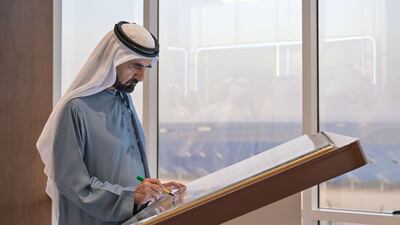
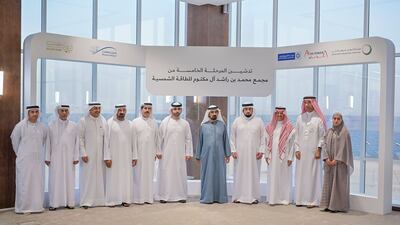
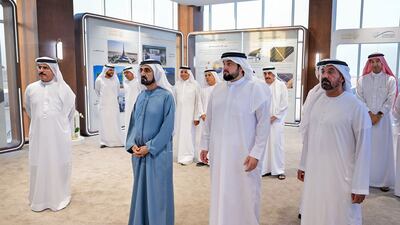
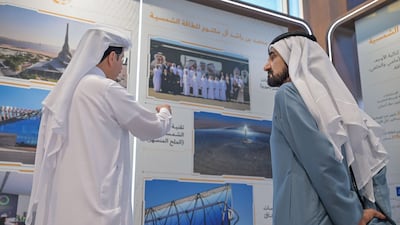
  • Sheikh Mohammed bin Rashid, Vice President and Ruler of Dubai, has inaugurated the fifth phase of the Mohammed bin Rashid Al Maktoum Solar Park. All photos: Wam
    Sheikh Mohammed bin Rashid, Vice President and Ruler of Dubai, has inaugurated the fifth phase of the Mohammed bin Rashid Al Maktoum Solar Park. All photos: Wam
  • It will provide 900MW of power
    It will provide 900MW of power
  • It is part of the largest single-site solar park in the world
    It is part of the largest single-site solar park in the world
  • The entire site has a planned capacity of 5,000MW by 2030
    The entire site has a planned capacity of 5,000MW by 2030

The green ammonia would be supplied to fertiliser manufacturers in Uzbekistan, which exports one million tonnes of fertiliser to Europe every year, Mr Arcelli said.

The deal is significant in the context of new carbon-compliance requirements in the EU.

The EU’s Carbon Border Adjustment Mechanism (CBAM), which entered its transitional phase on October 1, is set to apply to imports of certain goods whose production is carbon-intensive, such as cement, iron and steel, aluminium, fertilisers and electricity.

“They [Uzbekistan] need to decarbonise the economy, so they're really acting fast … [it] has one of the most interesting decarbonisation programmes in the world,” Mr Arcelli said.

Uzbekistan is working to improve its energy and power generation sectors, harnessing its natural resources and seeking investments from overseas.

The Central Asian country has also unveiled plans to raise the share of renewable energy in total electricity supply to 25 per cent by 2030, from 10 per cent in 2020.

Uzbekistan, Acwa Power’s second-largest market in terms of investments, has clear renewable energy targets for 2030, which “mobilises everybody to start a concrete discussion with private investors”, Mr Arcelli said.


Abdul Jabar Qahraman was meeting supporters in his campaign office in the southern Afghan province of Helmand when a bomb hidden under a sofa exploded on Wednesday.

The blast in the provincial capital Lashkar Gah killed the Afghan election candidate and at least another three people, Interior Minister Wais Ahmad Barmak told reporters. Another three were wounded, while three suspects were detained, he said.

The Taliban – which controls much of Helmand and has vowed to disrupt the October 20 parliamentary elections – claimed responsibility for the attack.

Mr Qahraman was at least the 10th candidate killed so far during the campaign season, and the second from Lashkar Gah this month. Another candidate, Saleh Mohammad Asikzai, was among eight people killed in a suicide attack last week. Most of the slain candidates were murdered in targeted assassinations, including Avtar Singh Khalsa, the first Afghan Sikh to run for the lower house of the parliament.

The same week the Taliban warned candidates to withdraw from the elections. On Wednesday the group issued fresh warnings, calling on educational workers to stop schools from being used as polling centres.

Mission%3A%20Impossible%20-%20Dead%20Reckoning%20Part%20One
%3Cp%3E%3Cstrong%3EDirector%3A%3C%2Fstrong%3E%20Christopher%20McQuarrie%3Cbr%3E%3Cstrong%3EStars%3A%3C%2Fstrong%3E%20Tom%20Cruise%2C%20Hayley%20Atwell%2C%20Pom%20Klementieff%2C%20Simon%20Pegg%3Cbr%3E%3Cstrong%3ERating%3A%3C%2Fstrong%3E%204%2F5%3C%2Fp%3E%0A
Analysis

Members of Syria's Alawite minority community face threat in their heartland after one of the deadliest days in country’s recent history. Read more

Mercer, the investment consulting arm of US services company Marsh & McLennan, expects its wealth division to at least double its assets under management (AUM) in the Middle East as wealth in the region continues to grow despite economic headwinds, a company official said.

Mercer Wealth, which globally has $160 billion in AUM, plans to boost its AUM in the region to $2-$3bn in the next 2-3 years from the present $1bn, said Yasir AbuShaban, a Dubai-based principal with Mercer Wealth.

Within the next two to three years, we are looking at reaching $2 to $3 billion as a conservative estimate and we do see an opportunity to do so,” said Mr AbuShaban.

Mercer does not directly make investments, but allocates clients’ money they have discretion to, to professional asset managers. They also provide advice to clients.

“We have buying power. We can negotiate on their (client’s) behalf with asset managers to provide them lower fees than they otherwise would have to get on their own,” he added.

Mercer Wealth’s clients include sovereign wealth funds, family offices, and insurance companies among others.

From its office in Dubai, Mercer also looks after Africa, India and Turkey, where they also see opportunity for growth.

Wealth creation in Middle East and Africa (MEA) grew 8.5 per cent to $8.1 trillion last year from $7.5tn in 2015, higher than last year’s global average of 6 per cent and the second-highest growth in a region after Asia-Pacific which grew 9.9 per cent, according to consultancy Boston Consulting Group (BCG). In the region, where wealth grew just 1.9 per cent in 2015 compared with 2014, a pickup in oil prices has helped in wealth generation.

BCG is forecasting MEA wealth will rise to $12tn by 2021, growing at an annual average of 8 per cent.

Drivers of wealth generation in the region will be split evenly between new wealth creation and growth of performance of existing assets, according to BCG.

Another general trend in the region is clients’ looking for a comprehensive approach to investing, according to Mr AbuShaban.

“Institutional investors or some of the families are seeing a slowdown in the available capital they have to invest and in that sense they are looking at optimizing the way they manage their portfolios and making sure they are not investing haphazardly and different parts of their investment are working together,” said Mr AbuShaban.

Some clients also have a higher appetite for risk, given the low interest-rate environment that does not provide enough yield for some institutional investors. These clients are keen to invest in illiquid assets, such as private equity and infrastructure.

“What we have seen is a desire for higher returns in what has been a low-return environment specifically in various fixed income or bonds,” he said.

“In this environment, we have seen a de facto increase in the risk that clients are taking in things like illiquid investments, private equity investments, infrastructure and private debt, those kind of investments were higher illiquidity results in incrementally higher returns.”

The Abu Dhabi Investment Authority, one of the largest sovereign wealth funds, said in its 2016 report that has gradually increased its exposure in direct private equity and private credit transactions, mainly in Asian markets and especially in China and India. The authority’s private equity department focused on structured equities owing to “their defensive characteristics.”

PROFILE OF SWVL

Started: April 2017

Founders: Mostafa Kandil, Ahmed Sabbah and Mahmoud Nouh

Based: Cairo, Egypt

Sector: transport

Size: 450 employees

Investment: approximately $80 million

Investors include: Dubai’s Beco Capital, US’s Endeavor Catalyst, China’s MSA, Egypt’s Sawari Ventures, Sweden’s Vostok New Ventures, Property Finder CEO Michael Lahyani

Other workplace saving schemes
  • The UAE government announced a retirement savings plan for private and free zone sector employees in 2023.
  • Dubai’s savings retirement scheme for foreign employees working in the emirate’s government and public sector came into effect in 2022.
  • National Bonds unveiled a Golden Pension Scheme in 2022 to help private-sector foreign employees with their financial planning.
  • In April 2021, Hayah Insurance unveiled a workplace savings plan to help UAE employees save for their retirement.
  • Lunate, an Abu Dhabi-based investment manager, has launched a fund that will allow UAE private companies to offer employees investment returns on end-of-service benefits.
COMPANY%20PROFILE
%3Cp%3E%3Cstrong%3ECompany%20name%3A%3C%2Fstrong%3E%20Switch%20Foods%3Cbr%3E%3Cstrong%3EStarted%3A%3C%2Fstrong%3E%202022%3Cbr%3E%3Cstrong%3EFounder%3A%3C%2Fstrong%3E%20Edward%20Hamod%3Cbr%3E%3Cstrong%3EBased%3A%3C%2Fstrong%3E%20Abu%20Dhabi%2C%20UAE%3Cbr%3E%3Cstrong%3EIndustry%3A%3C%2Fstrong%3E%20Plant-based%20meat%20production%3Cbr%3E%3Cstrong%3ENumber%20of%20employees%3A%3C%2Fstrong%3E%2034%3Cbr%3E%3Cstrong%3EFunding%3A%3C%2Fstrong%3E%20%246.5%20million%3Cbr%3E%3Cstrong%3EFunding%20round%3A%3C%2Fstrong%3E%20Seed%3Cbr%3E%3Cstrong%3EInvestors%3A%3C%2Fstrong%3E%20Based%20in%20US%20and%20across%20Middle%20East%3C%2Fp%3E%0A

Monster Hunter: World

Capcom

PlayStation 4, Xbox One

Updated: November 30, 2023, 12:27 PM