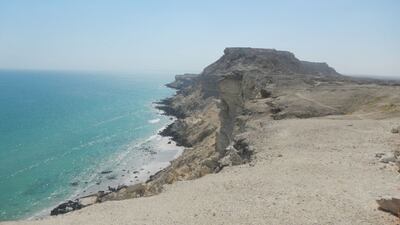
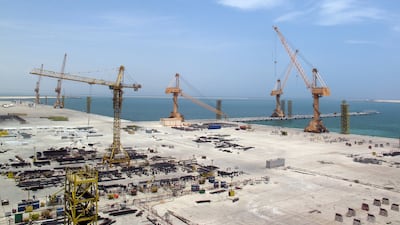
OQGN holds a natural monopoly over Oman's natural gas transport infrastructure. Source: Oman News Agency

Oman’s OQ Gas Networks set to raise up to $771 million in IPO


  • English
  • Arabic

Oman’s OQ Gas Networks, the pipeline business of state oil company OQ, aims to raise up to 297 million Omani riyals ($771 million) from its initial public offering in what could be the country's largest listing.

OQ set the price range for the IPO of OQGN at 131 baisas to 140 baisas per share, which would give the company a valuation of up to 606 million riyals ($1.57 billion), according to a statement on the Capital Market Authority's website on Sunday.

The state-run company is selling about 2 billion shares, representing a 49 per cent stake in OQGN through Oman Energy Trading Company and Oman Oil Services Limited.

Saudi Omani Investment Company, a unit of the Public Investment Fund, as well as Qatar Investment Authority subsidiary Falcon Investments and gas infrastructure company Fluxys Belgium, are each taking 10 per cent of the offer, OQGN said in a separate statement on Monday.

The offer is the “largest in the history of the Omani capital market in terms of volume and market value”, the CMA statement said.

The book-building period will run from September 26 until October 9 for institutional investors, while the retail offer is expected to close on October 5.

OQGN's shares are expected to commence trading on the Muscat Stock Exchange on October 24.

“The company’s high cash flow visibility, underpinned by a robust regulatory environment and experienced leadership team were critical in determining our investment,” said Muteb Al Shathri, acting chief executive of the Saudi Omani Investment Company.

“We have confidence in OQGN’s development and trajectory, as well as in Oman as an attractive investment destination.”

The company holds a natural monopoly over Oman's natural gas transport infrastructure and is the exclusive owner and operator of the company’s natural gas transportation network.

The network involves a system of pipelines, metering facilities, compressor stations, gas supply stations and block-valve stations.

Last year, the company transported 39.4 billion cubic metres of gas from six producers to about 130 consumers through 4,031km of pipelines, supported by three compressor stations and 25 supply stations.

OQGN reported a more than 41 per cent rise in its first-half profit to 33.1 million riyals as total income grew 16.5 per cent to 85 million riyals.

OQGN is set to be the second IPO from its parent company OQ amid Oman’s privatisation programme as the Gulf region’s smallest oil producer continues to focus on the diversification of its economy.

In March, OQ floated its oil-drilling unit Abraj Energy Services after raising $244 million in what was Oman’s biggest listing in more than a decade.

OQ, which is owned by the Oman Investment Authority, intends to privatise several assets in the coming five years, Mansoor Al Abdali, OQGN’s managing director told The National in an interview this month.

OQGN aims to expand its business and enter into hydrogen and “be a player in the CCUS [carbon capture, utilisation and storage]”, he said. It signed a preliminary agreement to “position the company as an infrastructure player for transportation of hydrogen,” he added.

There has been an IPO boom in the Middle East, with a number of companies listing their shares on regional stock markets such as the Abu Dhabi Securities Exchange, the Dubai Financial Market and Saudi Arabia’s Tadawul as economies recover from the coronavirus-induced slowdown on the back of higher oil prices and government reforms.

Middle East IPOs raised more than $23 billion in 2022 from 48 listings, compared with $7.52 billion from 20 offerings in the previous year.

That was the highest share for the Gulf region after 2019 when Saudi Aramco went public in a $29 billion offering, the world’s largest.

The bio

Favourite book: Peter Rabbit. I used to read it to my three children and still read it myself. If I am feeling down it brings back good memories.

Best thing about your job: Getting to help people. My mum always told me never to pass up an opportunity to do a good deed.

Best part of life in the UAE: The weather. The constant sunshine is amazing and there is always something to do, you have so many options when it comes to how to spend your day.

Favourite holiday destination: Malaysia. I went there for my honeymoon and ended up volunteering to teach local children for a few hours each day. It is such a special place and I plan to retire there one day.

MATCH INFO

Who: UAE v USA
What: first T20 international
When: Friday, 2pm
Where: ICC Academy in Dubai

UAE currency: the story behind the money in your pockets
UAE%20v%20West%20Indies
%3Cp%3EFirst%20ODI%20-%20Sunday%2C%20June%204%20%0D%3Cbr%3ESecond%20ODI%20-%20Tuesday%2C%20June%206%20%0D%3Cbr%3EThird%20ODI%20-%20Friday%2C%20June%209%26nbsp%3B%3C%2Fp%3E%0A%3Cp%3EMatches%20at%20Sharjah%20Cricket%20Stadium.%20All%20games%20start%20at%204.30pm%0D%3Cbr%3E%0D%3Cbr%3E%3Cstrong%3EUAE%20squad%3C%2Fstrong%3E%0D%3Cbr%3EMuhammad%20Waseem%20(captain)%2C%20Aayan%20Khan%2C%20Adithya%20Shetty%2C%20Ali%20Naseer%2C%20Ansh%20Tandon%2C%20Aryansh%20Sharma%2C%20Asif%20Khan%2C%20Basil%20Hameed%2C%20Ethan%20D%E2%80%99Souza%2C%20Fahad%20Nawaz%2C%20Jonathan%20Figy%2C%20Junaid%20Siddique%2C%20Karthik%20Meiyappan%2C%20Lovepreet%20Singh%2C%20Matiullah%2C%20Mohammed%20Faraazuddin%2C%20Muhammad%20Jawadullah%2C%20Rameez%20Shahzad%2C%20Rohan%20Mustafa%2C%20Sanchit%20Sharma%2C%20Vriitya%20Aravind%2C%20Zahoor%20Khan%0D%3C%2Fp%3E%0A

Mercer, the investment consulting arm of US services company Marsh & McLennan, expects its wealth division to at least double its assets under management (AUM) in the Middle East as wealth in the region continues to grow despite economic headwinds, a company official said.

Mercer Wealth, which globally has $160 billion in AUM, plans to boost its AUM in the region to $2-$3bn in the next 2-3 years from the present $1bn, said Yasir AbuShaban, a Dubai-based principal with Mercer Wealth.

Within the next two to three years, we are looking at reaching $2 to $3 billion as a conservative estimate and we do see an opportunity to do so,” said Mr AbuShaban.

Mercer does not directly make investments, but allocates clients’ money they have discretion to, to professional asset managers. They also provide advice to clients.

“We have buying power. We can negotiate on their (client’s) behalf with asset managers to provide them lower fees than they otherwise would have to get on their own,” he added.

Mercer Wealth’s clients include sovereign wealth funds, family offices, and insurance companies among others.

From its office in Dubai, Mercer also looks after Africa, India and Turkey, where they also see opportunity for growth.

Wealth creation in Middle East and Africa (MEA) grew 8.5 per cent to $8.1 trillion last year from $7.5tn in 2015, higher than last year’s global average of 6 per cent and the second-highest growth in a region after Asia-Pacific which grew 9.9 per cent, according to consultancy Boston Consulting Group (BCG). In the region, where wealth grew just 1.9 per cent in 2015 compared with 2014, a pickup in oil prices has helped in wealth generation.

BCG is forecasting MEA wealth will rise to $12tn by 2021, growing at an annual average of 8 per cent.

Drivers of wealth generation in the region will be split evenly between new wealth creation and growth of performance of existing assets, according to BCG.

Another general trend in the region is clients’ looking for a comprehensive approach to investing, according to Mr AbuShaban.

“Institutional investors or some of the families are seeing a slowdown in the available capital they have to invest and in that sense they are looking at optimizing the way they manage their portfolios and making sure they are not investing haphazardly and different parts of their investment are working together,” said Mr AbuShaban.

Some clients also have a higher appetite for risk, given the low interest-rate environment that does not provide enough yield for some institutional investors. These clients are keen to invest in illiquid assets, such as private equity and infrastructure.

“What we have seen is a desire for higher returns in what has been a low-return environment specifically in various fixed income or bonds,” he said.

“In this environment, we have seen a de facto increase in the risk that clients are taking in things like illiquid investments, private equity investments, infrastructure and private debt, those kind of investments were higher illiquidity results in incrementally higher returns.”

The Abu Dhabi Investment Authority, one of the largest sovereign wealth funds, said in its 2016 report that has gradually increased its exposure in direct private equity and private credit transactions, mainly in Asian markets and especially in China and India. The authority’s private equity department focused on structured equities owing to “their defensive characteristics.”

UAE currency: the story behind the money in your pockets
THE%20SPECS
%3Cp%3EEngine%3A%203-litre%20V6%20turbo%20(standard%20model%2C%20E-hybrid)%3B%204-litre%20V8%20biturbo%20(S)%0D%3Cbr%3EPower%3A%20350hp%20(standard)%3B%20463hp%20(E-hybrid)%3B%20467hp%20(S)%0D%3Cbr%3ETorque%3A%20500Nm%20(standard)%3B%20650Nm%20(E-hybrid)%3B%20600Nm%20(S)%0D%0D%3Cbr%3EPrice%3A%20From%20Dh368%2C500%0D%3Cbr%3EOn%20sale%3A%20Now%3C%2Fp%3E%0A
Groom and Two Brides

Director: Elie Semaan

Starring: Abdullah Boushehri, Laila Abdallah, Lulwa Almulla

Rating: 3/5

Simran

Director Hansal Mehta

Stars: Kangana Ranaut, Soham Shah, Esha Tiwari Pandey

Three stars

ULTRA PROCESSED FOODS

- Carbonated drinks, sweet or savoury packaged snacks, confectionery, mass-produced packaged breads and buns 

- Margarines and spreads; cookies, biscuits, pastries, cakes, and cake mixes, breakfast cereals, cereal and energy bars

- Energy drinks, milk drinks, fruit yoghurts and fruit drinks, cocoa drinks, meat and chicken extracts and instant sauces

- Infant formulas and follow-on milks, health and slimming products such as powdered or fortified meal and dish substitutes

- Many ready-to-heat products including pre-prepared pies and pasta and pizza dishes, poultry and fish nuggets and sticks, sausages, burgers, hot dogs, and other reconstituted meat products, powdered and packaged instant soups, noodles and desserts

Who's who in Yemen conflict

Houthis: Iran-backed rebels who occupy Sanaa and run unrecognised government

Yemeni government: Exiled government in Aden led by eight-member Presidential Leadership Council

Southern Transitional Council: Faction in Yemeni government that seeks autonomy for the south

Habrish 'rebels': Tribal-backed forces feuding with STC over control of oil in government territory

UAE currency: the story behind the money in your pockets
Klopp at the Kop

Matches 68; Wins 35; Draws 19; Losses 14; Goals For 133; Goals Against 82

  • Eighth place in Premier League in 2015/16
  • Runners-up in Europa League in 2016
  • Runners-up in League Cup in 2016
  • Fourth place in Premier League in 2016/17
The specs

Engine: 4.0-litre, twin-turbocharged V8

Transmission: nine-speed automatic

Power: 630bhp

Torque: 900Nm

Price: Dh810,000

Ms Yang's top tips for parents new to the UAE
  1. Join parent networks
  2. Look beyond school fees
  3. Keep an open mind
Moving%20Out%202
%3Cp%3E%3Cstrong%3EDeveloper%3A%3C%2Fstrong%3E%20SMG%20Studio%3Cbr%3E%3Cstrong%3EPublisher%3A%3C%2Fstrong%3E%20Team17%3Cbr%3E%3Cstrong%3EConsoles%3A%3C%2Fstrong%3E%20Nintendo%20Switch%2C%20PlayStation%204%26amp%3B5%2C%20PC%20and%20Xbox%20One%3Cbr%3E%3Cstrong%3ERating%3A%3C%2Fstrong%3E%204%2F5%3C%2Fp%3E%0A
Jetour T1 specs

Engine: 2-litre turbocharged

Power: 254hp

Torque: 390Nm

Price: From Dh126,000

Available: Now

Key figures in the life of the fort

Sheikh Dhiyab bin Isa (ruled 1761-1793) Built Qasr Al Hosn as a watchtower to guard over the only freshwater well on Abu Dhabi island.

Sheikh Shakhbut bin Dhiyab (ruled 1793-1816) Expanded the tower into a small fort and transferred his ruling place of residence from Liwa Oasis to the fort on the island.

Sheikh Tahnoon bin Shakhbut (ruled 1818-1833) Expanded Qasr Al Hosn further as Abu Dhabi grew from a small village of palm huts to a town of more than 5,000 inhabitants.

Sheikh Khalifa bin Shakhbut (ruled 1833-1845) Repaired and fortified the fort.

Sheikh Saeed bin Tahnoon (ruled 1845-1855) Turned Qasr Al Hosn into a strong two-storied structure.

Sheikh Zayed bin Khalifa (ruled 1855-1909) Expanded Qasr Al Hosn further to reflect the emirate's increasing prominence.

Sheikh Shakhbut bin Sultan (ruled 1928-1966) Renovated and enlarged Qasr Al Hosn, adding a decorative arch and two new villas.

Sheikh Zayed bin Sultan (ruled 1966-2004) Moved the royal residence to Al Manhal palace and kept his diwan at Qasr Al Hosn.

Sources: Jayanti Maitra, www.adach.ae

Updated: September 25, 2023, 9:15 AM