

AIQ, a joint venture between Adnoc and Group 42, expects “double-digit” growth in demand for its artificial intelligence offerings in the UAE in the next few years.
The company has seen a surge in AI deployment as well as the emergence of new uses for the technology in the Emirates and globally, Saravan Penubarthi, AIQ’s chief technology officer, told The National in an interview.
AIQ, which was formed in 2020, is working on critical AI projects in oil and gas, such as drilling performance, reservoir modelling, corrosion detection and product quality.
The company is 60 per cent owned by Adnoc and 40 per cent by AI company G42.

The UAE, the Arab world’s second-largest economy, has taken an early lead in the adoption of the technology, thanks to supportive policies and regulations, Mr Penubarthi said.
The regulations support the implementation of AI, with initiatives such as Make it in the Emirates resulting in quicker benefits, Mr Penubarthi said.
“We have seen the adoption of AI increase in the oil and gas industry and the reason for that … is an increase in awareness,” he said.
“Unlike other technologies like blockchain, where it takes some time for [companies] to really understand the value out of it … AI use cases are actually real.”
Almost three in four UAE companies and organisations have either maintained or increased their investment in AI initiatives in recent months, technology company Dataiku said in a report in May.
Up to 98 per cent of UAE businesses consider AI to be a “major enabler” when it comes to being more resilient amid current economic conditions, compared to 95 per cent in the Europe, Middle East and Africa region, the report said.
The arrival of big data, analytics and AI is giving a complete makeover to the global oil and gas industry.
Refineries from the US Gulf Coast to East China are already using smart sensors that collect data in real time.
The devices monitor the safety and functionality of crucial refining processes and the information they gather helps companies predict future performance.
AI is also expected to play a major role in lowering emissions from oil and gas extraction, processing and transportation.
Despite a surge in renewable energy adoption and electric vehicles, global crude oil demand is only expected to peak by the end of this decade. The oil and gas industry accounts for more than 40 per cent of global emissions, directly and indirectly.
AIQ has a suite of products that helps companies monitor energy emissions and optimise their processes. The company also has platforms that boost safety at oil and gas sites, where there is increased risk of fires and explosions.
“We have a product that is deployed at a customer site today, which does more than one billion predictions in a day,” Mr Penubarthi said.
AIQ expects “huge growth” from the renewable energy sector, which has been late to the AI revolution, the tech executive said.
“We have seen in the last six months, there's a lot of interest from solar and renewable [energy companies] for the adoption of AI,” Mr Penubarthi said.
The demand is mostly in energy management and emissions monitoring, he added.
Mr Penubarthi also said that there was high demand for predictive maintenance technologies, which monitor performance and equipment condition during regular operations to minimise the risk of breakdown.
“With the traction that we see on the ground … and in general in the market as well, there will a huge explosion of growth in renewables going forward,” he said.
-
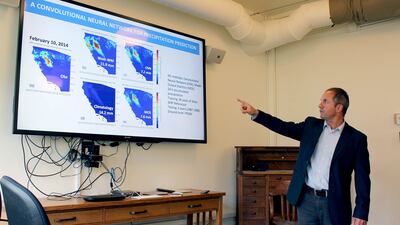
Dr Luca Delle Monache is conducting research into artificial intelligence and cloud seeding. Photo: National Centre of Meteorology / UAE Research Programme for Rain Enhancement Science -
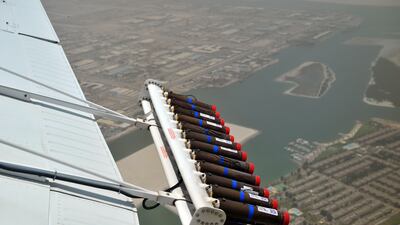
His work aims to devise an algorithm that can send planes to the best areas for seeding. Photo: National Centre of Meteorology -

The algorithm aims to work up to six hours in advance. Photo: National Centre of Meteorology -

Cloud seeding is crucial in a country with an arid climate. Antonie Robertson / The National -

The project is at the cutting edge of rain enhancement research. Photo: National Centre of Meteorology -
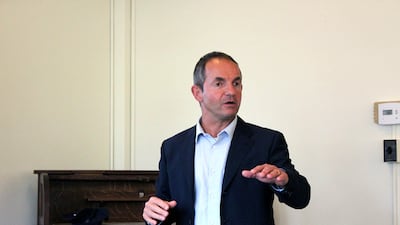
Dr Luca Delle Monache says the UAE is investing in cutting edge technology in a new field. Photo: National Centre of Meteorology / UAE Research Programme for Rain Enhancement Science


AIQ has also forayed into generative AI, which is currently disrupting industries across the board.
The company has started work to integrate ChatGPT-style AI into its product lines, allowing customers to interact with their dashboards using a chatbot in order to get information in real time, Mr Penubarthi said.
“It's not [just] a cherry on the top, [but] also the need of the hour because it has really improved the efficiency of the people on ground and also the efficiency of the executive team,” he added.
Generative AI, which can generate text, images or other media, could add as much as $4.4 trillion annually to the global economy and will transform productivity across sectors with continued investment in the technology, a recent report by consultancy McKinsey found.

