

An armed insurrection in Russia that has now abated will have a limited impact on oil prices this week, according to analysts.
On Saturday, Russian mercenary forces the Wagner Group withdrew from the southern Russian city of Rostov-on-Don and halted their march on Moscow following a deal, ending what could have been the first coup attempt in the country for three decades.
The mutiny ended as abruptly as it started, with Wagner chief Yevgeny Prigozhin ordering his troops to pull back after reaching within 200 kilometres of Moscow.
“Given that the short-lived event this weekend in Russia appears to have ended, we do not expect to see such a significant increase in oil prices,” Norway-based consultancy Rystad Energy said in a research note.
“We do, however, believe that the geopolitical risk amid internal instability in Russia has increased.”

Brent, the benchmark for two thirds of the world’s oil, was trading 0.43 per cent higher at $74.17 a barrel at 9.58am UAE time on Monday, while West Texas Intermediate, the gauge that tracks US crude, was up 0.39 per cent at $69.43 a barrel.
Both benchmarks shed more than 3.5 per cent last week amid concerns of further monetary tightening by global central banks.
“Oil markets appear to have taken the events in Russia over the last several days in their stride with both Brent and WTI trading up marginally,” said Daniel Richards, Mena economist at Emirates NBD.
“There appears to be no material threat to Russia’s oil production from the political unrest, leaving markets to remain focused on tighter central bank policies and a general slowdown in economic activity,” Mr Richards said.
The International Energy Agency and Opec expect the oil market to tighten in the second half of the year amid Opec+ cuts and a rebound in Chinese crude demand.
However, resilient Russian crude supply and rising output in countries under sanctions, such as Iran and Venezuela, could potentially result in a smaller deficit in 2023, analysts have said.
Several investment banks, including Goldman Sachs, MUFG and UBS, have slashed their short-term oil price forecasts over the past few weeks, citing higher-than-expected crude supply in the market.
Brent has lost nearly 14 per cent of its value since the start of 2023 amid growing concerns of a global economic slowdown.
Much of the oil sell-off over the past year reflects the policy and market response to the jump in prices in the first half of 2022, Goldman Sachs said in a research note on Friday.
Brent surged to nearly $140 a barrel following Russia’s invasion of Ukraine last year, resulting in record releases from America’s emergency crude reserves and aggressive interest rate increases by central banks, the US investment bank said.
-
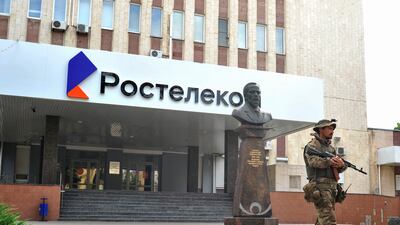
A serviceman from private military company Wagner Group blocks the access to the Rostelecom building in Rostov-on-Don, southern Russia. EPA -

A military column of Wagner private mercenary group drives along the M-4 highway, which links the capital Moscow with Russia's southern cities, near Voronezh. Reuters -

A man takes down the poster with writing reading 'Join us at Wagner' on the outskirts of St. Petersburg. AP Photo -

People pose for photos on a tank reading 'Siberia' as servicemen from Wagner Group block a street in downtown Rostov-on-Don. EPA -

Wagner forces near the headquarters of the Southern Military District in Rostov-on-Don. Reuters -

A Wagner group fighter on a street in the Russian city of Rostov-on-Don. AFP -
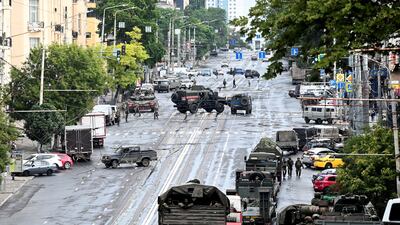
Fighters from the Wagner group on the streets of Rostov-on-Don close to the headquarters of the Southern Military District. Reuters -
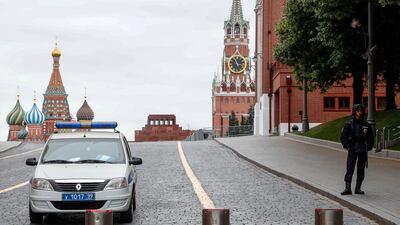
A Russian police patrol on guard at Kremlin in Moscow. EPA -
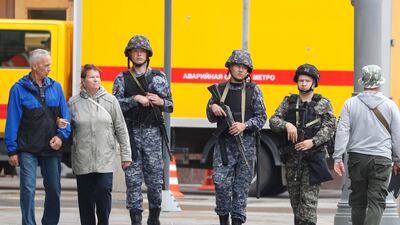
Russian servicemen stand on the streets of central Moscow. EPA -
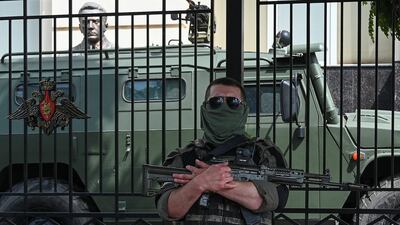
Wagner group fighter stands guard near the headquarters of the Southern Military District in the city of Rostov-on-Don, Russia. Reuters -

Yevgeny Prigozhin, founder of the Wagner mercenary group, speaks inside the headquarters of the Russian army's southern military command centre, which his forces took control of, in the city of Rostov-on-Don. Reuters -

Russian police officers guard the Wagner group's headquarters in Saint Petersburg, after President Vladmir Putin described the actions by the mercenary forces as treason. AFP -
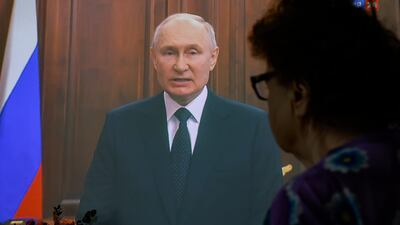
A woman watches Mr Putin's televised address to the nation, in Moscow. EPA -

Russian policemen block a street in downtown Rostov-on-Don, southern Russia. EPA -

Wagner fighters stationed on a street in Rostov-on-Don. Reuters -

Russian servicemen block a street in downtown Rostov-on-Don. EPA -
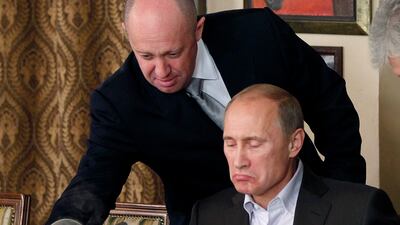
Mr Prigozhin serves food to Mr Putin, who at the time was Russia's prime minister, at the Wagner chief's restaurant outside Moscow. AP -

Wagner fighters in Rostov-on-Don. Reuters -

Policemen guard an area near the Wagner offices, in St Petersburg. AP -

A Wagner fighter stands guard on a street in Rostov-on-Don. Reuters -

Wagner fighters in Rostov-on-Don. Reuters -

A Wagner fighter on top of an armoured vehicle in Rostov-on-Don. Reuters


Goldman Sachs said that crude production in the US and sanctioned countries had surprised to the “upside”, adding that oil prices would likely not rebound to 2022 highs over the next year.
“Looking at the next few months, the SPR [strategic petroleum reserve] and US shale headwinds should start to turn into moderate tailwinds as the SPR gradually refills while US supply slows,” the bank said.
Meanwhile, global investment in oil and gas projects rose by 8 per cent last year but remained 40 per cent lower than 2014 levels despite the large price increases, Goldman Sachs said.
“The focus shifted from ESG [environmental, social and governance] to energy security, and European majors dialled down their plans to reduce oil production,” the bank said.
The price cap on Russian crude exports, designed to keep barrels on the market while dwindling Moscow’s revenues, may weigh on crude prices in the long run by shifting power from producers to consumers if it turned into a “blueprint” for future sanctions, Goldman Sachs said.
The bank also said that the energy crisis had not resulted in any “significant” damage to crude demand, but noted that rising investment in clean energy and electric vehicles would weigh on oil consumption in the long run.

