


Dubai has inaugurated the fifth phase of the Mohammed bin Rashid Al Maktoum Solar Park, the world's largest single-site solar park with a planned capacity of 5,000 megawatts by 2030, as part of its renewable energy push.
The 900-megawatt phase five will provide clean energy to about 270,000 homes in the emirate, reducing carbon emissions by 1.18 million tonnes annually, according to a statement from the Dubai Media Office on Sunday.
Sheikh Mohammed bin Rashid, Vice President and Ruler of Dubai, inaugurated the latest phase of the project.
“The completion of the fifth phase of the Mohammed bin Rashid Al Maktoum Solar Park takes us another major step closer to realising our vision for an economy fully powered by clean energy,” Sheikh Mohammed said.
“Dubai is resolute in its commitment to becoming one of the most sustainable cities in the world, with diverse initiatives.”
The emirate has set a target of generating 25 per cent of its energy requirements from renewable sources by 2030 and 100 per cent by 2050.
The new phase of the solar park coincides with the UAE's Year of Sustainability this year, and the year it is hosting the Cop28 climate change summit in November.
With a total investment of Dh50 billion, and based on the Independent Power Producer (IPP) model, the solar park is expected to reduce 6.5 million tonnes of carbon emissions annually when it is fully completed in 2030.
Phase five of the Solar Park, a Dh2 billion project, is a partnership between the emirate's utility Dewa, which controls a 60 per cent stake, and a consortium led by Acwa Power and Gulf Investment Corporation, which owns the remaining 40 per cent, through Shuaa Energy 3.
The total capacity of the solar energy projects commissioned at the solar park has reached 2,427MW from photovoltaic solar panels and concentrated solar power (CSP).
-
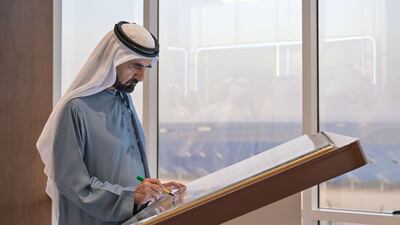
Sheikh Mohammed bin Rashid, Vice President and Ruler of Dubai, has inaugurated the fifth phase of the Mohammed bin Rashid Al Maktoum Solar Park. All photos: Wam -
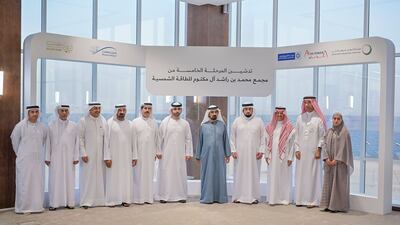
It will provide 900MW of power -
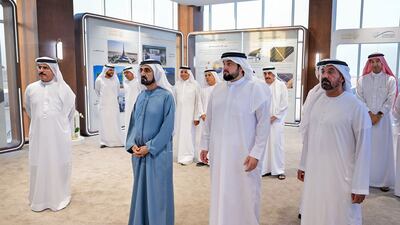
It is part of the largest single-site solar park in the world -
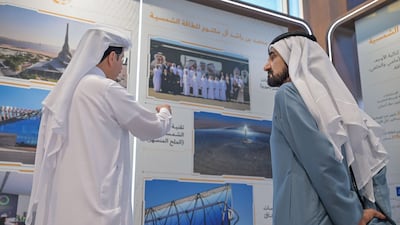
The entire site has a planned capacity of 5,000MW by 2030


The total capacity of the projects under construction at the solar park is 433MW from CSP.
Dewa has increased the share of clean energy in Dubai’s energy mix to about 16.3 per cent of its total installed capacity, which has reached 14,917MW, according to the statement.
The fifth phase of the solar park was completed ahead of scheduled opening date of December 2023, despite being launched during the Covid-19 pandemic, the Media Office said.
The fifth phase is one of the first projects in the Middle East to use Artificial Intelligence as part of an advanced robotic cleaning system for the operation and maintenance of photovoltaic panels.
The total area of the fifth phase is about 10 square kilometres, half of the total area of the 800MW third phase.
Earlier this month Dewa said it received two bids from Acwa Power and Masdar for the sixth phase of the Mohammed bin Rashid Al Maktoum Solar Park.
Masdar submitted the lowest bid of $1.62154 cents per kilowatt hour. The evaluation process has started and Dewa aims to select the preferred bidder during the third quarter of this year.
The production capacity of phase six is 1,800MW and will become operational in stages, starting from the fourth quarter of 2024, the utility company said at the time.

