

The UAE, the Arab world’s second-largest economy, will launch its National Hydrogen Strategy next month, a Ministry of Energy and Infrastructure official has said.
“There was phase one, which happened last year, and whereby we came up with just the general skeleton and, right now, we are working on phase two,” said Dipak Sakaria, energy transition expert at the ministry, during the World Hydrogen Mena conference in Dubai on Wednesday.
Last year in September, the UAE signed an agreement with Australia’s GHD and Germany-based Fraunhofer-Gesellschaft to develop its strategy for the low-carbon fuel.
The Emirates, which aims to achieve net zero emissions by 2050, is bullish about hydrogen and has been drawing up a comprehensive road map to position itself as an exporter of the clean fuel and tap into its future potential.
Hydrogen, which can be produced using renewable energy and natural gas, is expected to play a key role in the coming years as economies and industries transition to a low-carbon world to mitigate climate change.
The UAE currently has 28 hydrogen projects “on board”, of which seven have passed the financing stage, Mr Sakaria said.
Globally, 520 million tonnes of hydrogen will be needed to achieve net-zero targets by 2050, according to the International Energy Agency.
French investment bank Natixis estimates that investment in hydrogen will exceed $300 billion by 2030.
It comes in various forms, including blue, green and grey hydrogen. Blue and grey hydrogen are derived from natural gas while green hydrogen is produced using renewable sources.
“The demand [for hydrogen] is here. If you look at net zero and if you look at the energy mix [targets], you will get all those numbers … the question is on the supply [side],” said Mr Sakaria.
“We have looked at, like, 18 sectors that are calling for a lot of hydrogen by 2030 to 2031.”
Green hydrogen is expected to play an important role in reducing emissions in hard-to-abate industries such as cement, steel, aluminium and petrochemicals.
The Emirates is investing Dh600 billion in clean and renewable energy projects over the next three decades.
It is building the Mohammed bin Rashid Solar Park in Dubai with a five-gigawatt capacity.
Abu Dhabi, which is developing a two-gigawatt solar plant in its Al Dhafra region, has set a target of 5.6 gigawatts of solar PV capacity by 2026.
The UAE, which plans to use its hydrogen for both domestic consumption and exports, will closely monitor the latest EU regulations that specify the requirements a hydrogen project developer must fulfil for the fuel produced to be categorised as “renewable”, said Nawal Alhanaee, director of the ministry's future energy department.
The new rules apply to hydrogen produced both inside and outside of the EU, which aims to import 10 million tonnes of renewable hydrogen by 2030.
Last month, Abu Dhabi’s clean energy company Masdar signed a preliminary agreement with four companies from the Netherlands to explore the development of a green hydrogen supply chain between Abu Dhabi and Amsterdam.
Andrea Fontana, the EU Ambassador to the UAE, told The National last month that green hydrogen was an area where the two regions could team up.
-
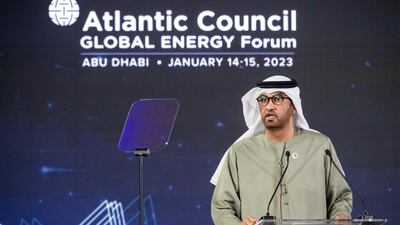
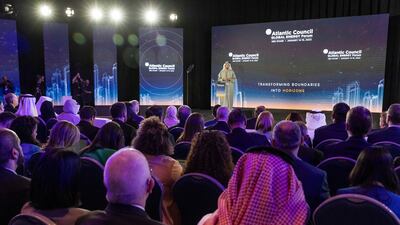
Dr Sultan Al Jaber, President-designate of Cop28, told the Atlantic Council Global Energy Forum that the world will require 'transformational' progress to meet net-zero targets. All photos: Antonie Robertson / The National -
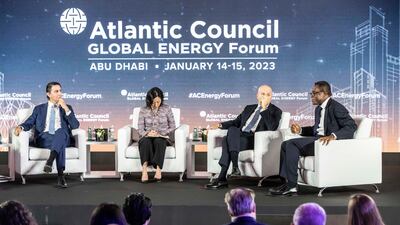
The energy forum brings together heads of state, policymakers and industry leaders for dialogue on movement towards to a net-zero future. -

Delegates at the Atlantic Council Global Energy Forum in Abu Dhabi on Saturday. -
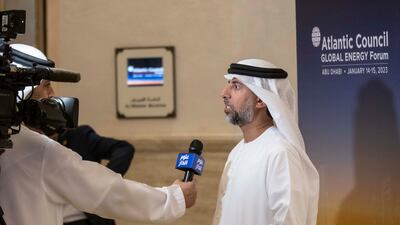
Suhail Al Mazrouei, Minister of Energy and Infrastructure, speaks to media on the sidelines of the event. -
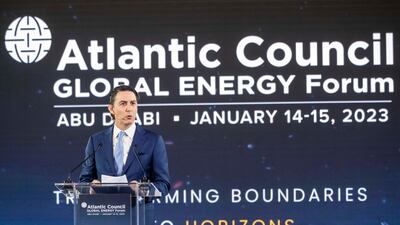
Amos Hochstein, special presidential co-ordinator for global infrastructure and energy security with the US Department of State, addresses a session. -

The Atlantic Council Global Energy Forum is a part of the Abu Dhabi Sustainability Week, which will run from January 14 to January 19. -
Dr Sultan Al Jaber, Minister of Industry and Advanced Technology, was named as president-designate of the UN Cop28 climate change summit, which will be held in the UAE this year.



